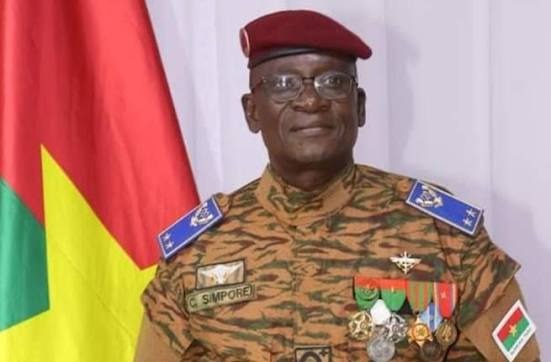
When General Célestin Simporé, Burkina Faso’s minister of defence, took his seat on the state broadcaster RTB to celebrate the security record of Captain Ibrahim Traoré, he reached for the most convenient argument available: the national army, he insisted, had been historically “poorly trained”. The line was tailored for a television studio. Its consequences are being absorbed somewhere else entirely — in villages without protection, on trade routes that no longer carry goods, and in households where the war is counted in funerals rather than in districts still under state control.
The reasoning leaves one uncomfortable question hanging over the whole broadcast: if yesterday’s force was the deficient one, how did it manage to hold provincial capitals and maintain comprehensible defensive lines with a fraction of today’s funding, today’s hardware and today’s troop numbers?
A narrative designed to shield the present from scrutiny
By repeating on national television that the armed forces lacked tactical instruction and operational preparation before the transition took power, the defence minister is assembling a tidy story in which today’s setbacks are simply yesterday’s inheritance. Reality refuses to cooperate with that framing.
Under earlier governments, the military worked with scarce equipment and obvious structural weaknesses, yet it still kept a functioning grid of provincial administrative centres and preserved defensive lines that could be identified on a map. Today, with the transitional government boasting of more than thirty freshly created battalions and of having placed military training back at the centre of its programme, effective state control has collapsed across more than 65% of the national territory.
When the Russian training model meets an asymmetric war
To replace the old training framework, Captain Traoré’s government threw itself wholeheartedly into the arms of Russian instructors from Africa Corps. The outcome of that overhaul has been measured in blood rather than in regained ground:
- A devastating human toll: Mass casualty events have become routine. From the tragedy at Mansila to the recent reversals in the Centre-Nord region, hastily assembled units are paying a price in lives that has no precedent.
- Blind to the logic of asymmetric warfare: A method built on frontal brutality and indiscriminate firepower is proving useless against mobile armed terrorist groups that move in small motorcycle columns and rely on improvised explosive devices.
- A rupture with the population: By sacrificing contact intelligence and military ethics in favour of scorched-earth logic, the new doctrine has turned rural communities into strangers, stripping soldiers of the single most effective barrier against a terrorist infiltrator — information supplied by ordinary citizens.
The consequences citizens feel before any communiqué admits them
This is where the debate stops being a matter of doctrine and becomes a matter of daily survival. When a state loses effective control of most of its territory, the first casualties are not only military. Farming communities along contested roads lose access to their fields and to the markets where they sell. Transporters stop running convoys. Local trade withers, prices climb, and entire districts slip into an economy of scarcity and displacement.
The wave of so-called “tactical evacuations” — the pattern seen around the tragedy at Boussouma — translates for civilians into abandoned homes, interrupted schooling and journeys toward urban centres that are already straining to absorb new arrivals. Businesses that once linked provincial towns to the capital lose their supply chains, and the tax base that funds public services shrinks alongside the map the state can still claim.
An insult dressed up as an explanation
Telling a television audience that the troops were “poorly trained” is a slight to the memory of the thousands of soldiers and gendarmes who fell in combat over the past decade. With rudimentary equipment and counted rations, those men held the line against an emerging threat without surrendering entire regions, as happens today under the cover of tactical withdrawal.
Two years on, the blame lands back at the top
General Simporé’s admission on RTB persuades no one. Two years after Captain Traoré’s absolute seizure of power, pointing the finger at the training of the past is itself a confession of powerlessness. The weapons of yesterday were never the problem. It is the strategy of today that is collapsing under the weight of its own propaganda — and the bill for that collapse is being settled by soldiers, farmers, traders and families who never had a seat on that television set.