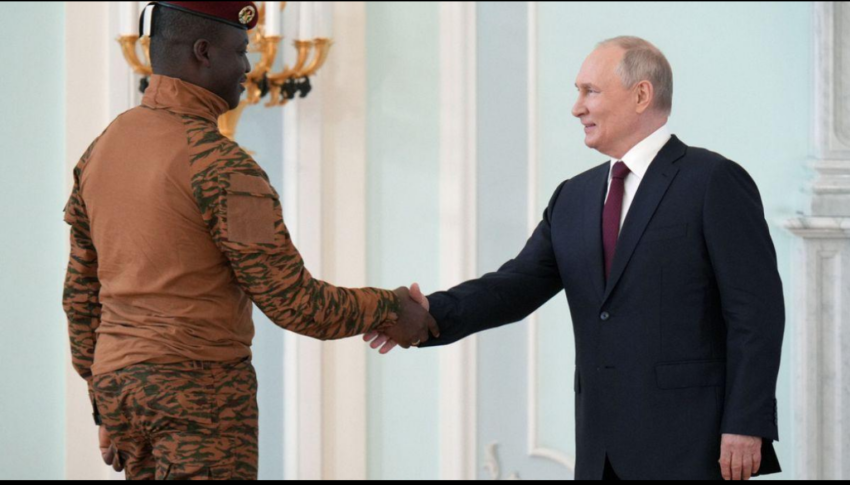
The Burkina Faso gold rush is no longer just about economic value—it has become a lifeline for political survival, especially under Captain Ibrahim Traoré’s leadership. Since Moscow stepped into the security void in Ouagadougou, the alliance has reshaped the country’s mining landscape, turning gold deposits into a strategic bargaining chip in the regime’s fight for stability.
Gold, guns, and geopolitics: when mining security becomes regime protection
The Bissa gold mine, operated by Russia’s Nordgold, stands at the center of this high-stakes game. What began as a commercial dispute between Russian security firms has exposed a web of interests linking mining security to the survival of Traoré’s administration. At stake is not just gold production, but the very ability of Burkina Faso’s government to maintain control in a region plagued by insurgency and political fragility.
Recent internal communications suggest that the eviction of RSB-Group—a competitor pushed out of the mine’s security contract—sparked accusations of escalating village raids blamed on its rivals. While these claims require independent verification, they highlight a disturbing trend: the security of Burkina Faso’s gold mines is no longer solely about protecting infrastructure or investors. It has become entangled with the regime’s survival in Ouagadougou.
From counterterrorism to regime security: Russia’s expanding footprint
Moscow’s involvement in Burkina Faso transcends counterterrorism rhetoric. Official ceremonies in Ouagadougou have showcased the presence of Russian paramilitary units, including personnel assigned to presidential security and intelligence networks. These deployments, documented in mid-2024, signal a shift from fighting extremism to securing Ibrahim Traoré’s grip on power.
The question arises: what does Moscow get in return? Evidence suggests that Russian economic interests in Burkina Faso’s mining sector, particularly gold, are expanding. Nordgold, a major player in Bissa and Bouly, has seen its operations intertwined with the country’s security apparatus. In early 2023, the government requisitioned 300 kilograms of gold from Bissa Gold, citing public necessity—a move that underlines the regime’s growing reliance on mining revenue to fund state operations.
The gold-for-security trade-off
While no public agreement explicitly ties Russian military support to gold concessions, analysts point to a disturbing pattern seen across the Sahel. In countries like Mali and the Central African Republic, Russia’s Wagner Group has been accused of linking security assistance to extractive industry contracts. Burkina Faso may be following a similar playbook, where protection of the regime and access to mineral wealth reinforce each other.
A study by the Combating Terrorism Center at West Point suggests that the protection of Russian mining interests may have been a key factor in Moscow’s initial engagement in Burkina Faso. Yet, researchers also caution that the most immediate priority for Russian forces appears to be the consolidation of Traoré’s power—potentially at the expense of local communities and democratic oversight.
For local communities, the stakes couldn’t be higher
For residents near the Bissa mine, the consequences of this geopolitical chess game are dire. Security contracts that prioritize regime stability over civilian safety risk worsening communal tensions, especially in regions already strained by insurgent violence and ethnic divisions. Villagers caught in the crossfire of corporate rivalries or military deployments bear the heaviest burden—displacement, disrupted livelihoods, and eroded trust in authorities who seem more preoccupied with Moscow’s interests than their own survival.
The mine’s security is no longer a technical issue managed by private firms; it has become a political tool. The eviction of RSB-Group and its subsequent lobbying efforts reflect a brutal competition where access to security contracts can mean the difference between business as usual and a breakdown in stability. For Traoré’s regime, this means the mines are not just economic assets—they are pillars of survival.
The unspoken pact: what does Ouagadougou gain from Moscow?
The Burkina Faso-Russia alliance operates in a gray zone where security assistance and economic concessions blur. While Ibrahim Traoré gains a powerful ally to suppress dissent and bolster his authority, Moscow secures influence over a country rich in gold—a resource increasingly vital for funding both its military operations and economic expansion in Africa.
Yet this relationship is far from transparent. No formal documents prove a direct quid pro quo between Russian paramilitary support and gold concessions. Instead, the evidence points to a silent convergence of interests: Burkina Faso offers an environment where Moscow can expand its security footprint while protecting lucrative mining ventures, and Traaré receives the tools to suppress internal threats and maintain control.
For the citizens of Burkina Faso, the implications are profound. The juxtaposition of foreign security contractors, corporate rivalries, and gold extraction paints a picture of a country where national sovereignty is increasingly traded for survival—both for the regime and its foreign benefactors.