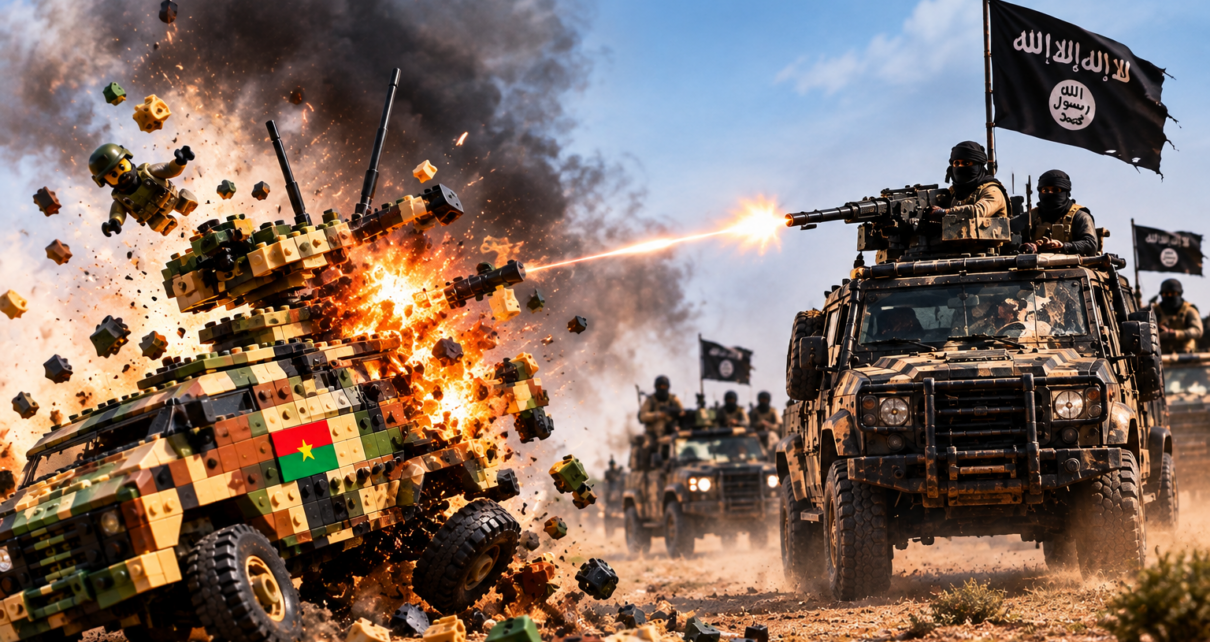
When military rhetoric collides with battlefield reality, the consequences for civilians and soldiers can be severe. In Burkina Faso’s Bam province, the recent claims by the Group for Support of Islam and Muslims (JNIM) regarding the capture of Mahlou and Winten a pair of strategic positions held by the Volunteers for the Defense of the Homeland (VDP) have cast a harsh spotlight on the operational effectiveness of the country’s locally manufactured armored vehicles.
These claims, though yet to be independently verified, underscore a critical juncture for Burkina Faso’s military ambitions. For months, the government of Captain Ibrahim Traoré has championed the nation’s growing defense industry, positioning it as a cornerstone of sovereignty and self-reliance. The narrative has been one of progress: locally assembled or produced equipment designed to reduce dependence on foreign suppliers and bolster the nation’s defensive capabilities.
From production lines to the front lines: the unfiltered performance test
The transition from factory floors to combat zones is where theory meets reality and where the gap between promise and performance often widens. The armored vehicles touted as a breakthrough in Burkina Faso’s defense strategy are now under scrutiny. Are they more than just a showcase of national pride? Do they deliver when it matters most?
The events at Mahlou and Winten serve as a stark reminder: military hardware, no matter how proudly manufactured, must withstand the brutal conditions of active conflict. The JNIM’s advance in the Bam region has exposed vulnerabilities that no amount of industrial rhetoric can paper over. The loss of these positions, if confirmed, would not merely be a tactical setback it would signal deeper systemic issues in Burkina Faso’s ability to secure its territory and protect its people.
Sovereignty in theory vs. sovereignty in action
The government’s emphasis on local defense production has been a recurring theme, framed as both a strategic necessity and a symbol of national resilience. Yet, the operational challenges facing the VDP and regular forces suggest that production alone does not equate to battlefield success. The JNIM’s repeated gains in the Bam province, including earlier claims on positions near Séguénéga and Bourzanga, highlight a troubling pattern: even when territory is retaken, holding it remains an uphill struggle.
This raises pressing questions: How effective are these armored vehicles in real combat scenarios? Can they endure sustained attacks, protect troops, and maintain functionality under fire? The answers will determine whether Burkina Faso’s defense industry is a game-changer or merely a costly experiment.
The human cost of unmet expectations
Behind the geopolitical and industrial narratives lies a human toll. Civilians in the Bam province, already grappling with displacement and insecurity, now face heightened risks as the conflict intensifies. The loss of Mahlou and Winten, if confirmed, could further destabilize the region, forcing more families to flee and exacerbating an already dire humanitarian crisis.
For the soldiers operating these vehicles, the stakes are even higher. Lives depend on equipment that must perform flawlessly under pressure. If the armored vehicles fail to deliver, the consequences are not abstract they are measured in casualties, abandoned positions, and eroded trust in the government’s ability to safeguard its citizens.
What comes next? The path to tangible security
The true measure of Burkina Faso’s defense industry will not be found in press releases or promotional videos. It will be determined by the performance of its armored vehicles in the field, the ability of its forces to hold ground, and the safety of the communities caught in the crossfire.
As the JNIM’s offensive continues, the government faces a stark choice: double down on unproven solutions or confront the operational realities that have thus far undermined its military strategy. The people of Burkina Faso deserve more than symbolic victories they need real security, delivered by equipment that can stand the test of war.