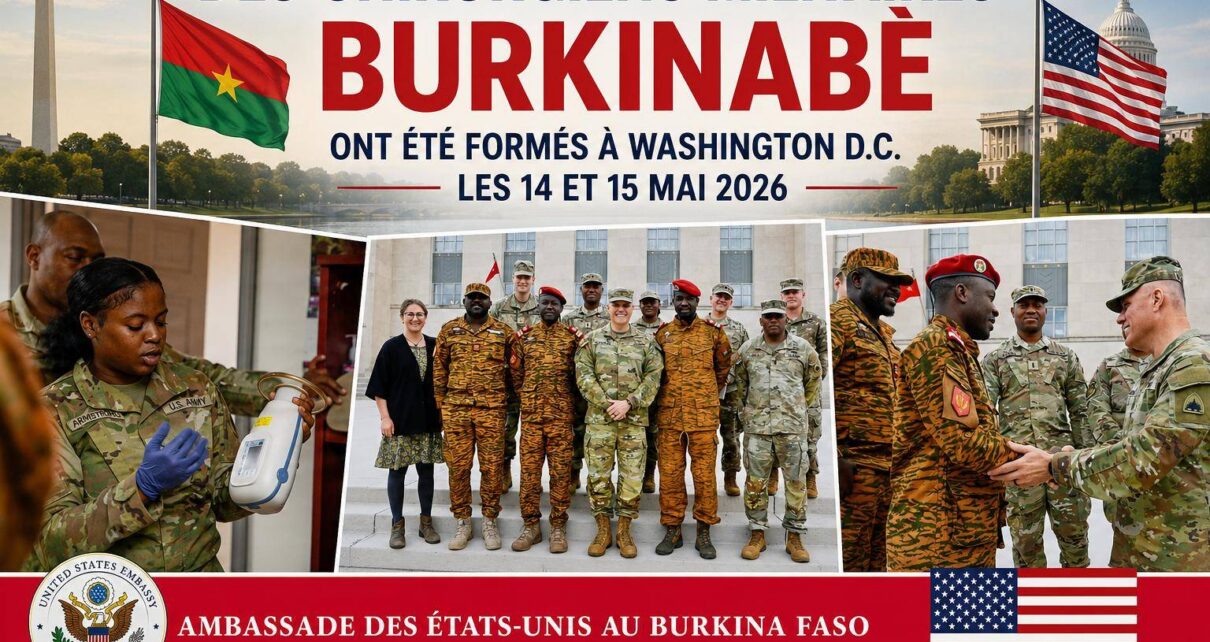
Despite the increasingly anti-Western rhetoric emanating from the Alliance des États du Sahel (AES), a nuanced reality emerges from technical cooperation on the ground. On May 14 and 15, 2026, Burkinabè military surgeons engaged in a high-level exchange session with the U.S. National Guard in Washington D.C. This meeting, part of the State Partnership Program (SPP), was announced on Saturday, June 6, by the United States Embassy in Ouagadougou. The development prompts a crucial question: why, amidst a strategic rapprochement with Moscow, do Sahelian states continue to rely on the expertise of traditional partners they publicly denounce? We delve into the heart of this Sahelian paradox, a key piece of Ouagadougou news.
A discreet yet highly strategic medical mission
The U.S. Embassy in Ouagadougou brought this information to public attention through a concise statement issued on Saturday, June 6, 2026. In mid-May, a delegation of surgeons from the Burkinabè Armed Forces spent two days in the U.S. federal capital. The mission’s objective aligns with the State Partnership Program (SPP), a long-standing cooperation mechanism of the U.S. National Guard that links American military capabilities with those of partner nations. Over two days, Burkinabè and American specialists exchanged insights on combat casualty care, battlefield traumatology, and managing surgical emergencies in hostile environments. Given the challenging asymmetrical conflict facing the nation, this direct transfer of skills offers a vital advantage for the survival of soldiers on the Burkinabè front, a significant update in Faso news today.
The AES paradox: between sovereignist discourse and technical pragmatism
This visit to Washington starkly illuminates a major contradiction within current Sahelian geopolitics. Since the formation of the Alliance des États du Sahel (AES), comprising Burkina Faso, Mali, and Niger, the political discourse against the West has intensified. Transitional authorities in the region frequently accuse Western powers, particularly France and sometimes, more subtly, its allies, of passivity or even complicity and indirect support for the armed terrorist groups plaguing the Sahel. Yet, behind the scenes, the channel of technical cooperation with the United States remains not only open but active. How can one explain senior Burkinabè officers traveling to the core of American institutions even as the official AES doctrine advocates a break from old influence patterns? This significant divergence demonstrates that, when confronted with the harsh realities of war, operational pragmatism often transcends ideological posturing, reflecting complex Burkina government news.
Why the Russian alternative falls short in war medicine
Following the rupture with France, Ouagadougou and its AES neighbors have heavily invested in their partnership with the Russian Federation. Moscow provides combat equipment, aerial assets, instructors, and direct security assistance on the ground. So, why was this surgical training not sought from the Russians? The answer lies in the intrinsic nature of traditional partnerships and the structure of Western armies. The U.S. National Guard, through the SPP, possesses an exceptionally high-performing combat medicine model, refined over decades of foreign interventions and documented according to global academic standards. Furthermore, Western military medicine benefits from historical continuity with African armies: protocols for medical evacuation, equipment formats, and initial training for Burkinabè doctors are historically compatible with Western standards. In military healthcare and saving lives in combat, the Russian offering, more focused on pure tactical support and hard security, appears for now less adapted or structured to meet these specific, advanced needs.
Mutually beneficial shadow diplomacy
For Washington, sustaining this program presents a golden opportunity to maintain a foothold in Burkina Faso and, by extension, within the AES sphere. While American influence in the region wavers, exemplified by the forced withdrawal of their troops from neighboring Niger, medical diplomacy allows for preserving a bond of trust with the Burkinabè military elite without alienating public opinion. For Captain Ibrahim Traoré and the Burkinabè command, this discreet collaboration serves as proof that Burkina Faso refuses complete isolation. While reaffirming a façade of sovereignty and an unwavering alliance within the AES, the Burkinabè leadership shrewdly capitalizes on the best of each bloc to enhance the effectiveness of its troops.
Sovereignty with flexible boundaries?
Ultimately, this exchange session in Washington underscores that Sahelian geopolitics cannot be reduced to declarations of rupture and protest slogans. Beyond the communication war and the interplay of global alliances, the paramount priority remains the survival of the Burkinabè state against terrorism. By agreeing to train its surgeons with the U.S. National Guard, Burkina Faso opts for medical efficacy over political consistency. This paradox proves salvational for those wounded on the front lines, demonstrating that in the art of war, health diplomacy adheres to far more pragmatic rules than tribune politics. This perspective is vital for understanding Ouaga latest news.