From viral images to concrete realities in Burkina Faso’s education push
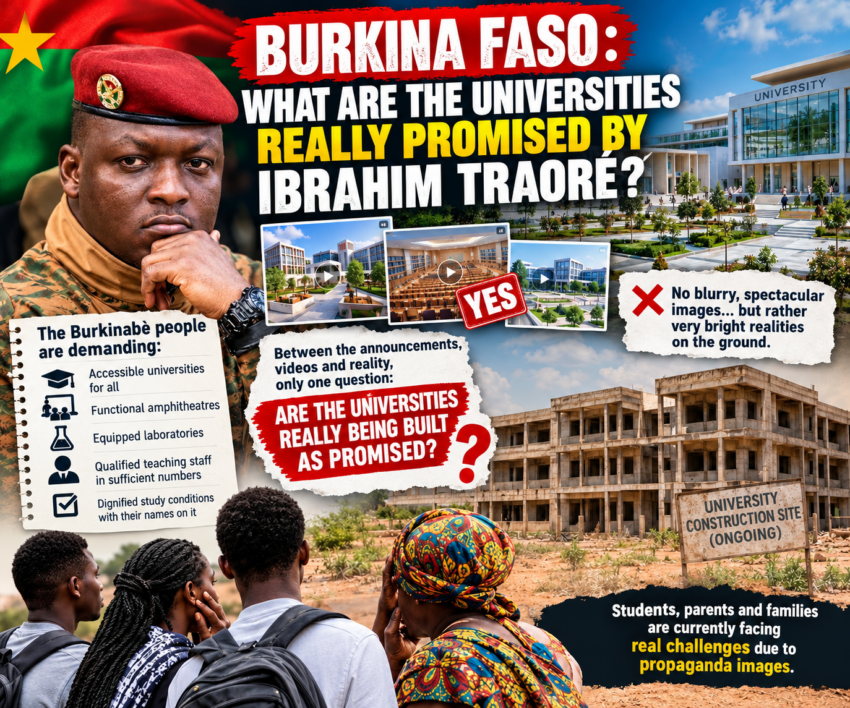
As Burkina Faso’s government showcases dramatic images of modern university campuses across social media platforms, a pressing question lingers among students, parents, and educators: which of these projects exist on the ground and which remain digital illusions?
The impact on Burkinabè families is significant. Many have invested their life savings in their children’s education, hoping for improved learning environments and better career prospects. Yet when announcements proliferate on digital platforms, parents need more than flashy visuals; they require verifiable proof of functioning institutions, equipped laboratories, and sufficient teaching staff. The gap between digital spectacle and tangible reality threatens to leave families in the dark about the actual progress of higher education development in the country.
When social media overshadows actual campus development
Digital deception has become a persistent issue in political communications, particularly concerning prominent leaders. Multiple investigations have exposed manipulated or misattributed videos circulating online, falsely claiming to showcase new infrastructure projects across Burkina Faso.
In one verified instance, a viral video falsely presented as showing an urban development project under Ibrahim Traoré’s leadership was traced back to an unrelated project in Algeria. Similar cases have been documented by independent fact-checking organizations, casting doubt on the authenticity of other digital content attributed to Burkina Faso’s government.
While some of these manipulated videos pertain to urban developments, their circulation raises critical questions: in an era where artificial intelligence can generate convincing visual content, how can citizens distinguish between authentic progress and synthetic propaganda?
The power of misinformation lies not only in its creation but in its unchallenged spread. Without rigorous fact-checking, families and students may be misled into believing that transformative educational infrastructure exists when it does not. This discrepancy between digital presentation and on-the-ground reality risks eroding public trust in government commitments to education.
Announcements versus achievements: the cost of delayed clarity
Political announcements, especially regarding education, carry significant weight. When a leader unveils plans for state-of-the-art universities, parents and students naturally expect rapid improvements in academic conditions and expanded access to higher learning. However, the journey from announcement to actual operation is long and complex.
Phase 1: Announcement of a project (lack of physical evidence)
Phase 2: Groundbreaking ceremony (symbolic act, not functional infrastructure)
Phase 3: Completion of construction (may lack equipment or faculty)
Phase 4: Official inauguration (no guarantee of student access or operational functionality)
Without clear, accessible data on how many universities have been completed, how many are operational, and what resources are allocated to their functioning, families are left to rely on unverified digital narratives. This uncertainty forces them to make life-altering financial decisions such as paying tuition fees in advance without knowing whether the promised institutions will open, or when.
The role of AI in shaping perceptions of progress
The rise of generative artificial intelligence has amplified the challenge of distinguishing truth from fabrication. A single fabricated video can create the illusion of widespread development, influencing public perception and policy discourse. Several cases have been documented where AI-generated content was shared as evidence of government accomplishments, including educational projects, even when no such infrastructure exists.
While not every inaccurately attributed video is produced by government sources, the proliferation of such content reflects a broader issue: the need for independent verification and transparent reporting. Governments must not only refrain from disseminating misleading information but also actively counter false claims that benefit their image while distorting public understanding.
In Burkina Faso, the credibility of its educational transformation rests not on the number of views a video receives, but on the number of students attending classes in functioning facilities, equipped with necessary resources. The burden of proof lies with authorities to provide verifiable evidence of progress.
Confirmed progress but is it enough?
According to official reports, some progress has been made. In September 2026, a university complex at Nazi-Boni University in Bobo-Dioulasso was inaugurated. The facility includes a 1,200-seat auditorium, four 210-seat lecture halls, and six laboratories. Additional projects have been announced under the Presidential Initiative for Quality Education for All.
These are tangible developments that must be acknowledged. However, verification is essential. Are these facilities fully operational? Are they accessible to students from across the country? Do they have sufficient staff, teaching materials, and operational budgets? Without independent assessments, the scale of progress remains uncertain.
Moreover, the broader initiative promises multiple university projects. To assess their impact, stakeholders need transparent data: construction timelines, funding sources, student intake capacities, and employment outcomes for graduates. Only with this information can families evaluate whether their investments in education will yield tangible benefits.
The path forward: accountability through transparency
The central challenge for Burkina Faso’s government is not the absence of announcements, but the lack of accessible, verifiable proof of implementation. While visual storytelling can enhance public engagement, it cannot replace tangible results. A university is more than a building it is a functional ecosystem of education, research, and opportunity.
To restore confidence, authorities must move beyond digital presentations and provide ground-level verification. Inviting independent journalists, student representatives, and education experts to visit sites and publish detailed reports would go a long way in dispelling skepticism. Families deserve to know not just that universities exist in concept, but that they exist in reality and that they are accessible, equitable, and effective.
In the end, the legacy of Burkina Faso’s education policy will not be measured by the elegance of its social media posts, but by the learning outcomes of its students and the opportunities they gain. The time has come to let the evidence speak louder than the algorithm.
By Cécile Mboua — Journalist