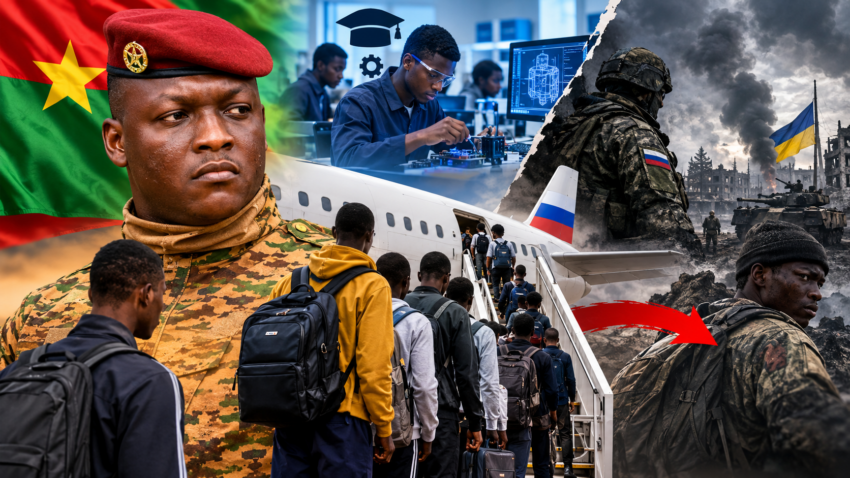
The Burkina Faso government’s decision to send young citizens to Russia for technologically advanced training has sparked intense debate, raising critical questions about the true costs and consequences for the youth and the nation. While officials tout the initiative as a gateway to high-tech education, mounting evidence and past precedents suggest a far darker reality may be at play.
From education promises to warfront risks: what’s really on offer for Burkinabè youth?
In 2023, Captain Ibrahim Traoré, Burkina Faso’s transitional leader, championed the idea of training the nation’s youth domestically to foster technological sovereignty. Fast forward to today, and his administration is now greenlighting a program to dispatch hundreds of young Burkinabè to Russian institutions. The stated goal? Equipping them with cutting-edge technical and industrial skills to drive national development.
Yet this abrupt pivot contradicts earlier declarations that prioritized homegrown education. More alarmingly, it occurs at a time when Russia is deeply entrenched in its war in Ukraine, a conflict that has drawn in foreign fighters through opaque and often coercive recruitment tactics. The juxtaposition of these two realities youth training and wartime mobilization—demands urgent scrutiny.
Russia’s war machine and the red flags for African recruits
Since the full-scale invasion of Ukraine in 2022, Moscow has systematically recruited foreign nationals to bolster its military efforts. While official narratives emphasize educational or professional opportunities, numerous reports from Africa and other regions highlight a pattern of deception. Recruits, often lured by promises of lucrative jobs or academic scholarships, have ended up deployed on combat fronts under unclear or outright misleading conditions.
Burkina Faso’s planned program shares unsettling parallels with past cases. In 2022, reports emerged of African students in Russia who were funneled into military service under the guise of vocational training. Similar concerns surfaced regarding Tunisian and Egyptian recruits, some of whom allegedly found themselves in Ukrainian conflict zones. The potential for these scenarios to repeat in Burkina Faso cannot be ignored.
What guarantees exist for Burkinabè families?
The government has yet to provide concrete answers to pressing questions about the program’s framework. Key details remain obscure, including:
Scale of participation: How many young Burkinabè are involved, and what criteria determined their selection?
Training institutions: Which Russian schools, universities, or technical centers are partnering with Ouagadougou?
Curriculum and certifications: What diplomas or credentials will participants earn, and are these recognized in Burkina Faso?
Legal safeguards: What bilateral or international agreements govern the stay and return of these students?
Protection against recruitment: How will the government prevent participants from being conscripted into military service, either directly or indirectly?
Without transparent mechanisms, families are left in the dark about the true purpose of their children’s journey. Is this initiative truly about education or a covert attempt to outsource national defense needs to a war-torn ally?
Broken promises and shifting priorities
Captain Traoré’s earlier commitment to in-country education reform now appears abandoned without justification. Burkina Faso’s universities, polytechnics, and research centers have long struggled with underfunding and outdated infrastructure. If the state was serious about fostering technological independence, why not channel resources into revitalizing these institutions first?
The current approach raises ethical and strategic concerns. Sending youth abroad under uncertain conditions risks turning them into bargaining chips in geopolitical maneuvering. Meanwhile, the country’s urgent need for engineers, scientists, and technicians capable of addressing local challenges such as food security, energy transition, and digital infrastructure remains unmet.
Human cost vs. economic gamble: who bears the brunt?
The most glaring consequence of this policy is the potential for irreversible harm to Burkinabè families. Parents who trusted their government’s assurances may one day face the devastating news that their children were not educated, but deployed into harm’s way. Such an outcome would not only scar individual lives but also erode public trust in state institutions for generations.
On the economic front, the program’s ROI is questionable. While short-term headlines may celebrate international cooperation, the long-term implications could include:
Loss of skilled labor due to casualties or permanent relocation
Erosion of confidence among foreign investors wary of instability
Strained diplomatic relations if Burkinabè youth are discovered in Russian military service
Undermined credibility of Burkina Faso’s governance amid shifting priorities
Critics argue that the government must prioritize substantive investment over symbolic gestures. Initiatives like the Russian program risk distracting from homegrown solutions that could yield sustainable growth without exposing lives to unnecessary danger.
A call for accountability and transparency
At its core, this issue is about more than geopolitics it is about human dignity and national responsibility. Burkina Faso’s youth deserve opportunities that align with their aspirations, not programs shrouded in opacity and potential exploitation.
The government must immediately clarify the program’s objectives, terms, and safeguards. Publicly addressing concerns is not just a matter of political convenience; it is a fundamental obligation to those it claims to serve. Until then, the shadow of doubt over this initiative will only grow darker, threatening both individual futures and the nation’s stability.
By Cécile Mboua — Journalist