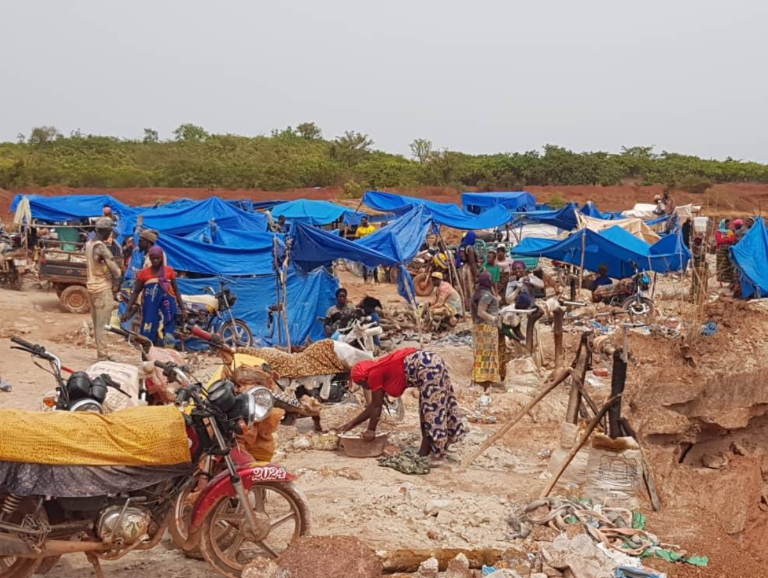
Guinea’s crackdown on illegal gold mining has exposed a harsh truth: thousands of West African workers, including many from Burkina Faso, are risking everything to survive in the country’s unregulated mines. The recent arrests of 1 412 miners, announced by Guinean authorities, highlight a growing humanitarian and economic crisis driven by regional disparities.
From desperation to deportation: the human cost of economic migration
The Guinean government’s sweeping operations, targeting clandestine gold mining sites, have shed light on a deepening migration crisis. While the arrests—1 263 processed in court and 149 detained across Kérouané and Siguiri—reflect a law enforcement response, they also reveal the desperation of workers fleeing Burkina Faso’s collapsing economic conditions. For many, these mines are not just an opportunity but a last resort to provide for their families amid chronic unemployment and poverty.
The phenomenon is not new, but its scale is reaching unprecedented levels. Historically, West African miners have moved freely across borders to exploit artisanal gold deposits. However, the current wave of migration signals a systemic failure: when local economies fail to offer viable livelihoods, workers inevitably seek survival elsewhere, even at the cost of legal consequences.
Burkina Faso’s economic promises vs. harsh realities
Since Ibrahim Traoré’s rise to power in 2022, Burkina Faso has prioritized economic sovereignty, particularly in the mining sector. The government has touted measures to nationalize operations and renegotiate contracts to boost state revenues. Yet, for many Burkinabè, these policies have not translated into tangible improvements in daily life. Rising insecurity, collapsing rural economies, and stagnant wages continue to push citizens toward neighboring countries—including Guinea, where gold mining offers, albeit illegally, a chance at income.
This migration pattern raises critical questions about the effectiveness of Burkina Faso’s economic strategies. While Traoré’s administration focuses on resource control, the lack of job creation and poverty alleviation in rural areas has resulted in a paradox: a nation rich in gold exports yet unable to provide for its own people.
Guinea’s dilemma: cracking down without addressing the root causes
For Guinea, the arrests send a clear message: illegal mining threatens national resources and environmental stability. Deforestation, river pollution, and land degradation are collateral damages of unregulated gold extraction. Authorities argue that legal enforcement is necessary to preserve ecosystems and public health. However, without addressing the economic push factors driving migration, these measures risk being temporary solutions to a persistent problem.
The Guinean justice system’s decision to prosecute the detained miners reflects a tough stance. Yet, as long as Burkina Faso’s economic struggles persist, Guinea may find itself repeating the cycle: more crackdowns, more arrests, and new waves of migrants exploiting alternative mining sites.
What the numbers don’t reveal: the human stories behind the arrests
While the official tally of 1 412 detainees confirms the scale of the issue, it obscures the individual struggles behind each case. Many arrested miners are not hardened criminals but laborers—fathers, husbands, and sons—desperate to feed their families. Their migration is not a choice but a necessity born from collapsing local economies. Without policy changes in Burkina Faso, their stories will continue to repeat, with the next generation facing the same grim prospects.
A regional problem demanding regional solutions
The illegal gold mining crisis is a symptom of deeper regional economic fractures. It demands coordinated action from governments, civil society, and international partners. For Burkina Faso, immediate measures could include investment in rural job creation, agricultural support, and vocational training to reduce reliance on informal mining. For Guinea, balancing environmental protection with economic compassion—such as reintegrating miners into formal sectors—could mitigate the humanitarian fallout of its crackdowns.The arrests are more than a statistic; they are a wake-up call. Economic sovereignty is not just about controlling resources—it is about ensuring that those resources translate into prosperity for the people they belong to.
The path forward: balancing enforcement and opportunity
- Burkina Faso must prioritize rural economic development to reduce migration pressures and create sustainable livelihoods.
- Guinea should explore amnesty programs or alternative livelihood initiatives for miners to transition away from illegal practices.
- Regional cooperation is essential to address cross-border migration driven by economic disparities.