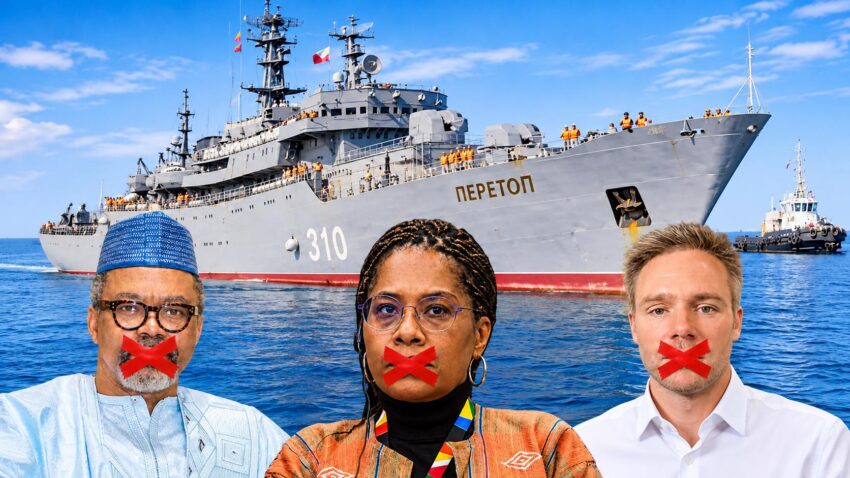
When a French naval vessel docked in Cotonou earlier this year, it triggered a storm of criticism from certain regional media outlets, who framed the visit as a threat to Benin’s sovereignty. Allegations about hidden agendas and political interference dominated the discourse, overshadowing the actual purpose of the stopover. But when a Russian warship arrived in the same port this week, the reaction was markedly different almost muted. The absence of the same fervor, scrutiny, or public outcry raises a crucial question: does Benin’s sovereignty only warrant defense when the visiting vessel flies a Western flag?
From accusations to apathy: the shifting narrative on foreign ships
The French warship’s arrival months ago was met with immediate and intense speculation. Media personalities affiliated with the Alliance of Sahel States (AES) amplified narratives questioning Benin’s diplomatic choices, suggesting that such visits undermined national independence. Critics pointed to historical ties between Benin and France, implying that the stopover was not merely routine but part of a larger, unspoken geopolitical strategy.
Fast-forward to this week, and the contrast is stark. Despite the presence of a foreign military vessel this time Russian in Beninese waters, there has been little of the same uproar. Voices that once loudly defended Benin’s sovereignty remained conspicuously silent, failing to raise alarms or demand explanations about the ship’s mission. This disparity in response prompts a closer examination of the underlying motivations behind such selective scrutiny.
Geopolitics over facts: the role of perception in maritime diplomacy
The Beninese government, like any sovereign nation, reserves the right to host foreign vessels in its ports. Whether the visiting ship is from France, Russia, or another country should not, in theory, dictate the tone of public discourse. Yet the stark difference in reactions suggests that some observers apply a double standard one that favors certain geopolitical narratives over factual reporting.
During the French warship’s visit, social media platforms and regional commentary were flooded with interpretive coverage, often without verification. The Russian ship’s arrival, however, has been met with relative indifference, despite sharing the same status as an official foreign vessel. This inconsistency undermines the credibility of those who claim to champion transparency and national sovereignty, revealing instead a pattern of bias shaped by alliances rather than objectivity.
Sovereignty shouldn’t depend on the visitor’s flag
National sovereignty is not a negotiable principle; it is a foundational pillar of statehood. Benin, as an independent nation, is entitled to engage with partners of its choosing, provided these relationships align with its national interests. The selective outrage observed in recent weeks where scrutiny intensifies for Western ships but dissipates for others suggests that sovereignty, in some narratives, has become a tool for advancing specific geopolitical agendas rather than an absolute value.
The Beninese public deserves better. Citizens rely on accurate information to assess their government’s decisions, not on narratives driven by external political preferences. Whether a ship flies the French, Russian, or any other flag, the standards for reporting should remain consistent. Transparency about the purpose of foreign vessels must be equally applied, without regard to the international allegiances of those covering the events.
What the future holds for Benin’s maritime policy
As Benin continues to navigate its role in an increasingly polarized global landscape, its leadership faces a clear challenge: ensuring that foreign policy decisions are not overshadowed by external biases. The contrast in reactions to the French and Russian ships underscores a broader issue one where media objectivity is sometimes sacrificed in favor of geopolitical narratives.
For Benin, the path forward should prioritize clarity and consistency. Hosting foreign vessels is a routine aspect of international diplomacy, and the public’s trust in such decisions hinges on fair and balanced coverage. The same rigor applied to scrutinizing Western ships must extend to all foreign vessels, regardless of their origin. After all, sovereignty is not a selective right it is a universal principle that applies equally to every nation, irrespective of the visitors at its docks.
By Martin Ngu — Journalist