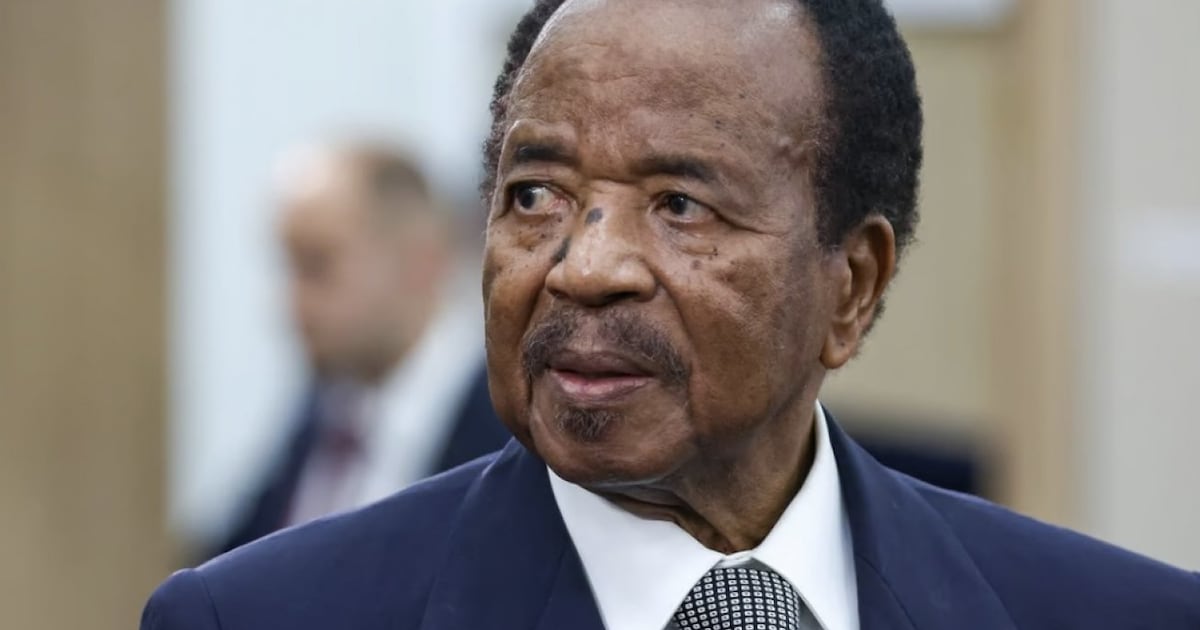
Paul Biya, the world’s longest-serving head of state and leader of Cameroon since 1982, is currently 93 years old. He departed Cameroonian soil 48 days ago, on June 7, for what an official communiqué described as a «short private stay in Europe,» accompanied by his wife, Chantal Biya.
The health of Mr. Biya, who frequently resides in Geneva, is a constant source of speculation, though these rumors are often refuted by the government.
Responding to various media reports on June 18, René Emmanuel Sadi, the Minister of Communication, issued a statement denying that the Cameroonian leader had been hospitalized in a Geneva clinic.
For Cameroon’s opposition, the President’s prolonged absence highlights a «glaring institutional void,» a sentiment expressed by Mamadou Mota, Vice-President of the Mouvement pour la renaissance du Cameroun (MRC), in a social media post on Friday.
«On autopilot»
In mid-July, Patricia Tomaïno Ndam Njoya, President of the Union démocratique du Cameroun (UDC), urged the government to establish «an impartial procedure for determining the temporary or definitive incapacitation» of the Head of State.
James Fame Ndongo, a senior figure within the presidential party and Minister of Higher Education, dismissed allegations of a power vacuum on Tuesday. He asserted that «wherever he is, the Head of State meticulously monitors the files submitted to him by his collaborators.»
Debates surrounding a potential power vacancy in Cameroon are not new; the most recent instance occurred in late 2024 when Mr. Biya spent approximately 50 days outside the country.
Another opposition party, the Social Democratic Front (SDF), dryly remarked on Friday that the nation was operating «on autopilot.»
These recurrent absences, spanning over two decades, consistently fuel frustration among many Cameroonians regarding the government’s perceived inertia. «People are already exhausted from waiting,» observed Viviane Ondoua Biwolé, a professor of public management at the University of Yaoundé.
She further explained, «Firstly, because the current government has been in power for eight years, setting a record. Secondly, because we are emerging from an election with very mixed results. Many believe that after an election, it’s time for renewal.»
Mr. Biya’s re-election to an eighth term in October 2025 sparked protests that were violently suppressed, with the government acknowledging «several dozens» of fatalities without providing an exact count.
The election results, disputed by the opposition, were met with considerable reservation from Western diplomatic missions.
Two months later, in his address to the Nation on December 31, Mr. Biya pledged to form a new governmental team «in the coming days.»
Yet, seven months have passed, and the new government he announced has still not been formed. This delay is compounded by multiple postponements of municipal and legislative elections, indefinitely extending the mandates of current officeholders.
After Biya
Despite these issues, the Cameroonian government recently initiated some institutional changes, including the replacement of the presidents of both parliamentary chambers in March, followed by the creation of a vice-president post through a constitutional reform in early May.
However, nearly three months after the reform, no vice-president has been appointed. This ongoing delay has inevitably fueled further speculation.
In June, an individual appeared at the public radio headquarters in Yaoundé, attempting to submit a document purported to be a presidential decree appointing the Vice-President of the Republic.
The fraudulent document bore presidential seals and a signature attributed to Mr. Biya, but alert journalists did not broadcast it, though the incident nonetheless contributed to the prevailing rumors.
These institutional maneuvers only intensify speculation about the «after-Biya» era and appear to accelerate the race for his succession, which remains shrouded in uncertainty.
«There is, more or less visibly, a crisis at the top of the state among the President’s close associates,» asserted Ms. Ondoua Biwolé.
This observation is corroborated by political scientist Stéphane Akoa, who noted that «increasing indiscretions point to quarrels between the various clans in his entourage.»
Behind one of these «clans» looms the shadow of Chantal Biya, the First Lady, who is «increasingly present in state affairs,» with «her name often cited in decision-making and high-level appointments,» Mr. Akoa observed.
Until a vice-president is named, the responsibility for assuming power in the event of a vacancy falls to the President of the Senate, Aboubakary Abdoulaye, pending the organization of a presidential election.