When Mali’s military command brushed aside the fighting at Dioura with a single throwaway line — that there was ‘nothing’ to report there — it gambled that silence would bury the story. That gamble has now collapsed. The documented losses of men and equipment are reshaping daily life in a conflict that reaches far beyond the barracks: into the homes of soldiers who will not come back, into the units that lost their officers, and into the growing doubt of civilians who no longer know which version of reality to believe about their own country.
Few episodes expose that gap as sharply as the standoff between the Malian Armed Forces (FAMA) hierarchy and the Jama’at Nusrat al-Islam wal-Muslimin (JNIM). By publicly downplaying the scale of the setback, the general staff hoped to contain the fallout. The jihadist group answered with a detailed statement of its own, backed by visual evidence, converting a battlefield defeat into a full-blown information crisis for Bamako.
The human cost: ranks, names and families left waiting
The JNIM’s own communiqué puts the death toll at 150 Malian soldiers — a figure that, if it holds, would rank among the heaviest single losses the army has absorbed in this conflict. The group also names senior officers among the dead, including a colonel and a captain, a detail that says much about how deeply the assault cut into command structures.
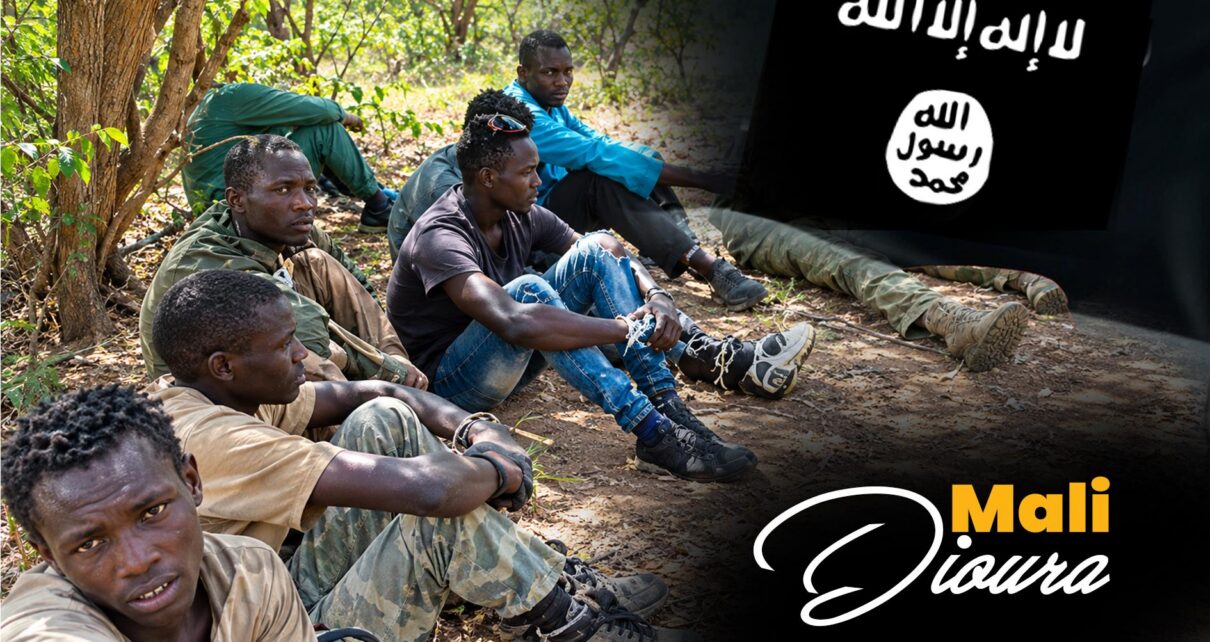
A further 93 soldiers were taken alive. Beyond the immediate tragedy for their relatives, these captives hand the armed group durable leverage: bargaining power in any future exchange, raw material for its propaganda machine, and a permanent source of pressure on the units that lost them.
An arsenal wiped out in a matter of hours
The material damage described by the attackers mirrors the scale of the human losses and translates, for the Malian army, into immediate operational shortfalls in the field.
- Destroyed: 15 military vehicles and more than 100 motorcycles used by patrol units.
- Seized in working order: 6 tactical vehicles and 10 motorcycles.
- Heavy weapons recovered: 6 guns of 14.5 mm calibre, 17 DShK heavy machine guns, 32 PK machine guns, 10 RPG rocket launchers, 3 mortars and one SPG recoilless cannon.
- Light weapons and ammunition: 233 Kalashnikov assault rifles plus a large stock of ammunition in multiple calibres.
To pre-empt any counter-claim, the group released photographs and video showing the captured stock and the prisoners, a level of documentation that leaves little room for dispute.
Why denying Dioura ends up costing more than the battle
What makes this episode so damaging is not only what was lost, but the way it was handled. By defaulting to silence or outright denial when operations go wrong, the military leadership hands the narrative to its opponent. Once verifiable images of seized weaponry and captured troops are circulating, official statements lose their footing — and the soldiers holding the front line are left feeling abandoned by their own chain of command.
For the government of Assimi Goïta, which has built its legitimacy on the promise of sovereign reconquest and a stronger army, the contrast is stark. Denying the obvious before it surfaced online exposes Bamako to a destructive loss of credibility, not only among international observers but above all among Malians who are increasingly unsure about the true security situation in their country.
Falling confidence inside the ranks
Every defeat that goes unacknowledged chips away at the trust soldiers place in their commanders and weakens the cohesion of an institution that is already stretched across several fronts. The damage accumulates quietly, but it is real, and it surfaces in the field.
A widening gap with the public
For ordinary citizens, the practical consequence is uncertainty. When armed groups publish verifiable proof of complex operations — a mass assault followed by the systematic recovery of heavy weaponry — the official version of events becomes impossible to sustain, and national cohesion pays the price.
Field reality versus the sovereignty narrative
Dioura reaffirms just how complex the security crisis in central and northern Mali remains. Despite a declared strategic break and the backing of new partners, armed groups have lost none of their capacity to disrupt. The attack proves that the JNIM still commands both the tactical mobility and the striking power needed to disorganise fortified army positions.
Confronted with the precision of the evidence published by the assailants, silence and minimisation can no longer pass for military strategy. For the authorities in Bamako, the challenge is no longer confined to reconquering territory: it now means confronting what actually happens on the ground, so that a security response under severe strain can be recalibrated — and so that Malians can once again trust what they are told.