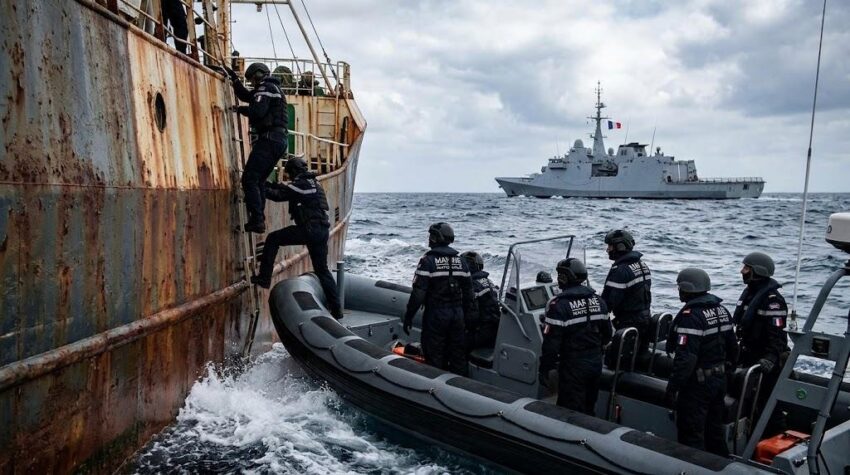
The interception of the Russian-flagged tanker DF Peak by French naval forces in the Indian Ocean has ignited a fierce debate over maritime law, sovereignty, and the exploitation of flag states in global sanction regimes. The operation, which unfolded over 830 kilometers south of La Réunion, has exposed the intricate web of deceit woven by Russia’s so-called ghost fleet and raised urgent questions about the integrity of Benin’s maritime registry.
High-seas confrontation: French forces strike under the radar of sanctions evasion
On October 12, 2026, French naval units intercepted the 244-meter DF Peak in international waters, suspecting it of violating international sanctions targeting Russia’s energy sector. The vessel, initially flying the Benin flag, was boarded following intelligence suggesting its involvement in circumventing trade restrictions imposed by the EU, US, and UK.
During the inspection, French authorities uncovered discrepancies in the ship’s documentation, casting doubt on the legitimacy of its Benin registration. Under judicial oversight, the tanker was escorted to a holding area near La Réunion for thorough investigations into its cargo, ownership structure, and compliance with maritime laws. The operation, publicly acknowledged by French leadership, underscores the escalating tactics of shadow fleets to bypass sanctions through flag-state manipulation.
Identity shifts: How the DF Peak evaded detection for years
The DF Peak embodies the archetype of a vessel engineered to disappear into the global maritime underworld. Originally registered as NS Captain, it operated under the Russian flag as Kaliningrad before adopting its current name and Benin registration in 2025. Its recent voyage from Venezuela—detected via satellite tracking—paints a clear picture of a ship repurposed to mask its origins and destinations.
Suspicions of its role in sanction-busting networks are further amplified by its 110,000-ton capacity, an ideal size for clandestine oil transfers and shadow trade operations. The DF Peak’s ability to switch identities with such fluidity highlights the systemic vulnerabilities in maritime regulation, where opaque corporate structures and flag-state loopholes create fertile ground for illicit activity.
Benin’s maritime sovereignty at risk: Legal fallout from the DF Peak incident
The use of Benin’s flag by the DF Peak has thrust Cotonou into the center of a geopolitical storm. Under Benin’s maritime code, vessels registered under its flag must demonstrate a genuine economic or operational link to the country—such as residence of owners, local company registration, or strict management controls. Failure to comply constitutes a criminal offense and a direct affront to Benin’s sovereignty.
If investigations confirm the DF Peak was registered fraudulently, Benin is legally obligated to revoke its flag immediately and pursue legal action against intermediaries facilitating such violations. As a signatory to the UN Convention on the Law of the Sea, Benin is further compelled to enforce stringent controls over vessels flying its flag—a responsibility now under intense scrutiny.
From a broader legal perspective, France’s interception aligns with international maritime law, specifically Article 110 of the Montego Bay Convention, which permits vessel inspections in cases of suspected false flags or lack of nationality. The case could also prompt Benin to seek mutual legal assistance from France to investigate potential complicity by local or international maritime actors in facilitating the fraudulent registration.
The shadow fleet dilemma: Why sanctions enforcement is failing at sea
The DF Peak incident is not an isolated anomaly but a symptom of a far larger crisis: the proliferation of ghost fleets designed to evade sanctions. These networks exploit legal loopholes through shell companies, unregulated insurance schemes, and mid-ocean cargo transfers that leave no paper trail. In the absence of robust global enforcement mechanisms, sanctioned entities continue to move oil, gas, and other commodities with alarming impunity.
For Benin, the interception is a wake-up call. The country must urgently audit its maritime registry to prevent its flag from becoming a haven for illicit operators. The stakes are high—credibility in the eyes of international maritime bodies, economic stability, and diplomatic relations all hang in the balance. Meanwhile, global stakeholders are left grappling with a critical question: How can sanctions designed to curb aggression remain effective when shadow fleets operate outside the reach of conventional law?