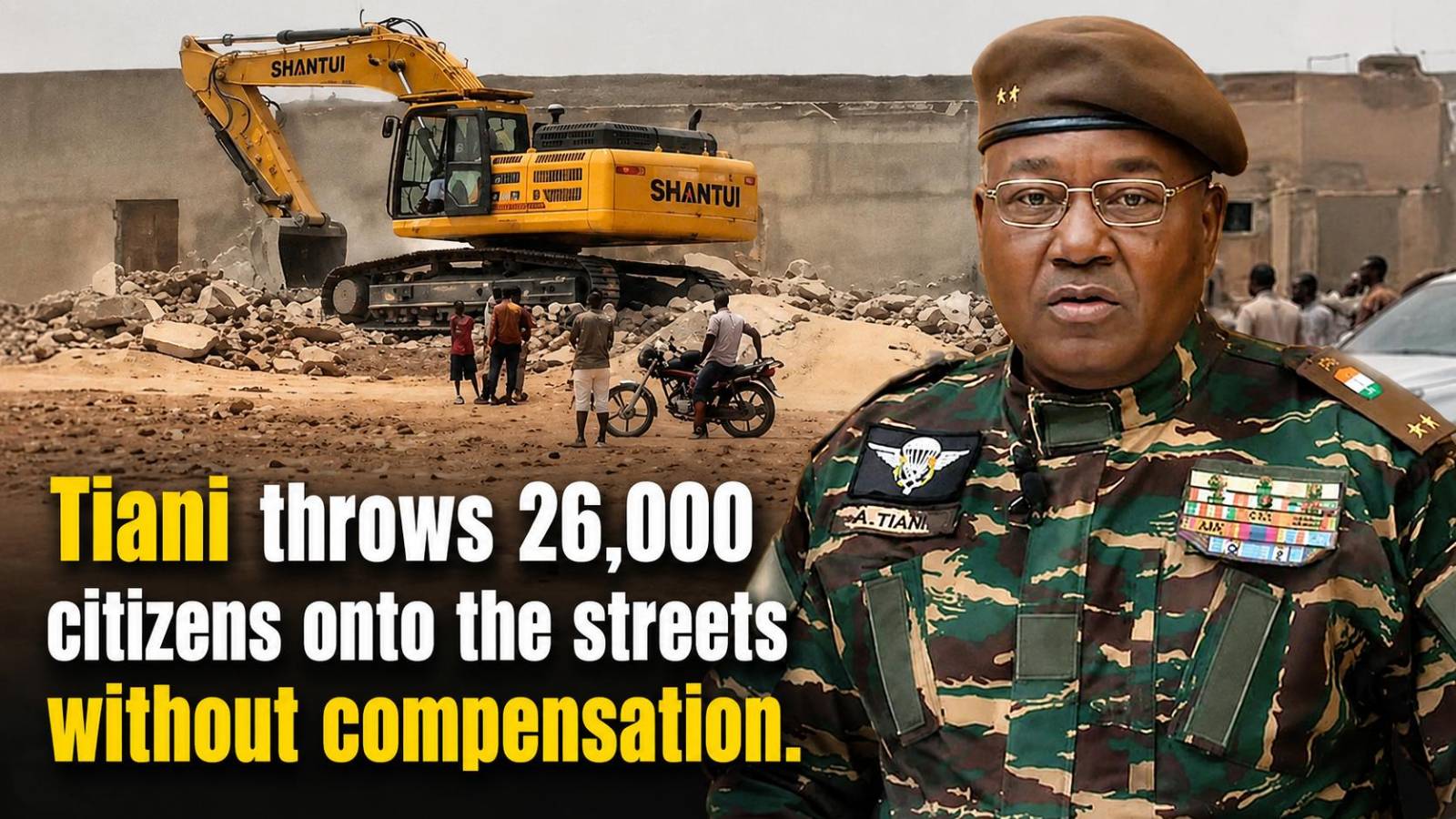
The recent mass eviction of 26,000 individuals in Niamey has sparked widespread outrage, particularly among civil society groups. Authorities executed this sweeping operation with no accompanying measures or relocation plans, prioritizing brute force over fundamental human rights. This raises a pressing question: is this the standard by which governance should be measured?
« Last night, sleep was impossible, » declared Maikoul Zodi, a prominent figure in Niger’s civil society, encapsulating the gravity of the unfolding humanitarian crisis. Evicting 26,000 people equates to erasing an entire small town from existence overnight. While authorities often cite urban planning or security imperatives to justify such demolitions, the methods employed here cross into illegality and inhumanity.
flouting national and international legal frameworks
Governance extends beyond issuing eviction decrees from the secluded chambers of the National Council for the Safeguard of the Homeland. True leadership means protection. Yet, by abandoning thousands to absolute precarity, the transitional regime has disregarded the most basic legal safeguards.
As Maikoul Zodi aptly underscores, Niger’s domestic legislation and ratified international conventions—particularly those addressing economic, social, and cultural rights—strictly regulate public land releases. Such large-scale evictions demand:
- A prior environmental impact assessment,
- A meticulous census of affected populations,
- And, crucially, fair compensation and a viable relocation strategy before any action is taken.
Without these essential safeguards, the operation can only be classified as a forced eviction, a practice explicitly prohibited under international law and tantamount to a blatant violation of human rights.
human consequences of a bureaucratic decree
Behind the sterile term « eviction » lie harrowing human realities. Children face abrupt interruptions in their education, while women, the elderly, and low-income workers are thrust into homelessness and destitution overnight.
Amid an already strained socio-economic landscape, how can a government justify abandoning its citizens to such despair with no consideration for their future? No alternatives have been offered to these 26,000 individuals—only abandonment to their fate.