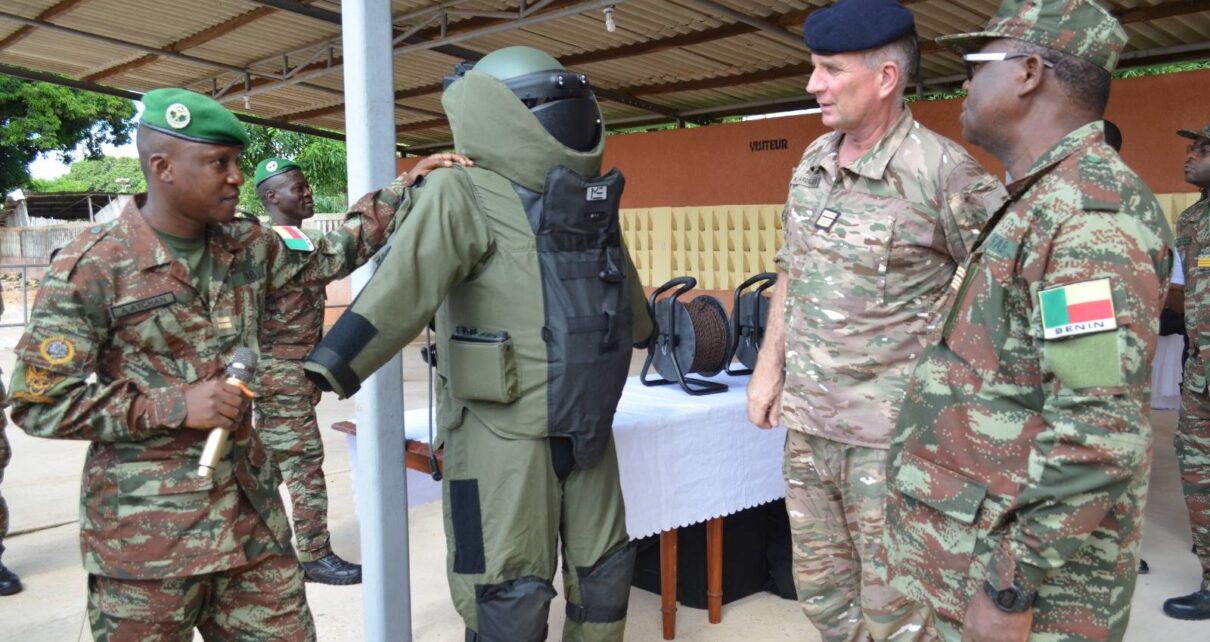
As terrorist tactics grow more sophisticated in the country’s northern regions, the military partnership between Cotonou and Paris enters a decisive new phase. On Tuesday, 23 June 2026, the Béninese armed forces officially received a major shipment of cutting-edge equipment designed to neutralise improvised explosive devices (IEDs). This delivery marks a strategic adaptation of Opération Mirador’s intervention doctrine, aimed at securing the northern territories and revitalising the local economy.
A technological leap against an asymmetric threat
The nature of the threat in northern Bénin has evolved. Terrorist armed groups, under constant pressure from security forces, increasingly abandon frontal assaults in favour of an invisible and deadly weapon: improvised explosive devices. Hidden on tracks and roads, these handmade traps seek to hinder troop mobility and spread fear.
To address this challenge head-on, France delivered a large consignment of specialised equipment on 23 June to the Centre de Perfectionnement aux Actions Post-Conflictuelles de Déminage et de Dépollution (CPADD) Colonel Jean Kouagou N’PINA. The package includes high-performance metal and anomaly detectors, disruptor cannons (used to disable bomb circuits remotely without triggering an explosion), and specialised intervention vehicles. However, the true added value of this delivery lies in the portable jammers. These devices, carried on soldiers’ backs or mounted on vehicles, instantly cut radio frequencies and cellular signals within a given perimeter, preventing terrorists from detonating bombs remotely as convoys pass.
Civil and economic impact: securing roads to revive the north
While this delivery falls under a strictly military framework, its deepest effects will be felt in the daily lives of northern Bénin’s population. In border areas, fear of improvised mines has gradually paralysed the local economy. Lieutenant-Colonel Djimon SAHGUI, Director of the CPADD, emphasised: “The proliferation of improvised explosive devices demands constant adaptation of our means.”
When roads become unsafe, weekly markets shut down, cotton trucks stop circulating, and access to health centres or schools becomes impossible. By bolstering the capabilities of the 1st Engineer Battalion, this donation speeds up the opening and securing of road axes. For residents of Matéri, Karimama, or Tanguiéta, seeing demining teams equipped with these new tools sends a powerful message of reassurance: the state is regaining full control of public space to allow pastoral and commercial activities to continue.
EOD training: towards greater operational autonomy
Acquiring advanced equipment is only meaningful when paired with flawless technical mastery. Lieutenant-Colonel Arnaud ARDILLIER, Defence Attaché at the French Embassy in Bénin, stressed that this donation represents above all “a concrete investment in the safety of Béninese soldiers.”
These new tools will immediately be integrated into the Explosive Ordnance Disposal (EOD) training programmes conducted at the CPADD. This regionally renowned centre will allow Béninese technicians to train on state-of-the-art technologies. The short-term goal is to deploy highly qualified demining teams capable of advancing on the front lines alongside combat units, drastically reducing casualty rates during patrols.
Political framework: a reaffirmed bilateral partnership
The ceremony, chaired on behalf of the High Command by Colonel Gilbert LOSSITODE, representing the Chief of General Staff of the Béninese Armed Forces, highlighted the strength of the ties between Cotonou and Paris in defence matters. As the security architecture in West Africa undergoes major reconfiguration, Bénin and France show a convergence of views and a cooperation that Lieutenant-Colonel SAHGUI describes as “solid and exemplary.”
While receiving the equipment, Colonel LOSSITODE praised “an act of solidarity and concrete commitment.” This cooperation project, the result of long coordination between general staffs, directly supports Opération Mirador, the Béninese military deployment in the north to counter jihadist infiltration.
Another step towards resilience
This new stage in the Franco-Béninese partnership demonstrates that the response to the terrorist threat can no longer be solely quantitative; it must be technological. By providing the 1st Engineer Battalion and the CPADD with top-tier technical means, the Béninese armed forces significantly increase their operational effectiveness.
Beyond the tactical advantage on the ground, the overall resilience of communities in northern Bénin is strengthened. Neutralising the IED threat is the prerequisite for restoring stability, reviving economic development, and allowing civilian populations to finally look to the future with confidence.