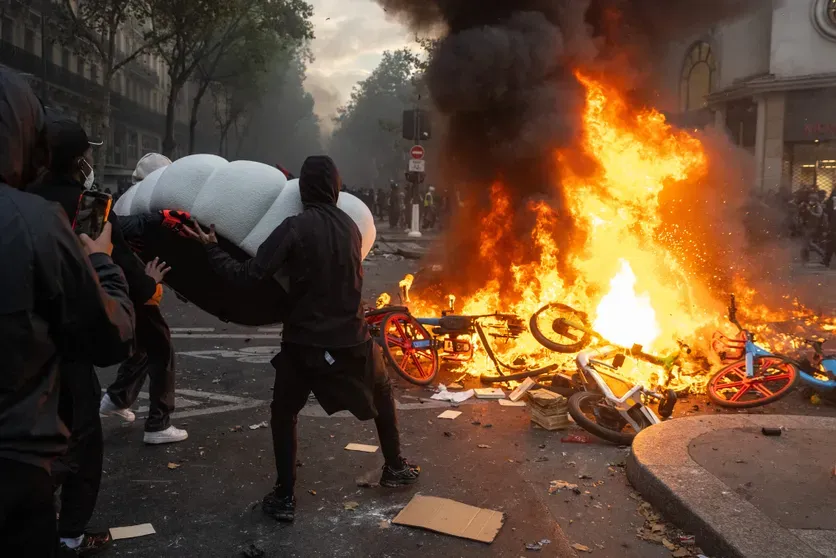
From shattered storefronts to tear gas-filled streets, every surge of public unrest in France sends shockwaves through the digital streets of Bamako, Ouagadougou, and Niamey. What Western observers interpret as domestic strife, military-led governments across the Sahel region increasingly frame as definitive proof of the West’s hypocrisy—turning French turmoil into a cornerstone of their anti-colonial legitimacy.
The French crisis as a propaganda goldmine for Sahel juntas
Scenes of confrontation between police and protesters are no longer isolated incidents; they have become ammunition in a calculated rhetorical war. Since the coups in Mali, Burkina Faso, and Niger, the new military regimes have waged a fierce information campaign aimed at dismantling France’s historical influence in West Africa. Each video of French police responding to protests is repurposed in state-aligned media to expose what they describe as the collapse of democratic values once championed by Paris.
For years, France positioned itself as the guardian of democratic norms, governance, and human rights in Africa. Now, its own handling of domestic unrest is being weaponized to dismantle that very narrative. Officials from the Alliance of Sahel States (AES) and their allies highlight France’s reliance on police tactics, such as crowd dispersal grenades and parliamentary bypasses, to justify their own crackdowns on dissent—framing their authoritarian measures as necessary for stability.
How public unrest in France undermines French influence in the Sahel
The ripple effects of France’s social crisis extend far beyond Parisian boulevards. Each episode of unrest provides Sahel juntas with fresh material to claim that the West’s model of liberal democracy is failing. They argue that their military-led governments, despite their shortcomings, offer a more resilient path to sovereignty—one unshaken by the chaos seen in European capitals.
Meanwhile, the AES regimes benefit from three strategic advantages:
- Eroding France’s moral authority: By contrasting France’s protest suppression tactics with their own narratives of resistance to foreign interference, these juntas portray themselves as defenders of national dignity.
- Diverting attention from local crises: While the international focus shifts to Paris, Sahel populations grapple with rising inflation, energy shortages, and the ongoing jihadist insurgency—issues that receive far less media coverage.
- Accelerating geopolitical realignment: Images of French unrest are amplified across digital networks tied to Russia, Turkey, and Iran, reinforcing the perception of a declining West and justifying closer ties with alternative partners.
Cracks in the narrative: why France’s civic space still sets it apart
Despite the concerted effort to frame France’s crisis as a sign of systemic decay, critical voices point to a fundamental contradiction. In France, citizens can openly denounce their government, organize strikes, and challenge policies without fear of detention or forced disappearance—liberties that are increasingly curtailed in Sahel states, where public dissent is often branded as treason.
Observers caution against overstating the propaganda’s impact. However, in the court of public opinion across the Sahel, the damage is already done. Every video of a French protest, every image of police intervention, chips away at France’s once-untouchable image as a bastion of democratic stability. For juntas determined to break free from Parisian influence, these scenes are not just a distraction—they are a tool for survival.
What’s next? The long shadow of France’s unrest on Sahel politics
As France struggles to contain its domestic crises, the AES regimes show no signs of easing their propaganda offensive. On the contrary, every new episode of unrest in France is likely to be seized upon, repackaged, and broadcast as evidence of Western decline. While the long-term consequences for French diplomacy remain unclear, one thing is certain: the reputational cost of France’s social fractures is rising in a region where image often trumps evidence.
The stakes are high—not just for France, but for the millions of citizens caught between growing instability and the promise of a new post-colonial order. Whether this narrative reversal will solidify the juntas’ grip on power or fuel deeper cynicism among Sahel populations remains an open question. What is clear, though, is that the battle for Africa’s future is increasingly being fought on the digital streets of Bamako, Ouagadougou, and Niamey—where every burning barricade in Paris becomes a talking point.