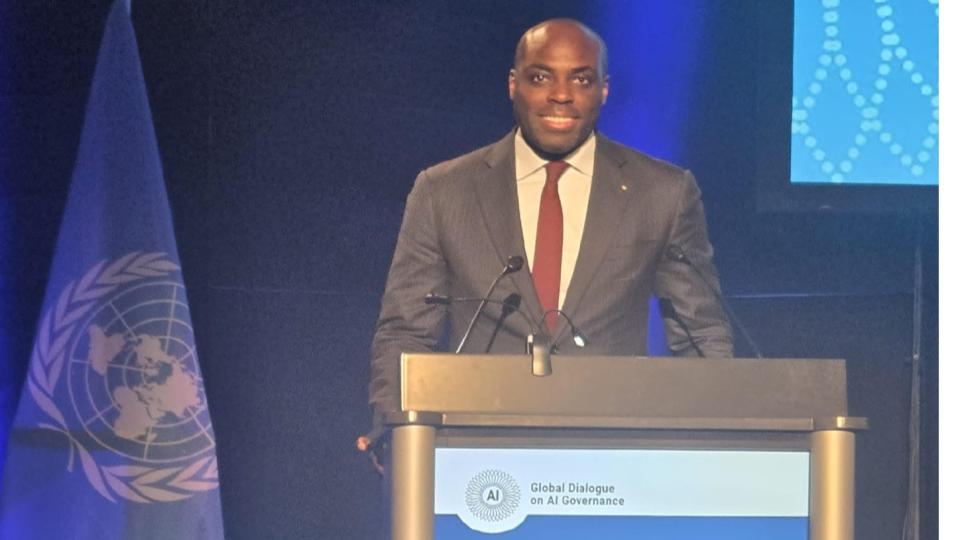
As global powers race to dominate the artificial intelligence landscape, Gabon is championing a radically different approach. Addressing delegates at the Global Dialogue on AI Governance in Geneva, under the auspices of the United Nations, Gabon’s Minister of Digital Economy, Mark Alexandre Doumba, called for a fundamental reassessment of how AI should evolve.
In a clear departure from the prevailing focus on sheer computational power and model size, the Minister emphasized that the true priority lies not in being the fastest, but in making intelligence universally accessible. « The goal is not to lead the AI frontier, but to deploy it widely,» he declared, challenging the assumption that technological supremacy is the only measure of progress.
From algorithmic supremacy to inclusive innovation
Gabon’s stance contrasts sharply with the strategy of major technology hubs, where scale and processing capabilities dominate the conversation. For Doumba, the obsession with ever-larger models risks sidelining the needs of communities that stand to benefit most from AI—those outside the traditional centers of innovation. « The breakthrough isn’t in bigger models. It’s in locally relevant solutions that empower African farmers, healthcare workers, and public servants to use AI in their daily lives.»
This vision of AI—what the Minister terms « small AI »—focuses on tailored applications rather than monolithic, one-size-fits-all systems. Whether improving agricultural yields, streamlining public services, or enhancing access to healthcare, the success of these tools will be measured not by their technical specifications, but by their real-world impact on people’s lives.
Building governance to prevent a new global divide
The Gabonese perspective extends beyond technical design into the realm of governance and ethics. Doumba warned that without deliberate efforts to ensure equitable access and responsible deployment, artificial intelligence could deepen existing inequalities. « The real challenge is not technical—it’s political. Who will establish the frameworks that prevent AI from becoming another tool of exclusion?»
He stressed that the current trajectory risks creating a new global fracture: one not between nations with and without weapons, but between those who create AI and those who merely consume its outputs. The future of AI, in this view, belongs not to those who build the most powerful systems, but to those who ensure these systems serve humanity as a whole. Success will not be measured in teraflops or data centers, but in tangible improvements to human dignity, opportunity, and well-being.