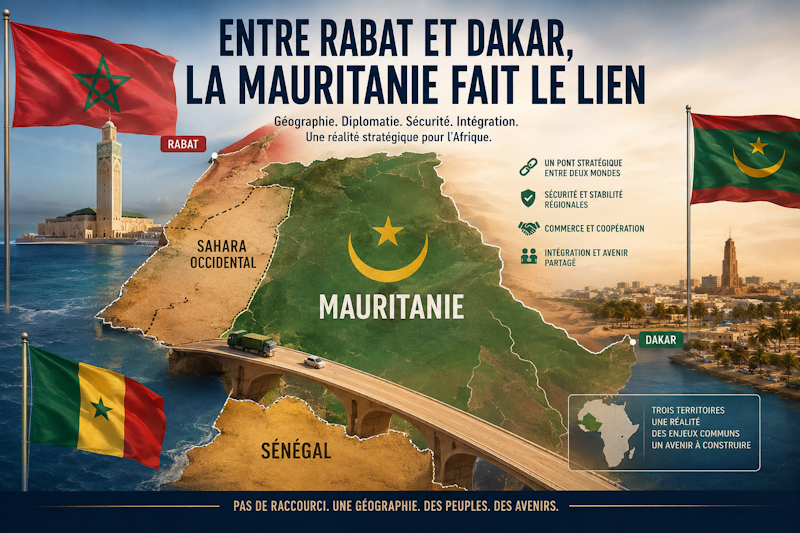

In the intricate web of North and West African relations, one simple truth often gets overlooked: the geographical and political realities between Morocco and Senegal cannot be reduced to a straight line. Mauritania sits at the very center of this equation, serving as a vital link between the Maghreb and Sub-Saharan Africa.
Ahmed Ould Bettar, a prominent Mauritanian journalist, recently highlighted this oversight in discussions about regional dynamics. While some analyses attempt to bypass Mauritania in favor of a direct Morocco-Senegal narrative, the truth is far more nuanced. The Western Sahara dispute looms large, but so does the Republic of Mauritania, a sovereign nation with its own strategic importance.
Why Mauritania cannot be ignored in Maghreb-West Africa relations
Africa’s geopolitical landscape is often misunderstood when geographical shortcuts replace factual analysis. Between Rabat and Dakar, the vast stretch of land is not merely a blank space on a map—it is a region defined by history, diplomacy, and security imperatives. Mauritania is not a mere transit zone; it is a nation with a distinct identity, playing a pivotal role in:
- Regional integration: Bridging the cultural and economic divide between North and West Africa
- Diplomatic influence: Acting as a mediator in disputes and a key player in continental organizations
- Security coordination: Addressing cross-border threats and stabilizing the Sahel
To overlook Mauritania’s role is to distort the very foundations of this geopolitical puzzle. Its capital, Nouakchott, functions as more than just a midpoint—it is a hub of political and economic exchange, where decisions reverberate across two continents.
Geographical realities vs. political narratives
The Western Sahara conflict remains a flashpoint, but it cannot overshadow Mauritania’s own sovereignty and strategic position. The country’s recognition as an independent state in 1960 marked its entry into a complex regional order, one where its voice carries weight in discussions on:
- Trade corridors linking Casablanca to Dakar
- Security alliances addressing terrorism and smuggling
- Cultural exchanges preserving trans-Saharan heritage
Yet, simplistic narratives persist. Some observers reduce the Morocco-Senegal axis to a direct path, ignoring the realities of desert trade routes, colonial-era borders, and post-independence statecraft. In doing so, they risk misrepresenting the very essence of North and West African interconnectedness.
The dangers of oversimplification in foreign policy
Geopolitics is not a work of fiction where shortcuts lead to happy endings. It is a discipline governed by tangible realities—borders, treaties, and national interests. When analysts or policymakers dismiss Mauritania’s role, they undermine the credibility of their own assessments.
Consider the implications:
- Failed diplomatic initiatives when key stakeholders are excluded
- Economic miscalculations that ignore Mauritania’s resource potential
- Security gaps where Mauritania’s mediation could have prevented escalation
The lesson is clear: geography and sovereignty matter. Mauritania is not an optional detour on the road from Marrakech to Saint-Louis—it is a destination in itself, a nation whose role must be acknowledged in any serious discussion of Maghreb-West Africa relations.