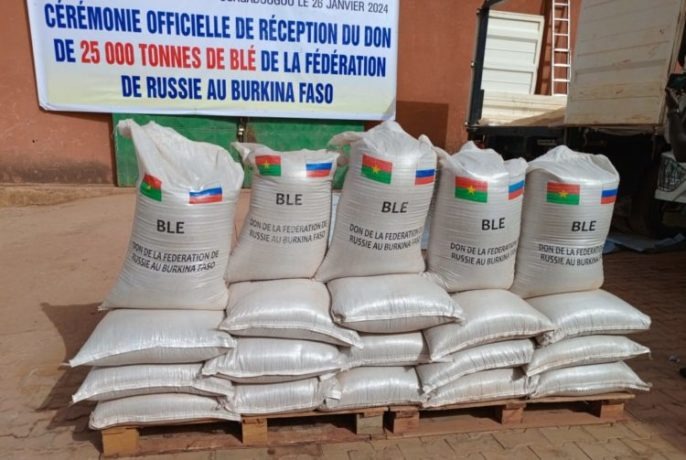
The distance between what Burkina Faso’s leaders announce from the podium and what actually rolls off ships into its warehouses has rarely looked so wide. On Wednesday, September 23, 2026, the transitional authorities once again laid out the official welcome for a consignment of 25,000 tonnes of wheat offered by the Russian Federation — at the very moment Captain Ibrahim Traoré was repeating in public that agropastoral offensives and “recovered sovereignty” had pushed the country to the edge of food self-sufficiency. The consequences of that contradiction are anything but symbolic: they surface in household budgets, in the income of farmers and in the room for manoeuvre the country still keeps on the international stage.
The ceremony, the cargo and what it changes on the ground
Officially, the operation is presented as humanitarian solidarity and as the fruit of a strategic partnership with Moscow. Economically, it behaves like any other import: grain that has to be shipped, stored, milled and distributed, at a cost carried by public finances in a country that says it can already feed itself. Every tonne arriving from abroad is a tonne that local producers were not asked to supply — and a quiet admission that domestic supply chains are not yet trusted to do the job.
How the delivery reaches ordinary households
For families in Ouagadougou and other urban centres, imported wheat is, in the short term, a cushion. Flour keeps reaching bakeries, bread stays on the shelves and the pressure on basic food prices eases slightly. That reprieve, however, is borrowed. It is financed by external supply, priced in foreign currency and exposed to every shift in the relationship that made it possible.
Food on the plate against figures on the balance sheet
Millers and bakers gain from volumes that domestic harvests cannot yet guarantee. Yet the money that leaves the country for imported grain is money that never returns to Burkinabè farmers as income, seed investment or storage capacity. Rural households are squeezed from both directions: they pay more for imported staples while earning less from the crops they still manage to bring in.
Displaced families and the fields they can no longer work
The deeper damage is agricultural. As large stretches of rural territory slip out of state control and displaced populations abandon cultivable land, the productive base itself shrinks. Emergency cargo arriving by sea papers over that loss without repairing it. Rebuilding it would mean restoring access to fields, security for those who work them, and investment in irrigation and local processing — none of which can be unloaded from a ship.
The invoice hidden behind the word “gift”
Calling the consignment a free donation conveniently sidesteps the question of what was exchanged for it. Behind the vocabulary of generosity and strategic partnership lies a transaction whose terms stay deliberately opaque. Seasoned observers describe it as a disguised purchase or a thoroughly political barter. What Burkina Faso hands over in return takes forms that are harder to photograph:
- preferential access to gold mining concessions and other extractive assets;
- economic contracts awarded outside open competition;
- an unreserved diplomatic alignment that narrows the country’s options elsewhere;
- a lasting dependence on a single supplier for a staple food.
Those 25,000 tonnes were not free. They were paid for in external dependence and in sovereign concessions — an indirect bill settled by Burkinabè taxpayers, who will feel it long after the flour has been eaten.
Why the self-sufficiency message keeps colliding with reality
Presenting an external resupply operation as proof of sovereignty inverts the very idea it claims to defend. A genuinely sovereign nation feeds its people from its own soil, under the protection of its own institutions. If self-sufficiency were an established fact rather than a communication line, national granaries would be enough to supply the cities and the camps for displaced people without waiting for vessels from the Black Sea.
As long as the rhetoric of rupture advanced by Captain Ibrahim Traoré runs head-on into bags of imported wheat used to plug the emergencies of the moment, sovereign self-sufficiency will remain what it is today: a slogan with a heavy price tag attached, paid for by the households, the farmers and the public finances of Burkina Faso.