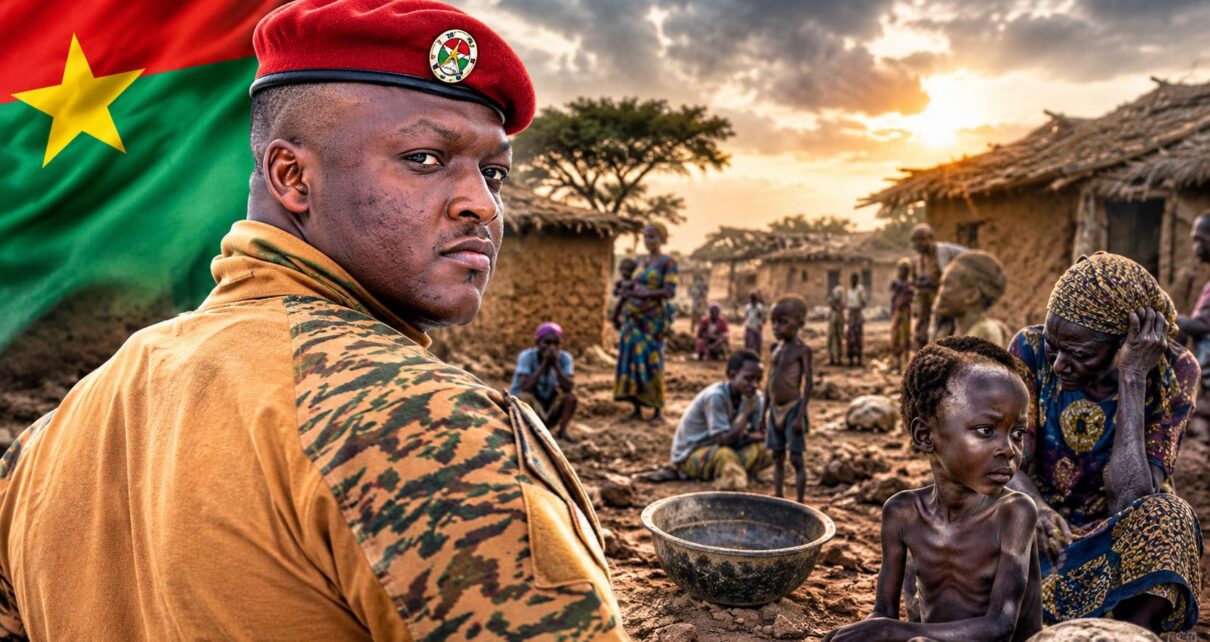
Barely 77 kilometres north-east of Ouagadougou, Boussouma has been reduced to a shell of its former self. The trading posts that once pulled in merchants from surrounding villages sit silent, fields have been left untended, and the households that gave the locality its rhythm have scattered in a forced rural exodus whose ripple effects are already being felt far past the village boundary. What started as a security shock has hardened into an economic and social rupture with consequences that now reach the doorstep of the capital.
A local economy ground to a halt
Boussouma was never just a place to live. It functioned as a crossroads of exchange and a symbol of community cohesion, a point where livestock, grain and everyday goods changed hands and where families from the wider area found both income and supplies. With its population gone, that function has vanished overnight. Farmers can no longer safely reach their plots, herders have lost their usual routes, and small traders have watched their customer base and their supply lines disappear at the same time.
The damage does not stop at the village limits. Communities that depended on Boussouma as a market and transit point now have to travel further, pay more and take greater risks for the same goods, while the loss of a productive rural hub feeds directly into the wider cost of living in the region.
The institutional break that opened the way
The security shift around Boussouma did not happen in a vacuum. It followed the recent overhaul of the administrative and traditional framework imposed from the centre. By dismantling local customary authorities and disrupting the long-standing administrative mesh — through the application of the law on the status of customary chieftaincy (law No. 002-2026/ALT) and adjustments within the royal court of Boussouma — the central government removed the social shield and the informal security anchor that had held the area together.
Customary leaders pushed aside
In practice, chiefs and traditional intermediaries were the ones who settled disputes, relayed warnings and kept lines of communication open between residents and the state. Stripping them of their role left a gap that no formal institution was positioned to fill quickly.
A void that armed groups were quick to exploit
That institutional vacuum and the loss of local reference points were read on the ground as a starting signal. Taking advantage of weakened traditional structures that had once provided community relays and close-range intelligence, armed groups moved in fast and imposed their control over the space.
What the displacement is costing families
The near-total departure of Boussouma’s residents marks a critical stage in the country’s security decline. Displaced families are arriving in neighbouring localities or trying to reach the outskirts of Ouagadougou with almost nothing, turning a local emergency into a regional burden as host communities stretch already thin resources to absorb them.
Livelihoods lost, not merely postponed
For farming and herding households, displacement means a lost harvest, lost animals and lost credit. For traders, it means a business that cannot be relocated or rebuilt in a season. These are not temporary interruptions but structural losses that will weigh on the area long after the immediate emergency fades.
Why Boussouma matters far beyond its own borders
Seeing a village positioned less than 80 kilometres from the capital emptied under armed pressure lays bare how far the state’s territorial reach has retreated. The Boussouma crisis is therefore not an isolated local tragedy; it is a measure of how close the consequences of instability can now come to the country’s political and economic centre.
The reform question the abandonment has reignited
The fate of Boussouma has sharpened a debate that was already simmering: whether the institutional reforms under way are suited to the realities on the ground. Among local populations, those decisions are increasingly seen as disconnected from the urgent, life-or-death priorities of the countryside — a perception that carries its own cost, because reforms perceived as imposed from afar are harder to defend and harder to make work.
For now, the empty stalls and abandoned fields of Boussouma stand as a quiet accounting of what has been lost, and as a warning about what the next 77 kilometres might bring.