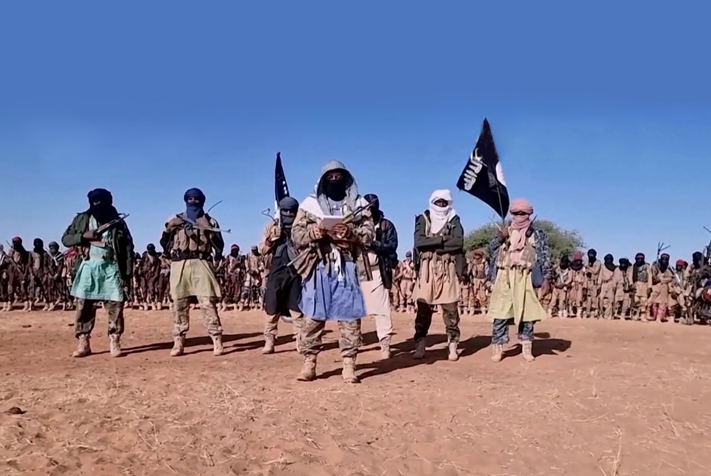
The Islamic State Sahel Province (ISSP) maintains its substantial influence across northeastern Mali. Despite significant attention on the JNIM, this formidable group continues its operations in several strategic locations throughout the country.
The regions of Gao, specifically the Ansongo district, and Ménaka remain under the persistent sway of the Islamic State Sahel Province (ISSP), formerly known as EIGS. This critical area, encompassing the key localities dubbed the “3 T’s” – Talataye, Tin-Hama, and Tessit – alongside Labbezanga, serves as the operational epicenter for the group. Here, the ISSP exerts robust territorial control and imposes continuous pressure on local communities.
Command Structure
Abou Al-Bara leads the group, having taken over after Adnan Abu Al-Walid Sahraoui was eliminated in 2021, though the precise chain of command remains somewhat veiled. Since 2020, the ISSP has strategically adapted its operational methods. They have shifted from a strategy marked by public executions and widespread terror to a more focused approach emphasizing territorial control and localized governance. This change has seen them limit spectacular attacks that often draw extensive media scrutiny, instead pursuing a strategy of community engagement to gain acceptance among the local populace.
Nevertheless, military operations targeting this group persist without pause. Malian Armed Forces (FAMa) recently neutralized a key operational leader of the ISSP during an aerial strike on the night of May 14-15, 2026, in Bara, Ansongo district. This operation also eliminated several subordinate combatants. Such actions underscore the constant pressure exerted by Malian forces on Islamic State strongholds in the Sahel, while simultaneously highlighting the group’s capacity to regroup in border areas and sustain its logistical networks.
Ongoing Operations
The ISSP consistently targets strategic locations along the Mali – Niger corridor, including Talataye, Tin-Hama, Tessit, Labbezanga, and Ménaka. They control the movement of people and goods, thereby maintaining significant influence over local armed factions. These actions are designed to assert the group’s presence and solidify its dominance over these vital regional pathways.
Furthermore, the ongoing rivalry with the JNIM remains a critical element in the Sahel’s security landscape. Contrary to some perceptions, the heightened visibility of the JNIM following coordinated attacks on April 25, 2026, near Bamako and other national localities, does not indicate the disappearance of the ISSP. Both groups employ distinct strategies. The JNIM typically concentrates its efforts on high-profile, media-attracting attacks, whereas the ISSP favors discreet territorial control, exerting pressure on local communities, and securing strategic transit routes.
Initially, defections from the JNIM contributed to a “Sahelian exception” where direct confrontations were limited, but this relative truce began to erode after 2020. Despite this, recent security developments in Mali, particularly offensives by the Malian army, have temporarily redirected both groups’ focus toward their shared adversary, without any formal peace agreement being reached.
Persistent Threats
The ACLED report of May 15, 2026, confirms that 86% of Islamic State activity globally was concentrated in Africa during the first quarter of 2026, marked by an increase in armed drone usage, motorized assaults, and economic pressure on both urban and rural routes. The ISSP has targeted civilian and military infrastructure along the Ménaka – Ansongo – Tessit axis and in Labbezanga, exploiting local vulnerabilities to impose its de facto governance. A prime example is the attack on civilian convoys escorted at Kobé, 35km from Gao, on February 7, 2026. While international security cooperation has led to the neutralization of key figures, such as Abu-Bilal Al-Minuki on May 16, 2026, during a Nigeria – United States operation in the Lake Chad basin, the threat posed by the ISSP remains substantial in northeastern Mali, particularly in the “3 T” localities and Labbezanga, where territorial control and influence over local armed groups endure.
The ISSP remains a pivotal player in northeastern Mali, strategically leveraging media attention on the JNIM and the Malian Armed Forces to strengthen its own position, control populations, and maintain continuous pressure on Malian forces. Its organized territorial structure and ongoing operations clearly demonstrate that the threat is deeply entrenched. This underscores the critical need to intensify pressure in specific strategic areas, especially along the Niger-Mali border.