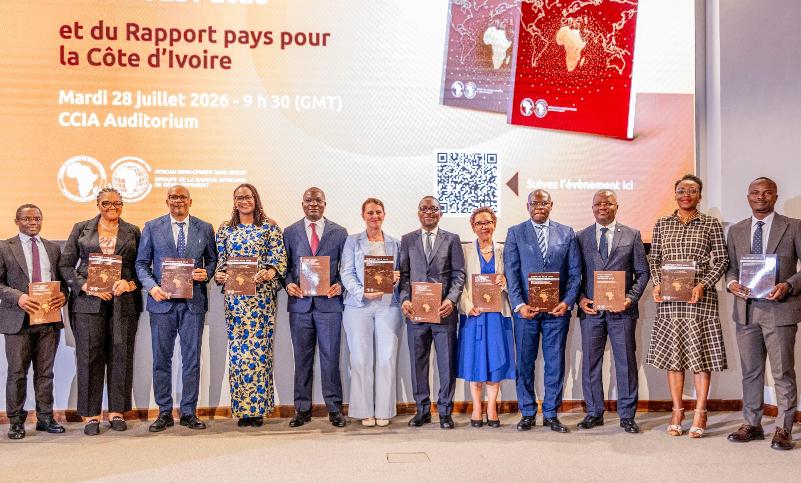
On Tuesday, July 28, in Abidjan, the Director of Cabinet for the Minister of Planning and Development, Professor Loesse Jacques ESSO, represented Dr. Souleymane DIARRASSOUBA at the launch of the 2026 Côte d’Ivoire Country Report (RP-CI) and the West Africa Economic Outlook (WAEO) by the African Development Bank (AfDB). Under the banner « Mobilizing large-scale resources for Africa’s development in a fragmented global economy », the event brought together AfDB representatives, national and international financial institutions, the private sector, and Ivorian authorities.
The conference theme aligns closely with the priorities set by Côte d’Ivoire. Under the leadership of President Alassane Ouattara, the government has made resource mobilization a cornerstone of the nation’s economic transformation. This vision is embodied in the National Development Plan (NDP) 2026-2030, which aims to accelerate growth by leveraging both public and private financing.
Speaking on behalf of the Minister, Professor ESSO commended the strong partnership between Côte d’Ivoire and the AfDB. He highlighted the reports published by the institution as critical decision-making tools that guide public policy formulation and foster dialogue with development partners.
Addressing the economic landscape, he noted that Africa’s projected growth of 3.9% in 2025 reflects a continent on the rise, with Côte d’Ivoire leading the charge at an estimated 6.5% growth rate—closing in on the benchmarks outlined in the African Union’s Agenda 2063.
ESSO emphasized that financing the NDP 2026-2030, valued at 114.8 trillion West African CFA francs (approximately $209 billion), remains one of the most pressing challenges in transforming Côte d’Ivoire’s economy. The success of the Consultative Group meeting held on July 8-9, 2026, which secured $80 billion (47.8 trillion CFA francs) in commitments, underscores the confidence international partners place in the country’s development strategy and its ability to mobilize significant financing.
Beyond Côte d’Ivoire’s progress, ESSO stressed that the reports’ findings resonate across the continent, where the urgency to mobilize resources remains a shared priority. Achieving structural economic transformation demands increased domestic revenue, greater private capital engagement, stronger financial systems, and deeper regional integration through initiatives such as the Pan-African Payment and Settlement System (PAPSS) and the African Continental Free Trade Area (AfCFTA).
ESSO urged participants to closely examine the reports’ analyses and recommendations, calling on them to contribute their insights to foster collective reflection on the challenges, opportunities, and responsibilities facing public administrations, the private sector, financial institutions, and civil society. He emphasized the need to craft more effective financing strategies for development, both in Côte d’Ivoire and across the region.