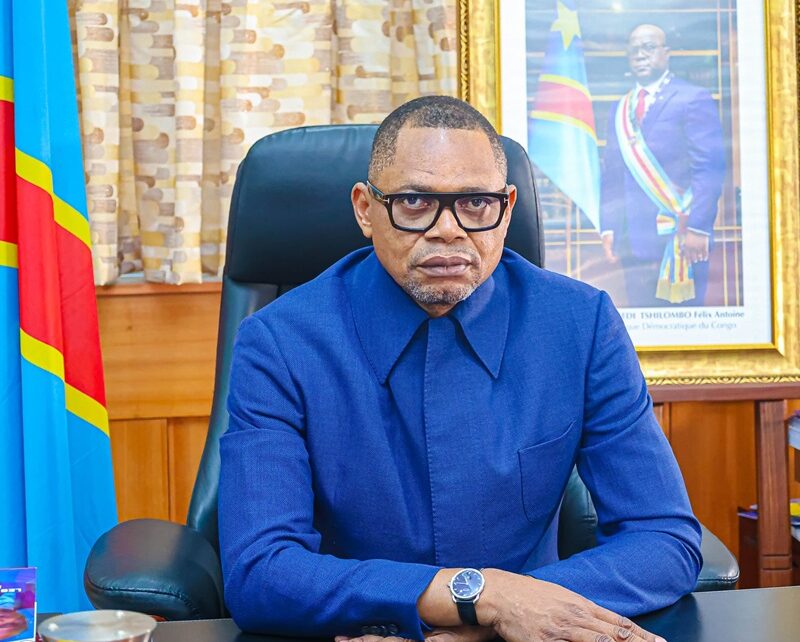
Exactly one year after assuming leadership at the helm of the Democratic Republic of the Congo’s Ministry of Posts, Telecommunications and Digital Technologies, Me José Mpanda Kabangu has delivered transformative results that are redefining the nation’s role in global telecommunications governance.
Upon taking office, he swiftly identified critical challenges within the sector: restoring the DRC’s international standing, enhancing administrative efficiency, and fostering a conducive business climate for telecom operators. His first decisive action was securing the country’s right to speak and vote at the Universal Postal Union (UPU)—a privilege lost over three decades ago due to unpaid dues. Through relentless advocacy with the President and government officials, Mpanda ensured the settlement of these arrears within weeks, restoring the DRC’s voice in global postal governance.
Bringing the African Telecommunications Union back to Kinshasa
One of his most historic achievements came in October 2025: the successful negotiation to relocate the African Telecommunications Union (ATU) headquarters from Nairobi, Kenya, back to Kinshasa—a move endorsed during the 7th Plenipotentiary Conference in Abuja, Nigeria, on July 23, 2026. This decision marks the return of the ATU, the only African Union institution hosted by the DRC, to its statutory seat after 34 years of absence. Mpanda’s leadership in clearing over $1.4 million in arrears and penalties was instrumental in this landmark decision.
The ATU’s new offices, currently located on the 6th floor of the Safi Building along Boulevard du 30 Juin, are already operational. With the ATU’s return, the DRC automatically secures a seat on its governing board, strengthening its influence in continental digital policy.
Ambition: Securing a seat on the ITU’s governing council
Building on these successes, Mpanda is now eyeing a seat on the International Telecommunication Union (ITU) Council for the 2027–2030 term. He will formally submit the DRC’s candidacy in November 2026 during the ITU Plenipotentiary Conference in Doha, Qatar. The ITU, a UN specialized agency, sets global standards in telecommunications, digital infrastructure, and ICT policies—making its governing council a pivotal platform for shaping the future of connectivity.
Mpanda’s push aligns with President Félix-Antoine Tshisekedi’s vision of a digitally connected DRC by 2030 and positioning the country as a technological hub in Central Africa. Securing this seat would unlock strategic leverage to mobilize approximately $1.5 billion in funding for telecom infrastructure projects during 2026–2030, including national fiber-optic backbones, rural connectivity expansion, data centers, and satellite infrastructure.
Modernizing the postal and telecom administration
On the domestic front, Mpanda has overhauled the Ministry of Posts, Telecommunications and Digital Technologies (PTNTIC). Within 144 days of his tenure, he equipped the General Secretariat with 10 brand-new vehicles, including three large buses and jeeps for senior officials—a first in the ministry’s 30-plus-year history. Staff also received promotions based on merit and seniority, alongside a revised salary grid and the rehabilitation of the ministry’s headquarters.
To stabilize the telecom sector, Mpanda addressed long-standing legal and judicial uncertainties by converting the licenses of the four major operators—Airtel, Vodacom, Orange, and Africell—into definitive titles. He also halved, retroactively, the 10-year moratorium on Congolese ownership stakes in telecom firms, enforcing the statutory 25% Congolese participation and 5% employee shareholding as outlined in the Telecommunications Law.
Connecting the DRC: A roadmap to 2030
Mpanda’s strategic vision is anchored in the outcomes of the national Post and Telecommunications General States, held in April 2026. Key priorities include:
- Fiber-optic expansion: Laying at least 54,000 kilometers of fiber across the DRC, with an initial 10,000 km funded by the World Bank and Agence française de développement through the National Digital Transformation Program (PTN).
- Rural connectivity: Constructing at least 30,000 towers or antennas to connect all 145 territories, reduce the digital divide, and boost fiscal revenue. The Universal Service Development Fund (FDSU) is leading this effort, with pilot phases already underway in Nkamba, Kongo Central.
- Satellite sovereignty: Negotiations are underway with China Unicom to acquire a sovereign satellite, a critical step to ensure national digital autonomy.
In a landmark move on August 8, 2026, the FDSU signed agreements with the four mobile operators, each receiving grants to build a minimum of 10 antennas in peri-urban and rural areas. This initiative targets underserved communities, ensuring no region is left disconnected.
Under President Tshisekedi’s leadership, Me José Mpanda is turning the DRC into a model of digital transformation. From restoring international credibility to laying the groundwork for universal connectivity, his first year in office has set the stage for a technologically sovereign and globally competitive Democratic Republic of the Congo by 2030.