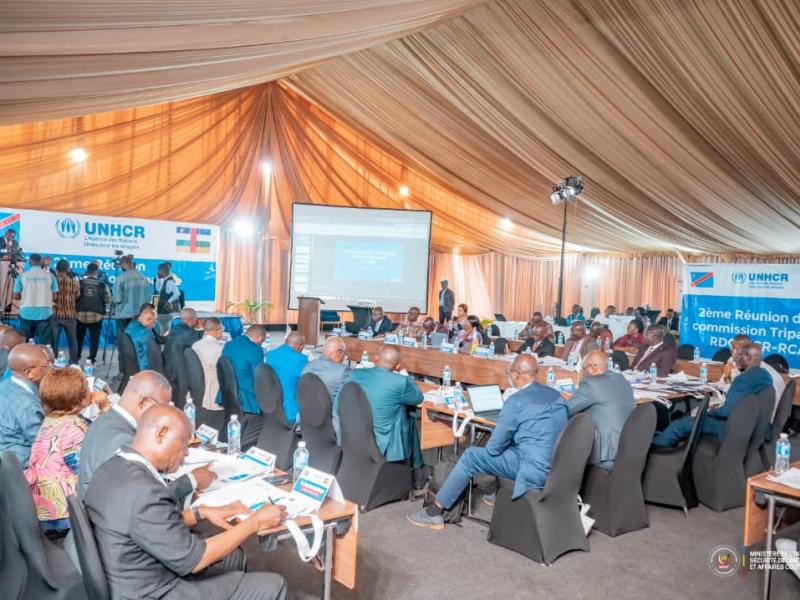
Kinshasa is currently the venue for the second tripartite meeting between the Democratic Republic of Congo (DRC), the United Nations High Commissioner for Refugees (UNHCR), and the Central African Republic (CAR). Running from Tuesday, June 9, to Thursday, June 12, this crucial gathering focuses on the voluntary repatriation of Central African refugees residing in the DRC. The discussions bring together a diverse group of experts from Congo, the Central African Republic, and the UNHCR.
According to details shared by the UNHCR’s country representative in the Democratic Republic of Congo, 22,604 biometrically registered Central African refugees remain in the DRC. These individuals are primarily sheltered in the Nord-Ubangi, Sud-Ubangi, and Bas-Uélé provinces. Additionally, the region has seen an influx of 65,000 new Central African asylum seekers who arrived in May 2025 in Zapaï, located within the Ango territory of Bas-Uélé.
The permanent secretary of the National Commission for Refugees (CNR) and head of the DRC’s delegation, Éric Mukandila, highlighted the resumption of voluntary repatriation efforts for Central African refugees. This process restarted following the pacification of formerly conflict-affected areas and was formalized by an agreement signed in July 2019 between the DRC, CAR, and UNHCR. He further explained that this initial accord received additional impetus from the 2022 Yaoundé Declaration, which advocates for a unified regional strategy to devise and implement sustainable solutions for individuals forcibly displaced by the Central African crisis. Thanks to these collaborative efforts, approximately 40,000 Central Africans have successfully returned to the CAR since 2019, with their safety and dignity ensured through the joint work of UNHCR and both governments.
Acknowledging the frustration and discouragement among those still awaiting return, Mukandila emphasized the urgent need for a thorough review. Such an examination is essential to identify effective pathways that guarantee a secure and dignified return to their homeland for all remaining candidates.
Mesmin Guenguebe Mbari, the Central African Republic’s delegation head and advisor for territorial planning, commended the successful repatriation of over 43% of Central Africans from the DRC under the existing agreement. He outlined his country’s projections for the current year, anticipating the potential return of nearly 60,000 refugees from various host nations. This ambitious plan is supported by an innovative strategy to establish development hubs in the designated return areas within the Central African territory. Mbari urged for open and practical discussions, advocating for a strategic pause to scientifically assess the real-life experiences of those who have already returned, evaluate their integration into communities, and measure the tangible impact of the aid they received.