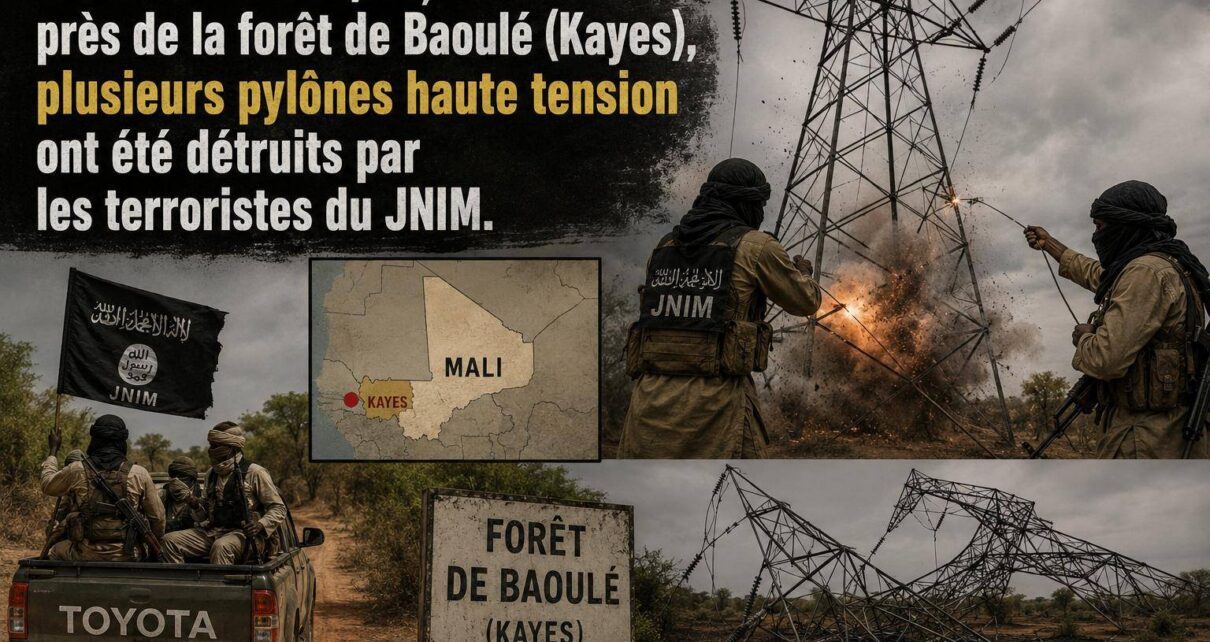
The weekend of May 10-11, 2026, marked a turning point for Mali’s energy sector following a brazen assault by the Group for the Support of Islam and Muslims (JNIM) near the Baoulé forest in the Kayes region. Terrorists targeted critical high-voltage transmission towers, plunging Bamako into a prolonged blackout amid soaring temperatures and water shortages. The attack unfolded despite the presence of Africa Corps forces, raising serious questions about counterterrorism effectiveness in the region.
JNIM’s strategic strike: disrupting Mali’s fragile stability
The assault was not a random act of violence but a calculated disruption of Mali’s economic lifelines. Over the past months, JNIM has systematically targeted supply routes, burning commercial trucks and civilian buses to choke off Bamako’s access to essential goods. Now, by attacking power infrastructure, the group has escalated its campaign to directly impact daily life and undermine the transitional government’s legitimacy.
The precision of the operation is striking. Pylons near the densely forested Baoulé area were demolished with technical expertise, cutting off electricity to entire districts of the capital. This has compounded an already dire energy crisis, leaving millions without cooling systems in scorching heat—temperatures have surpassed 45°C—and without reliable access to clean water. The collapse of the national grid has forced hospitals into emergency mode, where life-saving equipment and maternity services operate on life support.
Africa Corps’ limitations exposed in the face of hybrid warfare
The timing of the attack could not have been more embarrassing for Bamako’s security partners. Despite claims of securing key zones, the incident revealed glaring vulnerabilities in protecting critical infrastructure. While paramilitary units from Russia’s Africa Corps excel in urban demonstrations, their ability to thwart hybrid threats—such as sabotage of power lines—remains conspicuously inadequate. Drone surveillance and mixed patrols failed to detect or prevent the assault, raising doubts about the true value of the military alliance for ordinary Malians.
For the people of Bamako, this is the latest in a series of failures. Government promises of fuel convoys escorted by the Malian Armed Forces and Africa Corps ring hollow when backup generators are in critically short supply. The humanitarian toll is mounting: hospitals struggle to maintain emergency care, and vulnerable populations face severe health risks in the sweltering darkness.
Manantali and Sélingué: A looming regional catastrophe
The threat is not confined to Mali. Intelligence reports indicate that JNIM is now eyeing the Manantali and Sélingué hydroelectric dams, whose destruction would have devastating consequences beyond national borders. These facilities are central to energy and water distribution across West Africa, supplying power and irrigation to Senegal, Mauritania, and vast agricultural zones along the river basin.
A successful attack would plunge not only Bamako into darkness for months but also trigger a cascade of crises: energy rationing in neighboring countries, collapse of irrigation systems, and a potential food security emergency affecting millions. The evolution from truck burnings to pylon sabotage—and now the targeting of dams—reveals a deliberate escalation in asymmetric warfare that national and allied forces are struggling to counter.
Government at a crossroads: from rhetoric to action
The transitional administration and its Russian allies now face an existential challenge. Years of security cooperation and costly deployments have done little to protect Mali’s vital infrastructure or restore basic services. The gap between propaganda and reality has never been wider. Citizens are no longer satisfied with sovereignty slogans; they demand tangible improvements: reliable electricity, clean water, and real security.
With the JNIM threat inching closer to the country’s hydroelectric heart, the stakes could not be higher. If the dams fall, the Malian state’s credibility—and the well-being of an entire region—will be at risk. The people of Bamako are waiting. And they are waiting for more than words.