Following years of deep-seated instability and conflict, intensified by a jihadist insurgency and successive coups in 2020 and 2021, Mali has once again descended into a violent armed struggle with potentially far-reaching consequences. On Saturday, April 25, a major offensive was launched by Touareg rebels from the Front de libération de l’Azawad (FLA) in coordination with the Al-Qaeda-linked Groupe de soutien à l’islam et aux musulmans (JNIM).
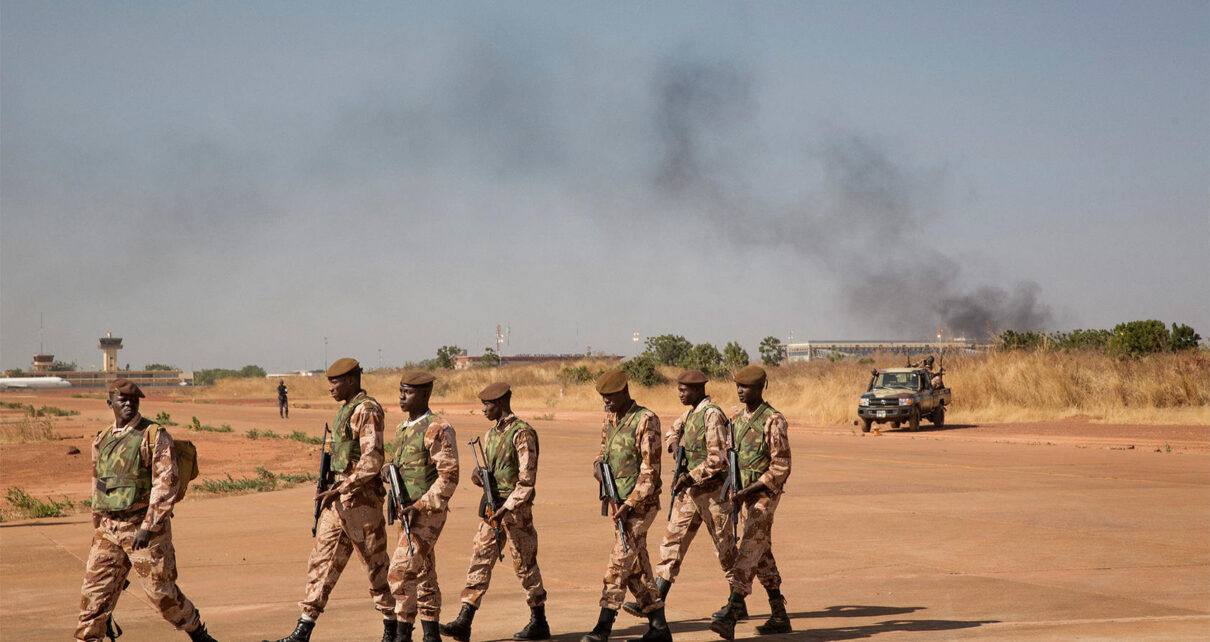
The insurgents executed synchronized strikes across seven key Malian locations: the capital Bamako and its nearby garrison town of Kati; Konna, Mopti, and Sévaré in the central region; and the northern hubs of Gao and Kidal. Kidal, a strategic military stronghold in the northwest, has reportedly fallen entirely under insurgent control. The attackers employed a lethal mix of car bombs, improvised explosive devices (IEDs), kamikaze drones, and direct ground assaults against military installations.
Reports indicate the violence erupted around 5:30 a.m. on Saturday. Both the JNIM and the FLA—the successor to the Coordination des mouvements de l’Azawad (CMA)—claimed responsibility. Targeted sites included the presidential residence, the Ministry of Defence, and Modibo Keita International Airport in Bamako, alongside military bases in Kati, Gao, Kidal, and Sevaré.
Government response and military claims
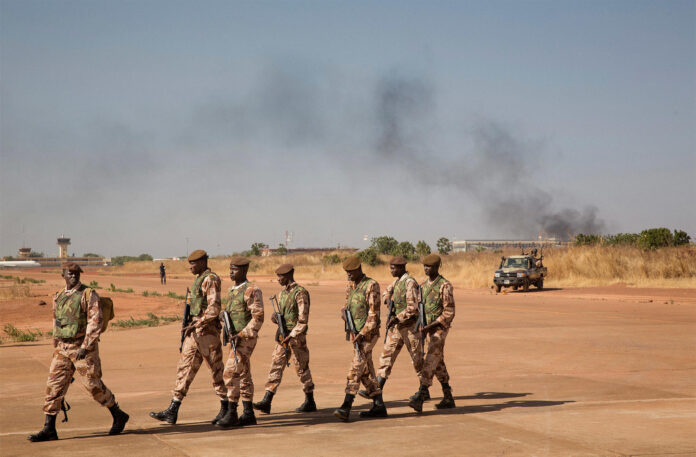
The transitional government characterized the strikes as “complex and coordinated,” reporting 16 casualties among soldiers and civilians while maintaining that the situation remained “under control.” A 72-hour curfew was imposed on Bamako, and the international airport remained closed through Sunday. Oumar Diarra, the Chief of General Staff, alleged that the attacks were part of a “destabilization plan” orchestrated by internal and external forces to create perpetual insecurity.
The Forces armées maliennes (FAMA) claimed to have neutralized over 200 militants during their counter-offensive. Regarding the loss of Kidal, General Diarra described the movement as a “strategic redeployment” toward Anefis, framing it as a tactical maneuver to improve operational flexibility and civilian protection.
Russian involvement and the Africa Corps
The Africa Corps, a paramilitary unit under the Russian Ministry of Defence that replaced Wagner group operations, confirmed its withdrawal from Kidal alongside Malian troops. They stated this was a joint decision with Bamako authorities, noting that wounded personnel and heavy equipment were successfully evacuated. Conversely, FLA rebels claimed they had reached an agreement with Russian forces to allow their safe exit from the combat zone.
The Africa Corps also alleged they thwarted a coup attempt supported by Ukrainian and European mercenaries and Western intelligence. They claimed to have neutralized 1,000 jihadists and destroyed 100 vehicles, preventing what they described as a “Syrian scenario” in Mali. Despite these claims, the group admitted to facing massive attacks in Kidal involving armored vehicles and drones, necessitating a regrouping to more favorable positions.
High-level casualties in the junta
The conflict has dealt a severe blow to the junta’s leadership. Minister of Defence Sadio Camara was killed following a suicide attack on his home in Kati. The assault also claimed the lives of one of his wives, two children, and several civilians. Camara, widely seen as the regime’s second-in-command and a key architect of the alliance with Moscow, died from injuries sustained during a shootout with the attackers.
Furthermore, Modibo Koné, head of the State Security Agency, was wounded by gunfire. The leader of the junta, Assimi Goïta, was reportedly evacuated from Kati to a secure location. These losses could significantly alter the internal power dynamics of the Malian transition.
A shifting alliance and the Ukrainian factor
This offensive highlights a tactical partnership between Touareg separatists and jihadist factions. The Front de libération de l’Azawad (FLA), established in late 2024 under Alghabass Ag Intalla, has officially abandoned the 2015 Algiers peace accords. While the Touaregs seek autonomy for Azawad and the JNIM aims for an Islamic state, they have united against the common threat of the Bamako junta and Russian mercenaries.
This collaboration became evident during the battle of Tinzaouaten in July 2024, where Russian forces suffered a major defeat. Analysts suggest that Ukrainian military intelligence (GUR) may be providing tactical support, including drone technology and intelligence, to the rebels. Ukraine has been accused of opening a “second front” against Russian interests in Africa, leading Mali to sever diplomatic ties with Kyiv, though Ukraine denies providing direct support to groups designated as terrorists.