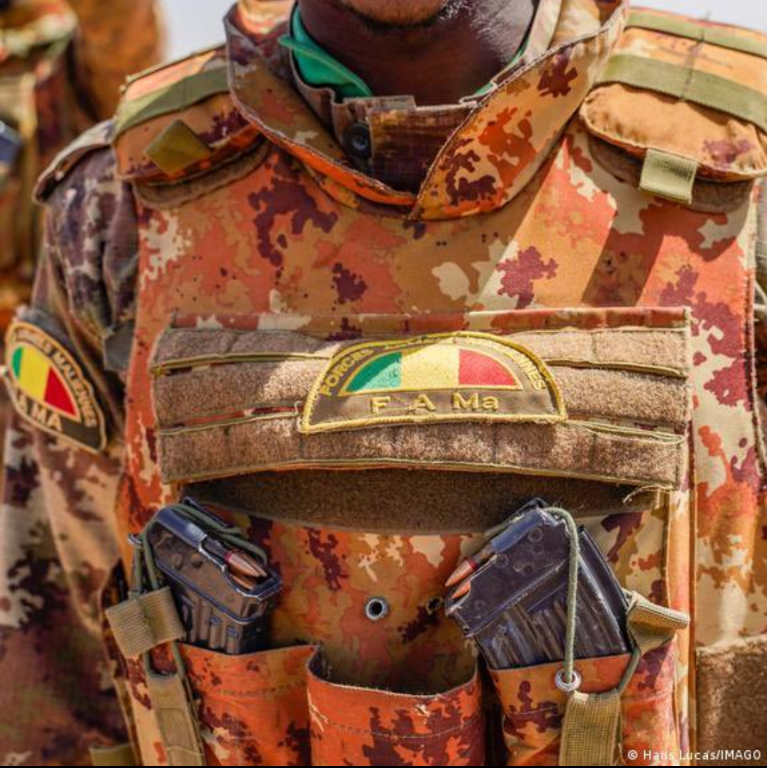
The Mopti region in Mali witnessed another surge in violence on Sunday, July 19, as the Group for the Support of Islam and Muslims (JNIM) launched a series of coordinated attacks against military and allied forces. The militant faction, linked to Al-Qaeda, claimed responsibility for four simultaneous assaults targeting the Malian Armed Forces (FAMa), Russian mercenaries from Africa Corps, and local militias. This bold maneuver underscored the group’s operational reach and the persistent challenges facing Mali’s security apparatus.
Coordinated assaults expose vulnerabilities in central Mali
The attacks on July 19 highlighted the worsening security crisis in central Mali, where armed groups continue to exploit gaps in state control. Through its propaganda channels, the JNIM detailed four separate operations, showcasing its ability to disrupt military movements. In the Douentza area, the group detonated three improvised explosive devices (IEDs), targeting a logistics convoy, a military truck, and a motorcycle detachment. These strikes were directed at both FAMa soldiers and Russian mercenaries from Africa Corps (formerly Wagner Group). Meanwhile, near Kansila, the JNIM launched a direct assault on a local self-defense militia known as the Dozo hunters, a group often used by the Malian government to bolster security. The militants reported three Dozo fighters killed in the clash.
Five years after the coup: promises vs. grim reality
Since Colonel Assimi Goïta seized power in a coup five years ago, the transitional government has vowed to reclaim full control of Mali’s territory and restore stability. However, independent conflict analysis reveals a stark contrast to these claims. Research data indicates a sharp rise in fatalities from political violence and terrorist attacks, with some regions seeing a two- to threefold increase in casualties compared to pre-coup levels. The conflict has also become more complex, with the emergence of new armed actors like Africa Corps and the escalation of intercommunal tensions. Daily ambushes and IED attacks, such as those on July 19, have become routine, crippling key transportation routes across the country.
State control crumbles as humanitarian crisis deepens
Despite official narratives from Bamako about the Malian army’s growing capabilities, the ground reality tells a different story. While the military has achieved symbolic victories, such as the recapture of Kidal in late 2023, it has struggled to maintain control over reclaimed areas. Vast swathes of the Mali’s Center and North now operate as gray zones, where state institutions are virtually absent. The humanitarian toll is staggering: over 400,000 internally displaced persons now live in precarious conditions, fleeing both jihadist violence and the collateral damage of military operations.
The blockade of entire communities by groups like the JNIM and the Islamic State in the Greater Sahara (EIGS) has plunged regions into severe food shortages. With roads unsafe and aid convoys frequently targeted, the delivery of humanitarian assistance has ground to a halt, turning a security crisis into a silent humanitarian catastrophe.
Russia’s Africa Corps: a costly and ineffective partnership
In its quest to fill the void left by departing French forces and the UN’s MINUSMA mission, the Malian government turned to Moscow for support. Initially under the banner of the Wagner Group and later as part of the state-backed Africa Corps, hundreds of Russian paramilitaries were deployed. Yet, this partnership has yielded little in terms of military success and has come at a high political cost. Reports of human rights abuses, including civilian casualties from operations like the Moura massacre, have fueled local resentment. Such actions have inadvertently driven communities toward insurgent groups, which position themselves as protectors. Military inefficacy is another glaring issue: Africa Corps has suffered consistent losses and lacks the manpower to conduct effective counterinsurgency operations across Mali’s vast terrain.
Aerial power struggles: the limits of Bamako’s air strategy
Facing a shortage of ground troops, the Goïta regime invested heavily in aerial assets, purchasing drones, attack helicopters, and fighter jets—primarily from Russia and Turkey. While these acquisitions initially enabled large-scale strikes, the strategy has hit critical snags. Maintenance has become a major hurdle: several aircraft, including L-39 Albatros fighter jets and Mi-24 helicopters, have been lost due to technical failures or enemy fire. The complexity of sourcing Russian spare parts has slowed repairs to a crawl. Meanwhile, jihadist groups have adapted, shifting to smaller, more agile units that blend into civilian areas or dense vegetation. This has rendered aerial strikes either ineffective or tragically imprecise, often resulting in civilian casualties.
Military-first approach: a dead end for Mali
The coordinated assaults in Mopti on July 19 are not isolated incidents but symptoms of a systemic failure. The Malian government’s all-military strategy has reached a deadlock. By severing dialogue channels, alienating regional and international partners, and relying on Russian mercenaries whose priorities lie more in resource extraction than stabilization, Bamako has cornered itself. Without a comprehensive political solution that includes governance reforms, the restoration of public services, and robust civilian protection, Mali risks further territorial disintegration. The expanding reach of Sahelian jihadism threatens to engulf the country in an unending cycle of violence and instability.