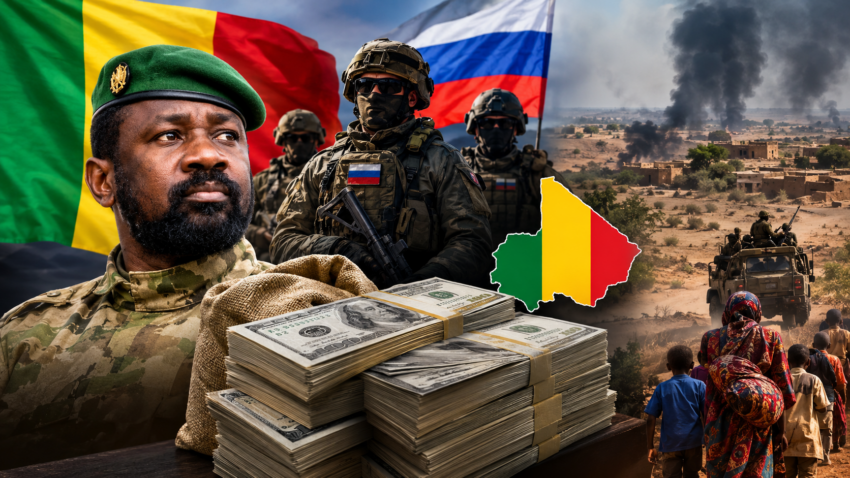
Nearly a billion dollars that is the staggering financial outlay Bamako has committed to securing support from Russian paramilitary forces, first through Wagner Group and later via the newly formed Africa Corps. With per-soldier costs estimated at approximately $10,000 per month, this partnership has placed immense fiscal pressure on Malian public finances. The central question now facing the transitional authorities is deceptively simple yet profoundly consequential: after pouring such a vast sum into this alliance, what verifiable improvements in national security can they credibly claim?
From Western partnership to Russian dependence: promises versus performance
By severing ties with traditional Western allies particularly France the Malian government positioned its pivot toward Russia as a sovereign choice aimed at reclaiming control of national security. The narrative was compelling: restoring state authority, revitalizing the Malian Armed Forces, and regaining territorial integrity through a partnership allegedly more respectful of national sovereignty. Yet strategic decisions must ultimately be measured by their tangible outcomes, not merely the rhetoric surrounding them.
For citizens across Mali, the true metric of success lies in visible security gains: intact roads, functioning public services in previously conflict-affected zones, reduced armed attacks, and restored freedom of movement. It is on this foundation of lived experience not political declarations that the Russian partnership must be judged. To date, however, persistent insecurity in key regions has cast serious doubt on whether the financial investment has translated into meaningful protection for the population.
The missed opportunity in economic and social reinvestment
The billion-dollar expenditure on foreign paramilitary forces represents billions of dollars that could have been directed toward critical civilian infrastructure, healthcare, education, or economic development in the country’s most vulnerable regions. While no military alliance can guarantee an overnight resolution to an insurgency of this scale, the sheer magnitude of public funds expended demands clear accountability and measurable results.
The crisis in Mali is not merely a military one it is a humanitarian and developmental emergency. When millions flow into external security arrangements without corresponding improvements in public safety or state presence, the strategic logic begins to unravel. The citizens of Mali deserve more than assurances; they deserve evidence that their tax burden is yielding tangible dividends in the form of safer communities and sustainable peace.
Reformulating Russian support: Africa Corps and the same strategic questions
The rebranding of Russian forces from Wagner Group to Africa Corps signals a structural attempt at legitimacy, yet it does nothing to address the fundamental concerns surrounding operational effectiveness, coordination with Malian troops, and sustainable security outcomes. Foreign fighters can provide tactical support, but they cannot serve as a permanent substitute for a professional, well-equipped national army capable of holding territory and protecting civilians.
Mali’s stated goal of achieving strategic autonomy is commendable, but autonomy cannot be outsourced. If the country remains dependent on costly external forces to maintain basic security, the very sovereignty it claims to defend becomes contingent on the continued involvement and financial terms of foreign partners. The Malian authorities must be prepared to demonstrate that their alliance with Africa Corps delivers better intelligence, stronger operational results, and a path toward long-term stability.
The political cost of unmet expectations
The decision to abandon Western partnerships and embrace Russian support was not merely a military calculation it was a political watershed. Central to this shift was the promise of greater independence, reduced foreign influence, and renewed national authority. But sovereignty demands more than rebranding; it requires transparency, accountability, and measurable performance.
The Malian public has a right to know: How much of the budget is being spent on this security arrangement? What specific operations has Africa Corps undertaken? What concrete improvements have occurred in the most vulnerable regions? And above all how are civilian lives being protected today compared to before the alliance? These are not questions of foreign policy preference but of democratic governance and public trust. Governments make strategic choices, but they cannot shield those choices from scrutiny when national security and public funds are at stake.
When rhetoric meets reality: who really benefits from the billion-dollar gamble?
The daily reality for Malians should be the ultimate measure of success. Families in remote villages, traders transporting goods across dangerous routes, farmers attempting to access their land, and displaced populations waiting to return home these are the voices that define the real cost of insecurity. Their experiences, not political speeches, reveal whether the billion-dollar investment has translated into safety and stability.
If communities continue to face violence, if roads remain unsafe, and if state institutions struggle to function in contested areas, then the partnership with Africa Corps must be reevaluated not on the basis of loyalty or geopolitical alignment, but on its demonstrated capacity to deliver security and restore normalcy.
A call for verifiable accountability
To fully assess the impact of this alliance, Malians and international observers alike require transparent data: verified expenditure reports, documented troop deployments, operational logs, and independent assessments of security trends before and after the arrival of Russian forces. A figure of $1 billion may be striking, but without context expenditure timelines, mission scopes, and outcome evaluations it remains an abstract number disconnected from the lives it is meant to protect.
The time has come for Bamako to move beyond narrative and produce tangible evidence. The question is not whether Mali has the right to choose its partners, but whether it can justify the cost of those choices in terms that matter most: the safety, dignity, and future of its people.
The unspoken question
The most pressing issue is not about allegiance it is about results. A billion dollars spent on military support from Russia may represent a strategic pivot, but it cannot, on its own, constitute a victory. Real sovereignty is not declared; it is demonstrated through the resilience of the state, the protection of its people, and the restoration of security where it has long been absent. Until Mali can present verifiable progress on these fronts, the true cost of this partnership will remain unpaid and the promises unfulfilled.
By Martin Ngu — Journalist