From Military Support to Economic Domination: The Hidden Costs of Russian Partnerships
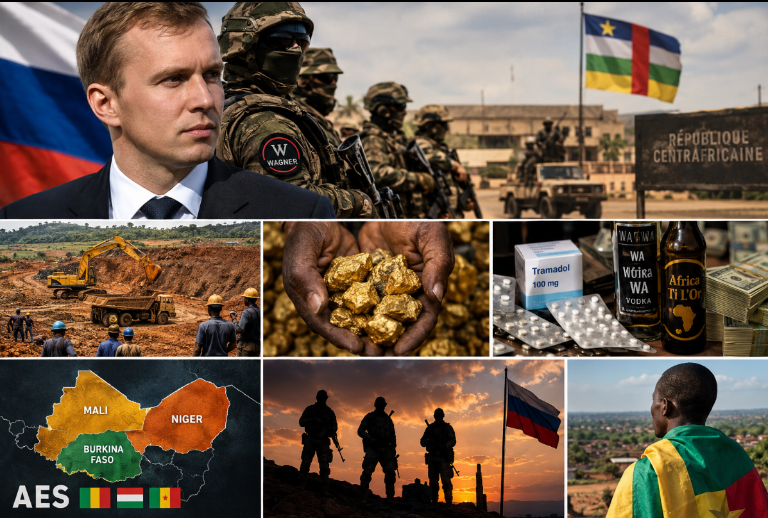
The Central African Republic has become an unexpected testing ground for a high-stakes security trade: protection in exchange for gold. Reports suggest that Pavel Prigojine, son of the late Wagner Group founder, has expanded an economic empire worth over $400 million annually. This model—where military protection and mining concessions intertwine—now raises critical questions about the future of Sahel states turning to Moscow for security.
The situation in Bangui offers a stark warning. Russian security forces, operating under murky economic arrangements, have secured their presence by guaranteeing the survival of a fragile government. But the real currency exchanged here isn’t just stability—it’s access to the country’s gold reserves, traded in opaque deals that bypass traditional oversight.
Gold Rush: The Unseen Consequences of Security-for-Wealth Deals
At the heart of this arrangement lies the gold industry. According to financial analyses, operations linked to the Russian network in the Central African Republic produce an estimated $250 million worth of gold annually. Yet the real profits—and the real questions—surrounding these transactions remain obscured.
Who truly benefits from these deals? The lack of transparency in export circuits and commercial agreements casts doubts over how much of this wealth actually reaches local coffers. Instead, evidence points to an intricate web where armed groups, political elites, and commercial entities share the spoils—often at the expense of broader development priorities.
This pattern extends beyond mere economics. Reports indicate that the Russian network has diversified into other lucrative sectors, including alcohol distribution, arms trafficking, and even the unregulated pharmaceutical market. These activities underscore a dangerous precedent: when security partnerships blur into commercial ventures, governance becomes collateral damage.
The Sahel’s Crossroads: Learning from Central Africa Without Repeating Its Mistakes
As Mali, Burkina Faso, and Niger forge closer ties with Russia through the Alliance of Sahel States (AES), the Central African experience looms as a cautionary tale. Each of these nations faces its own security challenges, yet all share a common dilemma: can military cooperation be balanced with economic sovereignty?
The Mali experience already shows the complexities. While Russian assistance has stabilized certain regions, controversies over civilian casualties and unregulated operations persist. Meanwhile, in Niger and Burkina Faso, the expansion of Russian military influence stirs debates about the long-term implications—particularly when access to natural resources is part of the negotiation.
Three core risks emerge for AES countries:
- Strategic Dependence: Reliance on external forces for security can erode local decision-making autonomy, particularly when those forces also control significant economic levers.
- Opaque Economic Agreements: Without transparent contracts, gold and other mineral concessions risk becoming avenues for private enrichment rather than national development.
- Erosion of State Authority: When external actors with commercial interests shape domestic policy, the line between protector and predator blurs, compromising public trust in institutions.
Moscow’s Strategy: Control vs. Chaos in Africa’s Heartland
Following the aborted Wagner mutiny in June 2023 and the subsequent death of its founder, the Kremlin sought to rein in the group’s sprawling operations. Yet in the Central African Republic, the transition hasn’t fully dismantled the pre-existing networks. Pavel Prigojine, now at the helm of some operations, continues to benefit from entrenched local alliances—illustrating how economic footholds can survive even when political sponsors shift.
This evolution reveals a paradox in Russia’s African strategy. On one hand, the Kremlin aims to centralize control over external operations through state-aligned bodies like the Africa Corps. On the other, decentralized commercial interests—some linked to former Wagner elements—operate independently, pursuing profits that may not align with Moscow’s stated geopolitical goals.
For countries in the Sahel, this duality poses a dilemma. Do they negotiate with a state actor that offers structured support but demands long-term influence? Or do they risk engaging with hybrid networks that blend military efficiency with extractive ambitions?
A Blueprint for Sahel Sovereignty: Transparency as the Ultimate Safeguard
The path forward for Sahel states doesn’t require rejecting all foreign partnerships. Instead, it demands rigorous frameworks to prevent security cooperation from morphing into economic subjugation. The Central African case offers three key lessons:
1. Mandate Clear, Publishable Contracts
Every security agreement should specify the exact terms of engagement—including payment structures, operational boundaries, and exit clauses. More importantly, these contracts must be publicly accessible to allow scrutiny by civil society and oversight bodies.
2. Establish Independent Revenue Oversight
Gold and other mineral wealth must be audited by third-party institutions to ensure that profits from concessions contribute to public services rather than private accounts. Revenue transparency laws could prevent the Central African scenario, where enriched elites benefit while communities see little return.
3. Balance Immediate Security Gains with Long-Term Stability
Security partnerships should be evaluated not just by their short-term success in combating insurgents but by their alignment with national development goals. Partnerships that enrich external actors while leaving local governance weakened ultimately undermine the very stability they aim to provide.
In the end, the gold-for-security model isn’t just an African issue—it’s a test of sovereignty. When a nation’s defense and its mineral wealth become the currency of an alliance, the real cost may be measured not in dollars, but in lost autonomy. The Sahel’s choices today will determine whether this becomes a cautionary tale or an avoidable trap.
This analysis does not represent an endorsement of any political or military actor, nor does it dismiss the legitimate security needs of Sahel states. Its purpose is to highlight the structural risks inherent in unchecked security-for-resource exchanges.
Beyond Bangui: A Warning for Sahel Partnerships
The Central African Republic’s experience shows how quickly security cooperation can translate into economic dominance. As Sahel states deepen their ties with Moscow, the question isn’t whether they need support—it’s how they can ensure that this support doesn’t come at the price of their future.