The coordinated assaults by Jama’a Nusrat ul-Islam wa al-Muslimin (JNIM) and the Front de libération de l’Azawad (FLA) on April 25, 2026, represent a significant strategic shift since 2012. By striking simultaneously in Bamako, Kati, Kidal, Gao, and Sévaré, these two groups exposed the limitations of a security framework heavily reliant on foreign support. The reclamation of Kidal specifically undermines the legitimacy narrative of Mali’s ruling junta and highlights the inadequacies of its Russian partnership in confronting jihadist forces. While a direct military takeover of Bamako appears unlikely in the short term, JNIM continues its strategy of attrition. The potential for regional destabilization is mounting, exerting increasing pressure across the entire Sahel and on coastal states within the Gulf of Guinea.
The tightening grip on Bamako
The coordinated offensive by JNIM and FLA on April 25, 2026, marks a significant escalation in Mali’s security challenges. The simultaneous and unexpected attacks targeted key locations including Bamako, Kati, Kidal, Gao, and Sévaré. These incidents reflect a continuous deterioration in security that has been observed since 2020, a trend further exacerbated by the junta’s rise to power in August of that year.
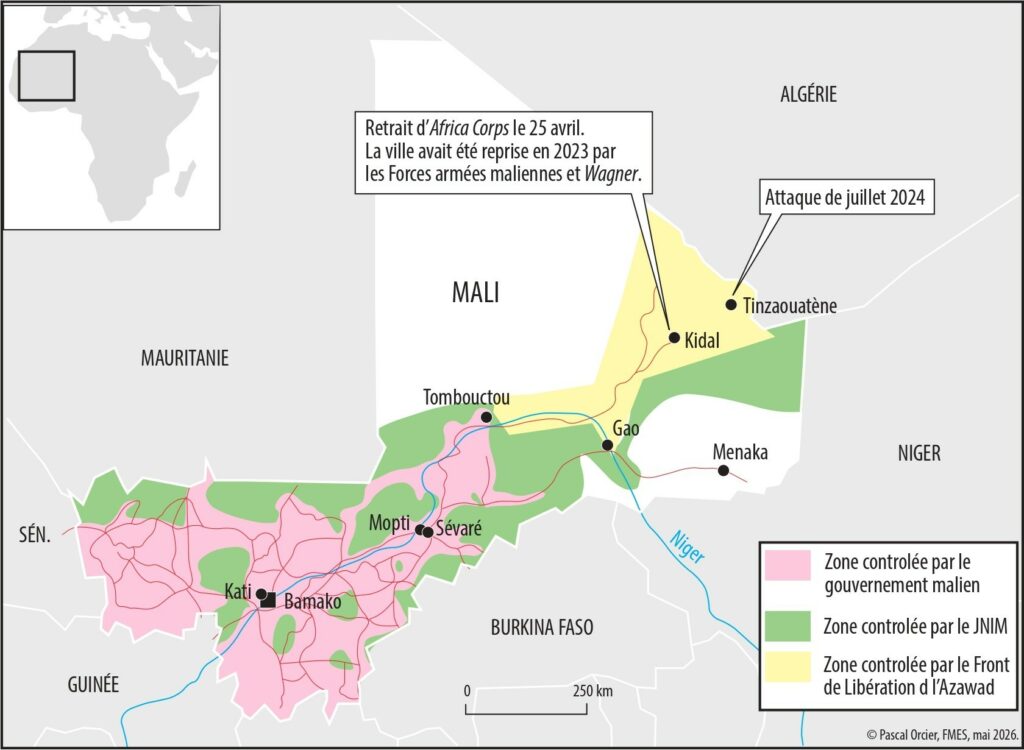
Initially operating primarily in Mali’s northern rural areas, JNIM has steadily enhanced its capability to strike further afield with increased intensity and coordination. In recent years, its operations have expanded westward and southward into regions previously less affected. The group’s influence now extends beyond Malian borders, impacting coastal nations such as Togo, Benin, and Nigeria. Concurrently, there has been a sharp rise in attacks attributed to JNIM, particularly those targeting the Malian Armed Forces (FAMA). In July 2024, FAMA, supported by the Russian Africa Corps, suffered a notable defeat against a coalition comprising JNIM and the Coalition of Democratic Forces for Change (CSD-DPA). Since then, JNIM has launched a series of assaults on military bases located in Tombouctou in the north, Bamako in the south, and Kayes in the west. Meanwhile, FAMA has also bolstered its capabilities, notably through Bayraktar drones supplied by Turkey, although these assets are far from sufficient for comprehensive territorial surveillance.
Since September 2025, JNIM has implemented an economic strangulation strategy against Bamako, a capital city home to approximately 3.2 million residents. This strategy involves disrupting logistical routes and targeting fuel convoys, aiming to progressively erode the government’s legitimacy. By directly impacting the population’s living conditions, particularly through rising fuel prices and associated economic disruptions, JNIM seeks to weaken the junta’s credibility while positioning itself as an alternative. The more the junta’s authority is undermined in rural areas and Bamako, the more JNIM appears as a credible alternative and a viable governance option to the populace. The blockade of the capital effectively serves to showcase the state’s impotence. JNIM thus aims to enhance its image not by seizing the capital through force, but by demonstrating the potential for an alternative form of authority. In areas under its control, the group has developed a parallel administrative structure based on Islamic justice, taxation, and trade regulation, enabling it to present itself as a concrete alternative to an absent state.
A military capture of the capital remains improbable for now, given the group’s estimated strength of 5,000 to 6,000 fighters compared to a city that concentrates the bulk of Mali’s security forces and infrastructure. JNIM also lacks sufficient popular support, especially in urban centers. However, targeted attacks against Modibo Keita International Airport, which hosts the Africa Corps base, could become more frequent. Conversely, rural areas, characterized by minimal state presence, offer a fertile ground for the group’s entrenchment. Furthermore, the blockade of Bamako suggests that a military takeover of the capital is not a short-term objective, with the strategy instead focusing on a primarily psychological war of attrition. The increasing pressure on Bamako, however, allows for a concentration of Malian Armed Forces’ responses there, thereby easing their grip on other parts of the territory.
Kidal’s recapture and narrative erosion
The April 25 attacks underscore this growing operational capacity. In Kati, the heart of Malian military power, Defense Minister Sadio Camara was killed. In Bamako, Modibo Keita Airport sustained damage. In Kidal, JNIM and FLA regained control of the city, which FAMA and Wagner had recaptured in 2023 in what was then hailed as a historic victory. This strategic reversal is unprecedented since 2013, forcing Africa Corps elements to withdraw from both Kidal and Gao. The pressing question now is whether FAMA will be capable of retaking the city in the coming weeks.
Kidal’s recapture by JNIM evokes the dynamics of 2012 when Tuareg rebels and jihadist groups initially collaborated before ideological differences led to their split. Specifically, JNIM advocates for the implementation of Sharia law, whereas Tuareg rebels champion an autonomist agenda focused on Azawad. Kidal subsequently became a symbol of this division, contested by both factions. While these divergences persist today, the identification of common adversaries—the junta and its Russian partner—has fostered an opportunistic tactical convergence. Signs of rapprochement between the groups were already circulating in March 2025. According to jihadist movement expert Wassim Nasr, negotiations had reportedly taken place as early as December 2024 with the aim of combining efforts. The durability of this opportunistic coalition and its ability to maintain control over Kidal remain to be seen.
These attacks occurred despite reports of a truce that was supposedly due to be signed in late March 2026 between JNIM and the Malian government, which would have involved the release of a number of “jihadists” in exchange for lifting the fuel blockade on Bamako. Mali subsequently denied releasing 200 “jihadists.” The veracity of this alleged agreement thus remains questionable. Regardless of its existence, it clearly failed to halt JNIM’s offensive momentum.
On April 28, JNIM declared the commencement of a “total siege” targeting Bamako and issued a demand for Russians to permanently withdraw from the territory. The following day, spokesperson Mohamed Ramadane asserted that the regime would fall and that the group intended to “liberate” Gao, Tombouctou, and Ménaka. Such maximalist rhetoric offers little indication of any immediate willingness to negotiate.
The blow to the junta is both political and military. The killing of the Defense Minister is not insignificant. More critically, Africa Corps’ withdrawal from Kidal undermines the narrative upon which the regime had based its legitimacy since 2021: the promise of restored sovereignty through a Russian partnership presented as structurally superior to the French presence. Wagner, and subsequently Africa Corps, were promoted in the junta’s official discourse as the appropriate response to the country’s insecurity and a guarantor of power. Kidal has fallen once more, and with it, the Russian security narrative begins to fracture.
While Africa Corps certainly faltered against the rebels and jihadists, it nonetheless succeeded in protecting the government and Assimi Goïta personally, thereby fulfilling part of its mandate. This setback weakens their standing without signaling their ultimate demise in Mali or neighboring countries.
External support put to the test
It is important, however, not to overstate JNIM’s immediate objectives. The group may not necessarily benefit from the immediate collapse of the regime. A weakened but still-present junta serves as a useful adversary, which helps to bolster JNIM’s own legitimacy among the populace. Conversely, a political vacuum could facilitate the return of international actors that the group seeks to exclude, and a direct confrontation with Russia could prove particularly costly given Russia’s superior capabilities and potentially larger troop numbers. While the Russians may lack the air superiority that French forces enjoyed during Operation Barkhane, Vladimir Putin could readily dispatch reinforcements to salvage his position if he so chooses.
In any event, a Russian disengagement does not appear to be on the immediate horizon. Moscow swiftly reaffirmed its backing for Bamako, and the Russian ambassador was received by Assimi Goïta in the days following the attacks. On Africa Corps’ Telegram channels, an aggressive communication campaign quickly emerged, attempting to regain control of a narrative that was slipping away by showcasing numerous combat images. Withdrawing from Mali, a showcase for the Russian security model in Africa through Wagner and then Africa Corps, would be an admission of defeat for Russia. The Kremlin will thus strive to preserve its credibility, even if it means increasing its commitment.
It should also be noted that Russia is not the sole external supporter of the junta. Turkey, through the company SADAT, has reportedly been present in Mali since 2024, engaged in a dual mission of protecting the junta and training special forces. This arrangement likely played a role in ensuring the safety of the junta leader during the April 25 attacks. As the situation deteriorates, Ankara may be called upon to play an increasing role in safeguarding the regime. In a communiqué published on May 1, FLA spokesperson Mohamed Ramadane even urged Turkey to “re-evaluate the nature of their engagement alongside the ruling junta in Bamako, in order to play a positive role in Mali.”
A reconfigured Sahel
The Alliance of Sahel States (AES) has maintained a discreet stance. While a communiqué was indeed issued on April 27 to condemn the attacks, neither Niger nor Burkina Faso intervened militarily. Yet, the Liptako-Gourma Charter, which established the alliance in September 2023, includes a mutual assistance clause in the event of an infringement on the sovereignty and integrity of member states. Article 6 explicitly states:
“Any infringement on the sovereignty and territorial integrity of one or more Contracting Parties shall be considered an aggression against the other Parties and shall trigger a duty of assistance and relief from all Parties, individually or collectively, including the use of armed force, to restore and ensure security within the area covered by the Alliance.”
Furthermore, during the meeting of chiefs of staff on April 16 and 17, 2026, the three nations had announced their intention to expand their unified force to 15,000 soldiers, up from its original 5,000. Confronted with the same jihadist threat within their own territories, Niger and Burkina Faso evidently did not deem it expedient to disperse their forces.
Further north, the situation could benefit Algeria. On one hand, the shift in the center of gravity of attacks towards central and southern Mali moves the core threat further away from Algeria’s borders, where it was historically concentrated. On the other hand, Algiers has been pursuing a strategy of re-engagement in the Sahel for several months. Evidence includes President Tiani’s state visit to Niger in February 2026, the trans-Saharan gas pipeline project traversing Niger, and the announcement of a 50 billion CFA francs program to modernize Burkina Faso’s infrastructure. Algiers views its influence in the Sahel as a natural extension of its sphere of influence. Its historical rival, Morocco, is advancing its own initiatives with the Atlantic Initiative, launched in 2023, which aims to offer landlocked Sahelian countries access to the Atlantic Ocean via Mauritania. The destabilization of the Malian junta provides Algiers an opportunity to regain momentum, even if relations between the two capitals remain tense, particularly due to Bamako’s alignment with Moroccan positions regarding Western Sahara.
The current configuration offers Algiers the advantage of a privileged channel for negotiation with the FLA, with whom it has historical ties. Under its auspices, the 2015 Algiers Accord was negotiated, a framework now largely obsolete but retaining symbolic value. While Algiers refuses dialogue with JNIM, its access to the FLA could nonetheless facilitate mediation between the Tuareg rebels and Bamako. It is precisely as a mediator that Algiers could play a structuring role and appears to wish to reposition itself in the Sahel.
These attacks also coincide with Washington’s efforts to re-engage with Bamako. In February 2026, Nick Checker, head of the Bureau of African Affairs at the State Department, visited Mali to “express the United States’ respect for Mali’s sovereignty.” This rapprochement is part of the Trump administration’s new approach towards the three AES juntas to counter Russian influence. These recent attacks further weaken an interlocutor with whom the United States is attempting to re-establish ties.
Towards fragmented regional contagion?
The April 25 attacks signal the beginning of a new phase: more coordinated, geographically widespread, and now collaborative between two actors with distinct agendas. However, the risk of regional contagion does not manifest uniformly and requires distinguishing the specific rationales of each actor.
The FLA, driven by a nationalist agenda centered on Azawad, has neither the inclination nor the interest to operate beyond northern Mali. Its logic is territorial and identity-based, not transnational. It does not pose a destabilizing threat to Burkina Faso, Niger, or the coastal states.
JNIM, conversely, possesses a demonstrated regional projection capability. It operates in Burkina Faso and Niger, and is extending its pressure towards the Gulf of Guinea. A sustained weakening of the Malian Armed Forces, or even more so a collapse of the junta, would offer it an expanded sanctuary from which to intensify these operations. Burkina Faso and Niger, whose political survival is partly linked to Bamako’s, would be the first to be exposed to these developments.
This divergence in agendas raises questions about the durability of the coalition between the two groups. Their rapprochement is founded on a common adversary rather than a shared political vision. The coalition can persist as long as the conflict against the junta remains the primary objective. It will most likely fracture once the question of the aftermath arises, with the control of Kidal serving as a crucial initial test.
Further west, Senegal and Mauritania, largely spared until now, are not immune. They represent the primary access routes for fuel and goods to landlocked Mali, axes that JNIM is already actively targeting in the Kayes region. JNIM does not constitute an immediate existential threat to these countries, but the trajectory is concerning. Several attacks could occur at the borders, further exposing these economies to Mali’s security shifts.
In the Gulf of Guinea, the threat to Benin and Togo, already experiencing incursions, follows a different logic. These nations are not directly imperiled by the Malian situation itself, but by its potential downstream effects. It is the instability of Burkina Faso, a bordering country, that represents the primary vector of contagion towards the coastal states. A further deterioration in Burkina Faso, which a collapse in Bamako would make more probable, would be the most immediate and threatening scenario for them.
However, the threat is not exclusively external. An internal coup in Mali cannot be ruled out. The junta has simultaneously intensified its domestic repression, risking accelerating its own fragility. As Wassim Nasr highlights, this radicalization of the regime could reinforce the belief among opponents that an internal overthrow is the only way to dislodge the junta. Such a scenario would offer JNIM an additional window of opportunity to consolidate its gains. Ultimately, these attacks reveal the accumulated fragilities of a regional security system reliant on external partners with contested results, and a Malian state whose legitimacy erodes as its capacity to protect its populations diminishes.