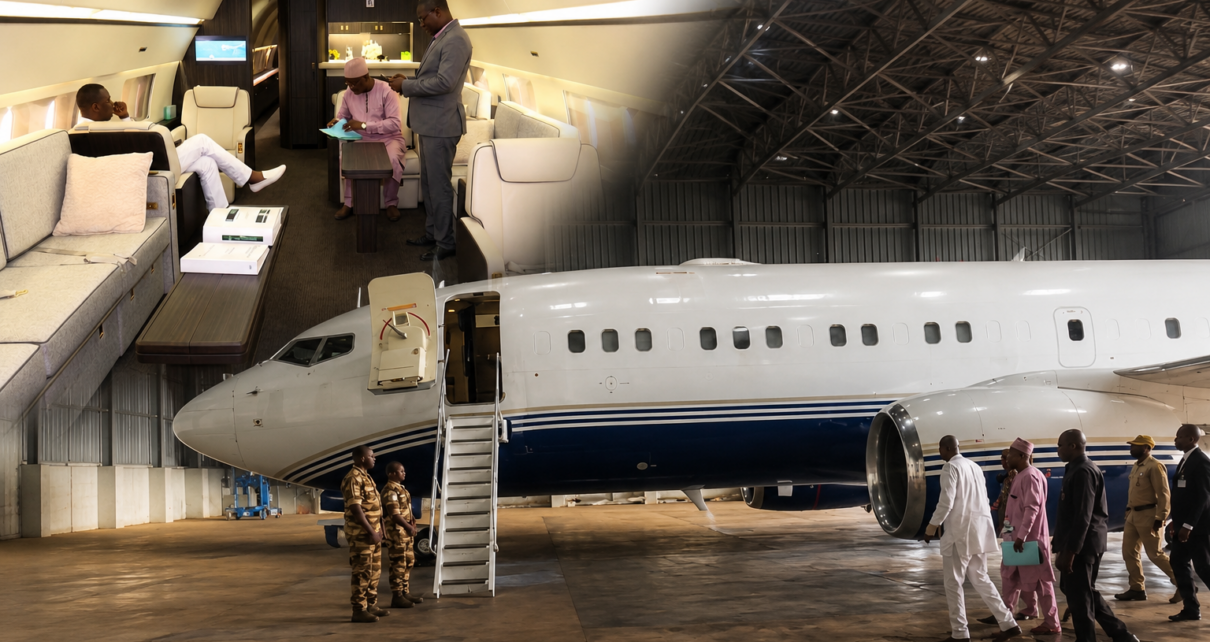
The unveiling of Mali’s new presidential Boeing 737 on national television has sparked significant debate, drawing attention to the stark contrast between government priorities and the nation’s pressing challenges. The aircraft, acquired to serve President Assimi Goïta and senior officials, was presented as a financially sound decision, with its net cost reduced to approximately 6 billion West African CFA francs after accounting for insurance payouts and parts resale from the previous plane.
Timing and perception
The timing of the announcement has intensified scrutiny. While authorities repeatedly urge national sacrifice and resilience, the introduction of a state-of-the-art presidential jet has fueled perceptions of a leadership more focused on projecting prestige than addressing immediate public needs.
Across multiple regions, insecurity remains a daily reality. Military outposts continue to face attacks, road ambushes persist, and civilian violence shows no signs of abating. Many areas remain inaccessible, and the state struggles to re-establish enduring control over parts of the country.
Unresolved security challenges
Three years into the Transition’s stated priority of territorial recovery, substantial obstacles persist. In northern Mali, coalitions such as the Permanent Strategic Framework—including the Azawad Liberation Front—maintain significant disruptive capabilities, contesting control over key areas.
Elsewhere, the Group for the Support of Islam and Muslims (JNIM) continues to expand its influence through coordinated attacks on military installations, state infrastructure, and representatives. Dangerous roadways disrupt commerce, transportation, and economic activity, further straining an already fragile environment.
This reality sharply contrasts with the image of strength the government seeks to project.
Budgetary priorities under scrutiny
Despite official claims that the aircraft’s actual cost is far below the initial price tag, analysts argue that billions of francs could have been allocated to more critical needs:
- Enhancing operational readiness of Malian armed forces
- Procuring armored vehicles, communication systems, and protective equipment
- Improving intelligence, surveillance, and aerial monitoring capabilities
- Supporting injured soldiers and families of fallen military personnel
- Assisting internally displaced persons and reconstructing damaged infrastructure
Beyond financial considerations, the decision has raised broader questions about the government’s hierarchy of needs.
Eroding the image of austerity
Since assuming power, the Transition has built legitimacy on promises of austerity, national integrity, and citizen-centered governance. The acquisition of a high-capacity presidential jet, however, undermines this narrative for many observers.
The move is seen as reinforcing perceptions of power personalized over public service, particularly as economic hardships deepen. Rising living costs, strained public finances, unmet social needs, and sluggish economic sectors further magnify the disconnect.
Diplomatic rationale vs. domestic reality
Government officials may argue that a modern presidential jet facilitates diplomatic travel, official missions, and international representation. Yet critics contend that a nation’s credibility rests not on the modernity of its presidential fleet, but on its ability to secure its territory, protect citizens, and restore functional institutions.
For many Malians, sovereignty is measured not by the quality of state aircraft, but by the state’s tangible presence and control throughout the country.
Political symbolism and distrust
The acquisition has become a lightning rod for political criticism. Some interpret it as evidence of a regime prioritizing its own mobility over that of the state. Others suggest that a long-range jet serves as a safeguard for top officials in the event of worsening instability—though such claims remain unproven.
Regardless, the perception reflects a growing climate of skepticism toward government decision-making.
Reassessing governance amid crisis
The arrival of the Boeing 737 transcends a mere procurement decision. It underscores deeper questions about the Transition’s strategic direction.
As security threats persist, attacks continue unabated, and economic burdens weigh heavily on the population, every symbolic expenditure is met with heightened scrutiny. For many Malians, true sovereignty lies not in modernizing a presidential fleet, but in the state’s capacity to protect its people, reclaim authority across the nation, and improve daily living conditions. Until these goals are met, investments in prestige risk widening the gap between leadership priorities and public expectations.