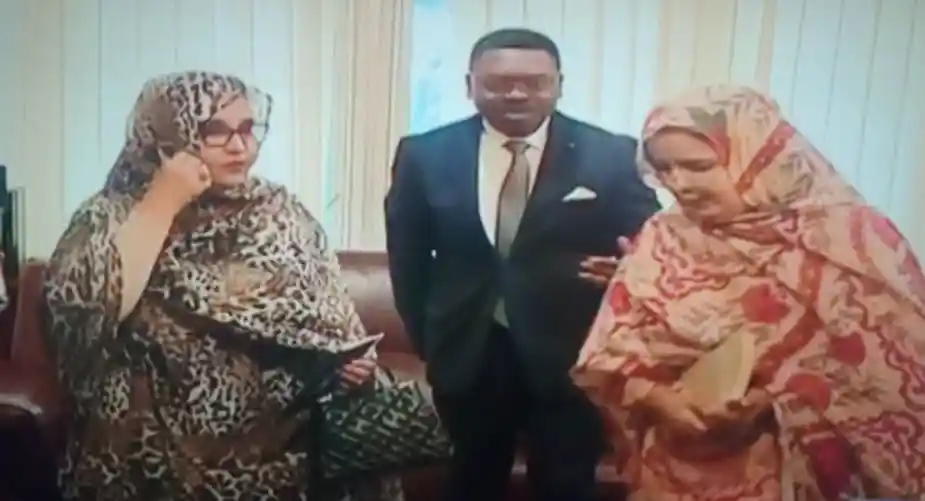
Yaoundé has recently hosted two Mauritanian ministers within a single week. On June 24, President Mohamed Ould Cheikh El Ghazouani sent his second special envoy, Bessouda Mohamed Laghdaf, the Minister of Environment, to the Unity Palace. She carried a sealed letter intended for President Paul Biya. The clear objective behind her visit was to secure Cameroon’s endorsement for Coumba Bâ’s aspiration to become the next Secretary-General of the International Organisation of La Francophonie (OIF).
A confidential message, a swift meeting, and an unambiguous request
In President Paul Biya’s absence from Yaoundé, Ferdinand Ngoh Ngoh, the Minister of State and Secretary-General of the Presidency of the Republic, met with the Mauritanian emissary late in the afternoon. The discussion lasted approximately thirty minutes, during which Bessouda Mohamed Laghdaf made no attempt to conceal the purpose of her mission.
Emerging from the Unity Palace, she informed the press, “We have delivered a message from the Mauritanian Head of State, Mohamed Ould Cheikh El Ghazouani, addressed to his brother, President Paul Biya. This sealed correspondence was handed to the Secretary-General of the Presidency.”
The presence of two ministers within a week, each bearing a confidential letter for President Biya, clearly signals a concerted campaign. Mauritania’s Minister of Foreign Affairs, Mohamed Salem Ould Merzoug, initiated these diplomatic overtures on June 18, carrying the initial communication for the Head of State.
The candidate championed by Nouakchott is Coumba Bâ, an advisor within the Mauritanian presidency. Minister Bessouda highlighted Cameroon’s significant role, describing it as a nation capable of influencing the “balance between various regions,” a principle Mauritania aims to embody through Coumba Bâ’s candidacy.
A historical precedent at the AfDB and an explicit strategy of reciprocity
Mauritania’s current diplomatic push is rooted in a clear historical context. In 2025, Cameroon extended its support to Sidi Ould Tah’s bid for the presidency of the African Development Bank (AfDB), a race Mauritania ultimately won. Now, Nouakchott seeks to replicate this successful strategy, but this time for the OIF leadership.
It is evident that an explicit, almost asserted, logic of reciprocity underpins this initiative. Indeed, the Mauritanian minister spoke to the press about fostering a “win-win partnership.”
Nouakchott is also keenly focused on consultations within the OIF, the Organisation of Islamic Cooperation (OIC), and the Islamic Development Bank (IsDB). This indicates that Cameroon’s support is being sought across multiple significant international platforms simultaneously.
The official response from Yaoundé, including its nature and timing, remains undisclosed.