
The late July 2026 diplomatic flare-up in Dakar has cast a spotlight on Mauritania’s delicate balancing act in the Western Sahara conflict. Between asserting its sovereignty, protecting economic interests, and maintaining cordial ties with Morocco, Nouakchott’s leadership finds itself walking a razor’s edge to avoid provoking its powerful neighbor.
A seemingly routine book launch at the Moroccan embassy in Dakar took an unexpected turn when former Senegalese foreign minister Cheikh Tidiane Gadio made remarks that reignited old tensions. Referring to Morocco’s proximity to Senegal as “just a few kilometers away” in a historical context, Gadio’s words were perceived in Mauritania as an attempt to erase its very existence. The Mauritanian representative, Mohamed Ould Abdellahi Ould Ethmane, swiftly cut short the speech, condemning what he called an attempt at “historical revisionism.”
While Morocco’s ambassador, Hassan Naciri, stepped in to calm the situation, the incident revealed the fragility of Mauritania’s diplomatic tightrope. Nouakchott must publicly endorse events celebrating Morocco’s claims over Western Sahara while maintaining its long-standing official recognition of the Sahrawi Arab Democratic Republic (SADR) since 1984. This dual approach has become a defining feature of the country’s foreign policy.
The controversy sparked by Gadio’s comments has drawn strong reactions from prominent Mauritanian figures. Former Mauritanian foreign minister Isselmou Ahmed Izidbih took to social media to demand Gadio be declared persona non grata in Mauritania, stating that as a Mauritanian citizen, he wished to see the Senegalese politician barred from Mauritanian airspace, territorial waters, and land.
Mauritania’s strategic ambiguity
This diplomatic tango in Dakar encapsulates the contradictions of Mauritania’s foreign policy. On one side, Nouakchott maintains regular dialogue with the Polisario Front and the Algerian leadership—critical for its northern security. Yet, it stops short of granting the SADR full diplomatic recognition by refusing to elevate its representation in Nouakchott to embassy status, a concession made to Rabat to avoid escalating tensions.
The recent incident serves as a reminder that Mauritanian neutrality, while pragmatic, remains highly sensitive. Any perceived threat to its national identity or territorial integrity triggers an immediate response from Nouakchott, which insists on its role as a sovereign and indispensable player in Maghreb stability.
Guerguerat: The economic lifeline
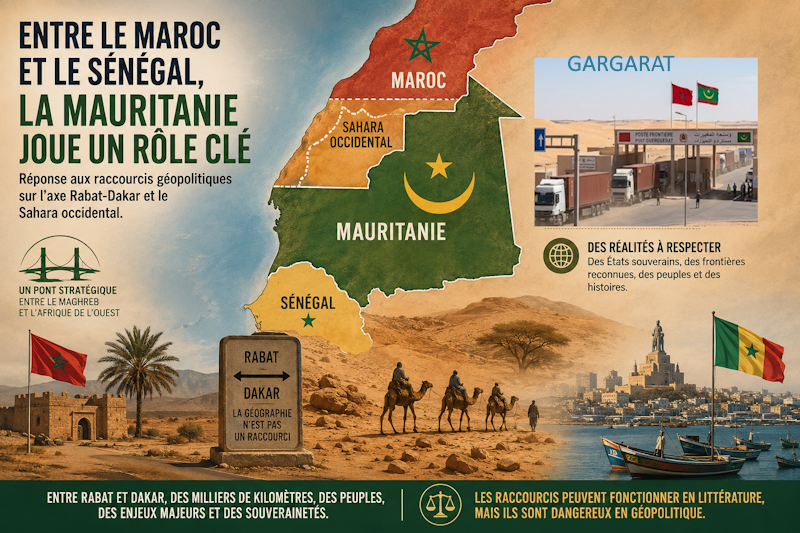
Beyond symbolism, Mauritania’s stance is heavily influenced by economic realities. The Guerguerat border crossing, situated at the junction of Western Sahara and Mauritanian territory, has become a vital economic artery linking Morocco to West Africa.
Daily convoys of Moroccan trucks pass through this zone, supplying Mauritanian, Senegalese, and Malian markets with essential goods. For Nouakchott, disrupting this trade would be economically disastrous. By keeping its borders open and secure, Mauritania implicitly endorses Morocco’s operational control over the territory without formally recognizing its sovereignty—a classic example of diplomatic ambiguity in action.
Survival through calculated neutrality
For regional observers, Mauritania’s “both at once” strategy is not indecision but survival. Trapped between an economically assertive Morocco and a security-conscious Algeria, Nouakchott cannot afford to pick a side without risking retaliation or destabilization. The Dakar incident underscores just how volatile this balancing act can be. Whenever Mauritanian sovereignty appears at risk, Nouakchott reacts swiftly to reaffirm its indispensable—and sovereign—role in maintaining regional equilibrium.