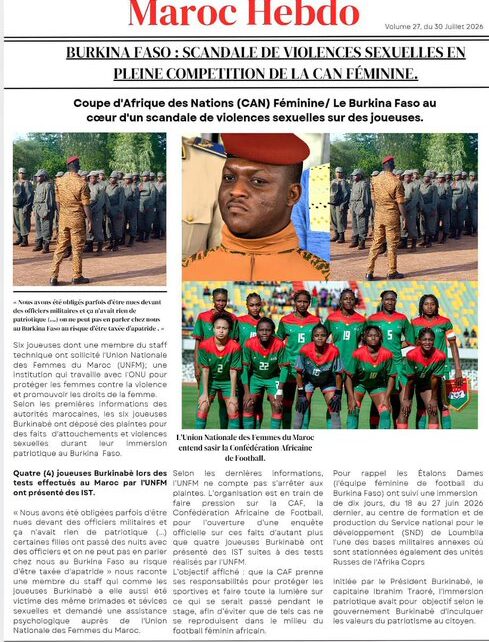
The recent allegations of sexual violence against members of Burkina Faso’s women’s national football team have cast a harsh spotlight on the country’s expanding military influence. The incident, reportedly occurring during a military-run training camp, has raised urgent questions about the limits of state power when oversight mechanisms are eroded.
Patriotic initiative turned into a scandal
What was framed as a noble effort to instill discipline and civic pride has now become a source of controversy. The women’s football team was dispatched to a military facility for what officials described as a patriotic immersion program, designed to cultivate national values before an upcoming continental competition. Yet, according to a complaint filed abroad, the experience took a disturbing turn.
Six players and a technical staff member have accused military officers of sexual violence during the training period. If substantiated, these claims would represent a severe breach of human rights and expose the dangers of unchecked military authority in civilian affairs.
The militarization of burkinabè society
Beyond the immediate scandal, this incident reflects a broader trend under Captain Ibrahim Traoré’s leadership. Since assuming power, the military has extended its reach into sectors far removed from traditional defense roles, including education, youth programs, culture, and even sports.
This shift reflects an attempt to position the armed forces as the central pillar of national identity. However, when military structures replace civilian institutions in areas outside their remit, the usual safeguards against abuse—accountability, transparency, and independent oversight—are weakened.
Human rights advocates have long warned that this concentration of power undermines democratic checks and balances, leaving citizens vulnerable to exploitation.
The consequences of unchecked power
A functioning democracy relies on a delicate balance between institutions. When the judiciary, media, civil society, and opposition groups face restrictions, the ability to expose wrongdoing diminishes. Victims of abuse may remain silent out of fear—fear of retaliation, professional consequences, or even physical harm.
In this case, the complainants reportedly only took action after leaving Burkina Faso, highlighting a profound distrust in domestic accountability mechanisms. The mere fact that victims sought justice abroad underscores the systemic failure of national protection systems.
A climate of fear stifles dissent
The current environment offers little room for criticism. Questioning military actions is often equated with disloyalty, while journalists, activists, and civil society members face intimidation or legal repercussions. Independent media outlets have also come under pressure, limiting the spread of dissenting voices.
Security imperatives, though legitimate, have overshadowed concerns about human rights and victim protection. In such a climate, silence cannot be mistaken for consent—it may simply reflect the cost of speaking out.
Beyond football: a systemic crisis
This case is not merely about sports. It raises critical questions about the military’s role in a society at war and the boundaries that should govern its involvement in civilian life. It also tests the state’s capacity to ensure the safety of citizens participating in government-led programs.
While the fight against terrorism is undeniably vital, it cannot justify the erosion of judicial guarantees, public freedoms, or institutional accountability.
International intervention as a last resort
The decision to file a complaint outside Burkina Faso signals a crisis of confidence in domestic institutions. For the victims, seeking justice abroad may be the only path to impartiality and protection.
This internationalization of the case could pressure authorities to conduct a thorough, transparent investigation—one that identifies those responsible, supports the victims, and, if necessary, delivers justice.
Conclusion: the price of unchecked power
The allegations surrounding the patriotic training camp serve as a stark reminder: no political project, no matter how ambitious, can survive without the rule of law. Patriotism cannot serve as a shield for abuses, nor can it justify the suppression of accountability when grave human rights violations occur.
If proven, this incident would mark a pivotal moment in assessing Burkina Faso’s governance, exposing the risks of excessive power concentration and the weakening of institutions meant to protect its people.