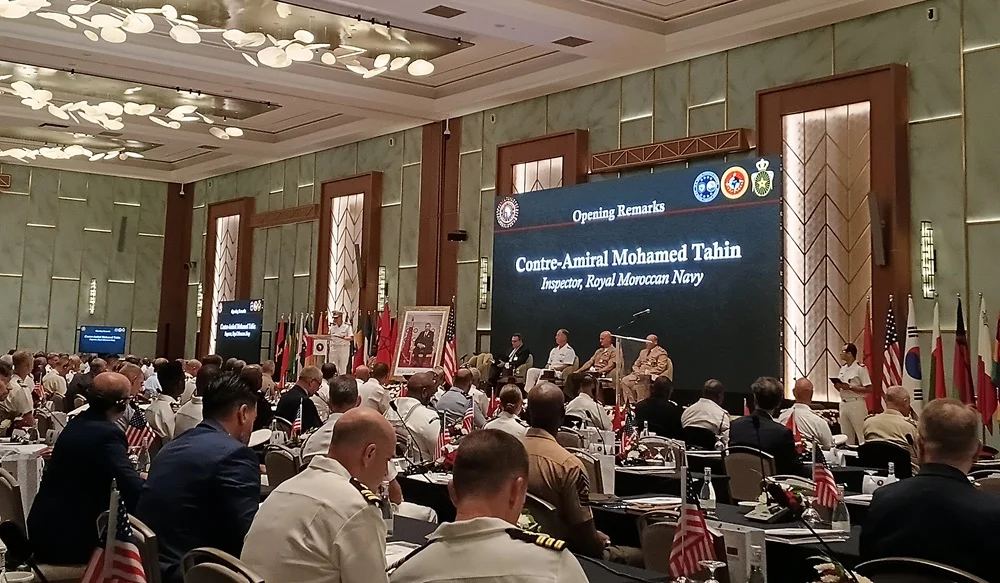
Rabat is set to host the African Maritime Forces Summit (AMFS) 2026 from July 20 to 24, under the leadership of the Royal Moroccan Navy in collaboration with the U.S. Naval Forces Europe and Africa (NAVAF) and U.S. Marine Corps Forces Europe and Africa (MARFORAF). The event places maritime innovation and security at the forefront of its agenda, emphasizing collaborative solutions to shared challenges.
The summit’s agenda is structured around three key pillars: national policy innovation through inter-ministerial cooperation, regional partnerships, and technological advancements in maritime safety. Organizers highlight that the focus is on consolidating maritime security by enhancing collective capabilities and fostering cross-border collaboration.
Tackling shared threats
Vice Admiral Mohamed Tahin, Inspector of the Royal Moroccan Navy, underscored Morocco’s commitment to regional stability, stating, «This summit reflects our unwavering dedication to African cooperation, collective peace efforts, and the strengthening of maritime security across the continent.»
He emphasized that discussions would address pressing issues such as illegal, unreported, and unregulated fishing, maritime trafficking, terrorism, irregular migration, and environmental protection. «Maritime security is a fundamental responsibility and strategic priority that demands sustained dialogue, mutual trust, and coordinated action among all stakeholders,» he noted.
«We are confident this summit will deepen cooperation between African maritime forces and international partners, promote best practices, and pave the way for a safer, more secure, and prosperous maritime future for Africa.»
Admiral George Wikoff, Commander of NAVAF, reinforced the summit’s significance, noting that maritime security impacts legal trade, food security, regional stability, and the livelihoods of communities dependent on Africa’s waterways. «The AMFS brings together African maritime leaders, Morocco, the U.S., and international partners to address challenges no single nation can face alone—piracy, illegal fishing, trafficking, terrorism, and transnational crime,» he explained. «These threats transcend borders, disrupt economies, and demand unified, cross-agency responses.»
He added, «Our goal is to forge sustainable solutions, strengthen partnerships, and train competent professionals capable of securing maritime access and collaborating with neighboring nations when threats cross borders.»
Strengthening Morocco-U.S. maritime ties
The AMFS 2026 reflects a growing synergy between Rabat and Washington, particularly in military cooperation. Following the announcement of the Atlantic Initiative at the recent African Lion military exercise, Morocco has shown strong interest in developing a robust national defense industry, with tangible benefits for its armed forces, including the navy and maritime security sectors. These discussions are a key topic at the summit, according to Ben Ziff, Chargé d’Affaires at the U.S. Embassy in Rabat.
«Morocco’s military-industrial infrastructure is a major focus of our defense cooperation discussions,» he said. «Together with the Moroccan government, we explore co-production opportunities, job creation for Moroccans, and ways to enhance Morocco’s defense ecosystem, including armaments and related sectors.»
«We continually seek new avenues of collaboration to meet our shared needs. Morocco is a valued partner with a strong industrial base. The focus is on leveraging our combined capabilities to bolster security for all.»
The AMFS 2026 also features the Senior Enlisted Leaders (SEL) Conference, providing senior maritime officials with a structured platform to enhance shared interests and exchange innovative security solutions.