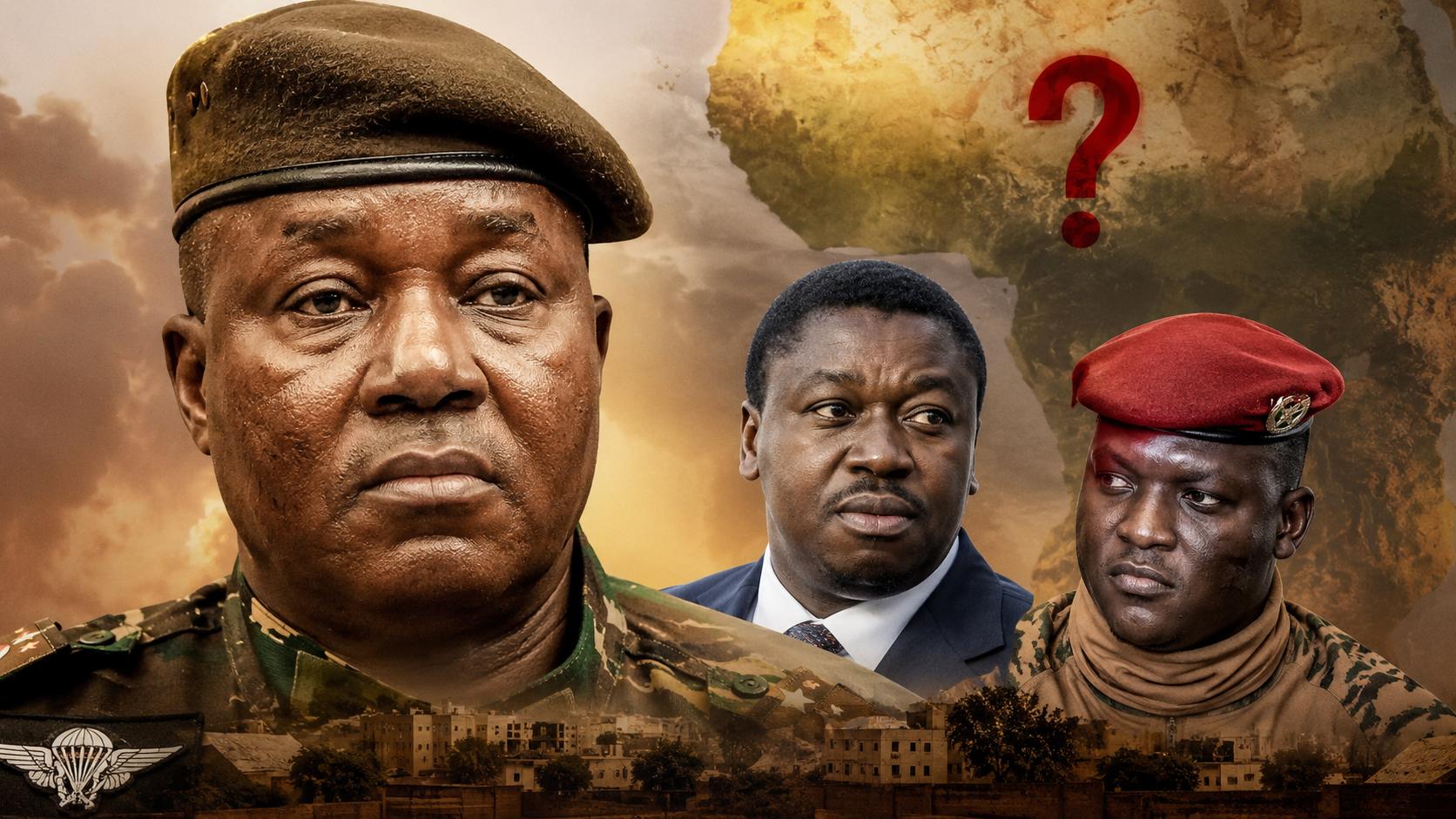
In West African geopolitics, those who sow discord often find themselves reaping it. While regional chanceries remained focused on the financial and logistical threads of the thwarted plot in Cotonou, where the footprints of Niamey’s administration and its steadfast partners were starkly evident, retribution was swift. On the night of August 28-29, the very heart of General Abdourahamane Tiani’s power in Niamey reverberated with automatic weapon fire and artillery blasts. A tragic irony, yet a moment of undeniable political logic.
The Niamey-Lomé-Ouagadougou alliance: exporting instability
For months, the National Council for the Safeguard of the Homeland (CNSP) in Niamey had sought to consolidate its own precarious position by forging a strategic and financial alliance with Captain Ibrahim Traoré in Burkina Faso and Faure Gnassingbé in Togo. By actively partnering with Ibrahim Traoré and Faure Gnassingbé to fund destabilization attempts in neighboring Bénin, the Tiani regime believed it could project its internal contradictions outward and neutralize a perceived troublesome neighbor.
This opportunistic coalition between Tiani, Traoré, and Gnassingbé pursued a clear ambition: to weaken surrounding democracies, thereby legitimizing military authoritarianism and imposing a new regional power order. Yet, financing disorder in a neighbor’s territory when one’s own foundations are fragile demonstrates a profound strategic misjudgment.
The inherent fragility of military governance
The intense gunfire heard around Air Base 101 and the presidential palace in Niamey highlights a reality that the propaganda of the Alliance of Sahel States can no longer obscure: the rot was always present. By resorting to force to overthrow constitutional order in July 2023, General Tiani not only seized power; he effectively endorsed the gun as the singular mode of succession.
By sponsoring external power grabs alongside Ibrahim Traoré and with the discreet backing of Faure Gnassingbé, all while simultaneously grappling with escalating insecurity and simmering discontent within his own barracks, the Nigerien junta became ensnared in its own trap:
- Resource dispersion: Instead of concentrating financial and military efforts on combating terrorism and fostering troop cohesion, strategic resources were diverted towards regional political destabilization schemes.
- Command chain fragmentation: The Nigerien army, instrumentalized and fractured into factions, now projects an image of a poorly structured institution. When officers observe their superiors endorsing coups abroad, they internalize the notion that power in Niamey itself is vulnerable to any audacious armed faction.
- Erosion of security promises: After three years of transition without a clear electoral timeline and facing disputed security outcomes on the ground, the frustration among rank-and-file troops inevitably catches up to the high command.
A taste of one’s own medicine
The political history of the Sahel shows no mercy for strategic amateurism. One cannot construct the stability of a regime upon the ruin of neighboring states. By co-financing disorder in Cotonou, with the complicity of Ibrahim Traoré and Faure Gnassingbé to create a diversion, the Tiani regime merely accelerated the exposure of its own internal weaknesses.
The tremors of that night of August 29 in Niamey are not an isolated incident, but a symptom of a system nearing its breaking point. General Tiani now discovers, to his detriment, an immutable truth: the weapons and financing networks used to destabilize others are precisely the same ones that eventually turn against oneself.
Faced with the spectacular wobble of power in Niamey and the unveiling of these interference networks, a pressing question now confronts the rest of the region: should Faure and Ibrahim Traoré also begin to prepare themselves?