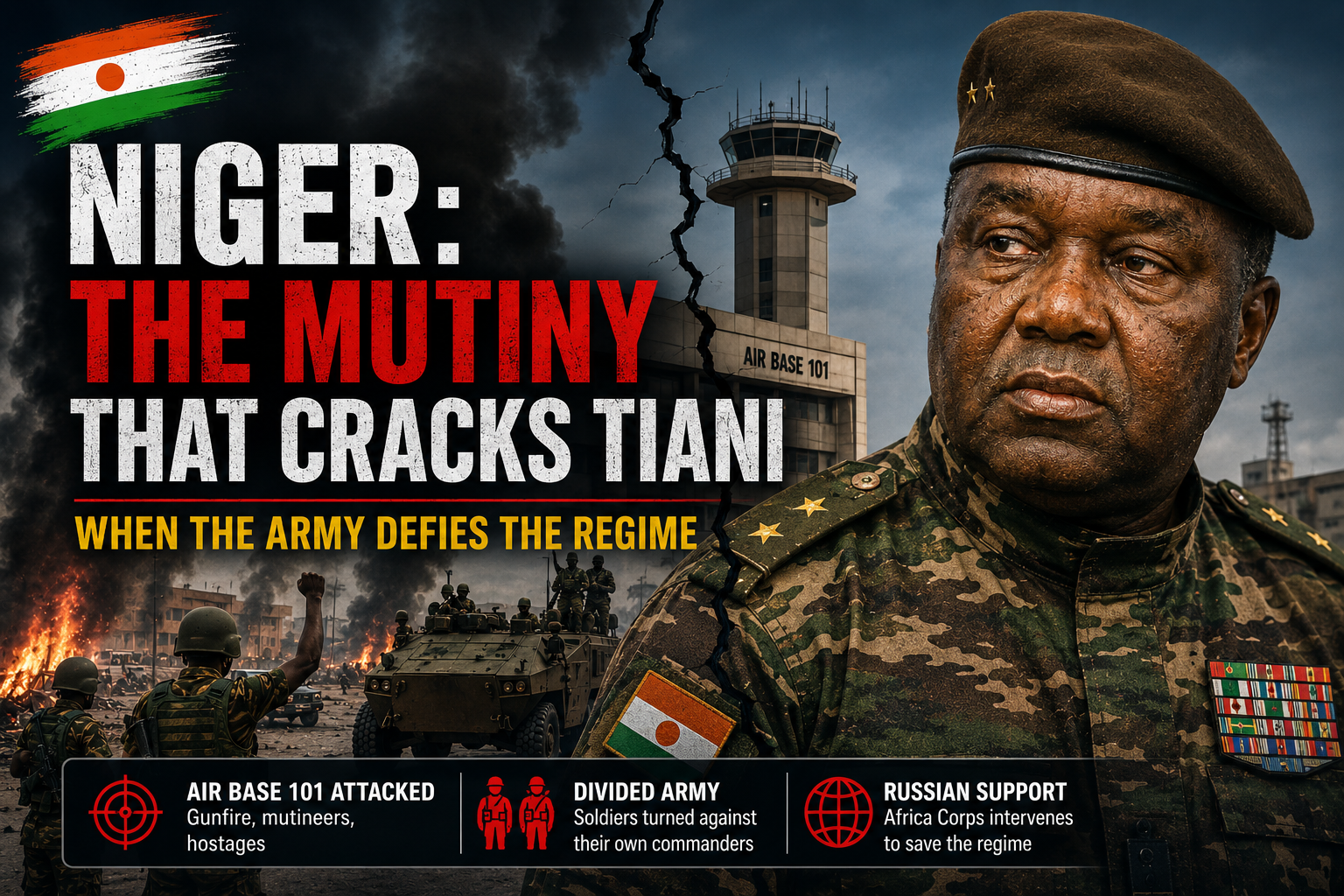
The violent events of Saturday, August 29, 2026, in Niamey cannot be dismissed as mere political impatience or dismissed by official rhetoric. The assault carried out by soldiers against Air Base 101 and multiple sensitive sites in the capital represents a severe rupture in the recent history of the regime. Authorities have acknowledged that a faction of military personnel kidnapped some of their comrades before opening fire on key installations.
Beyond a Disciplinary Incident: A Structural Crisis
This episode transcends the boundaries of a routine military grievance. When a military uprising targets a strategic installation in the heart of the capital, when gunfire erupts near the airport and presidential palace, and when state media experiences temporary blackouts, the foundation of the government’s authority is fundamentally challenged. Reuters confirmed sustained gunfire for several hours around the airport and presidential complex, with state television and radio off the air for part of the morning.
A Divide Within the Armed Forces
The narrative framing mutineers as impatient radicals eager to sever geopolitical ties does not withstand scrutiny when examining the scale of the targeted objectives. When Nigerien soldiers engage their own comrades in combat over installations of national importance, the issue evolves from ideological dissent to institutional collapse.
The critical question now revolves around the cohesion of the military apparatus. While armies can endure political disagreements or internal rivalries, they become critically vulnerable when these tensions escalate into armed confrontations among their own ranks.
This fracture is particularly alarming given the profiles of those involved. Reports indicate that mutineers originated from multiple regions, including Ouallam, Téra, and Dosso, and managed to seize control of a site as fortified as Air Base 101. These details suggest that the dissent was neither isolated nor confined to a small, marginalized faction.
The Paradox of a Regime Built on Security
Since assuming power in July 2023, General Abdourahamane Tiani’s administration has positioned itself as a guardian of sovereignty, security, and military reform. Yet just three years later, the government faces an armed challenge originating from within its own security apparatus.
This paradox lies at the heart of the crisis. A regime that claims full control over the state, restructured national defense, and strengthened Niger’s sovereignty should theoretically maintain an unbreakable chain of command. Nevertheless, soldiers managed to secure a strategic military installation, detain colleagues, and engage in firefights in the capital before loyalist forces gradually regained control.
While the mutiny was eventually quelled, its mere occurrence serves as a stark warning.
The Erosion of Sovereignty Through Foreign Assistance
Another factor undermines the regime’s narrative: the reported involvement of Russian forces from the Africa Corps in retaking Air Base 101.
Regional media outlets suggest Russian elements supported loyalist troops in reclaiming the critical facility. This development introduces a glaring contradiction.
The Tiani administration has consistently framed national sovereignty as a cornerstone of its legitimacy. Yet, when stability is threatened within the capital itself, the Nigerien military appears sufficiently weakened to require external military support to secure its most vital assets.
The matter is not merely the presence of foreign troops but the symbolism it conveys: a government that claims to have restored full operational capacity yet must rely on external partners to protect its most strategic sites. This dependency risks deepening frustrations among the national army, where soldiers may perceive foreign actors as supplanting their role in national defense—a sentiment that could ignite further instability.
Military Success Does Not Guarantee Political Stability
The retaking of Air Base 101 and the surrender of several mutineers mark a tactical victory for the regime. However, such an outcome does not resolve the underlying causes of the uprising.
Nigerien authorities can reclaim a barracks, detain soldiers, and restore order in the streets. Yet they must confront a far more difficult question: why did members of the defense apparatus turn against their own command structures?
This unresolved tension may haunt the regime in the coming months. Suppressing a mutiny can prevent an immediate coup but does not necessarily restore trust across the military’s various factions.
The Dual Threat to National Security
This internal fracture emerges amid a broader security crisis the regime has pledged to resolve. General Tiani positioned the restoration of security as a central pillar of his leadership, promising to dismantle jihadist networks and reclaim national sovereignty. Yet, terrorist attacks continue unabated, and the capital has already witnessed multiple assaults on military and airport facilities in 2024 alone.
The irony is stark: while authorities tout their security apparatus as a definitive break from past strategies, the jihadist threat persists, and a new menace has now emerged from within the very institution tasked with combating it.
The regime now faces a dual challenge: neutralizing armed groups operating across the country while preventing internal military frustrations from escalating into further insurrections.
The Myth of Unity Crumbles
For years, the military leadership presented itself as the unifying force against the former political order and foreign influences. The August 29 mutiny, however, reveals a far more complex reality.
The apparent unity under the National Council for the Safeguard of the Homeland (CNSP) masks deep divisions within the armed forces. The dissent is no longer confined to external opposition; it has surfaced within the very institution responsible for guaranteeing the regime’s stability.
This development poses an existential challenge for Tiani. A government may survive political opposition or international criticism, but when factions of its own military take up arms against it, the question of its long-term viability becomes impossible to ignore.
A Cautionary Episode, Not an Isolated Incident
It would be premature to interpret the August 29 mutiny as the definitive downfall of the Tiani regime. Loyalist forces have reclaimed Air Base 101, and authorities assert control has been restored. Nevertheless, dismissing the episode as a mere disciplinary issue would be equally shortsighted.
This marks the first time since the 2023 coup that the Tiani administration has faced a military challenge of such magnitude, complete with armed clashes across multiple strategic sectors of Niamey.
The mutiny failed militarily, but it succeeded in exposing a critical weakness: beneath the veneer of an invulnerable regime, fractures run deep within the very institution tasked with preserving its survival.
Perhaps the most enduring lesson of August 29 is this: while Tiani’s forces secured victory in Niamey, they have also uncovered that the gravest threat to his power may now originate from within the ranks.