When a political opinion costs you your bank account
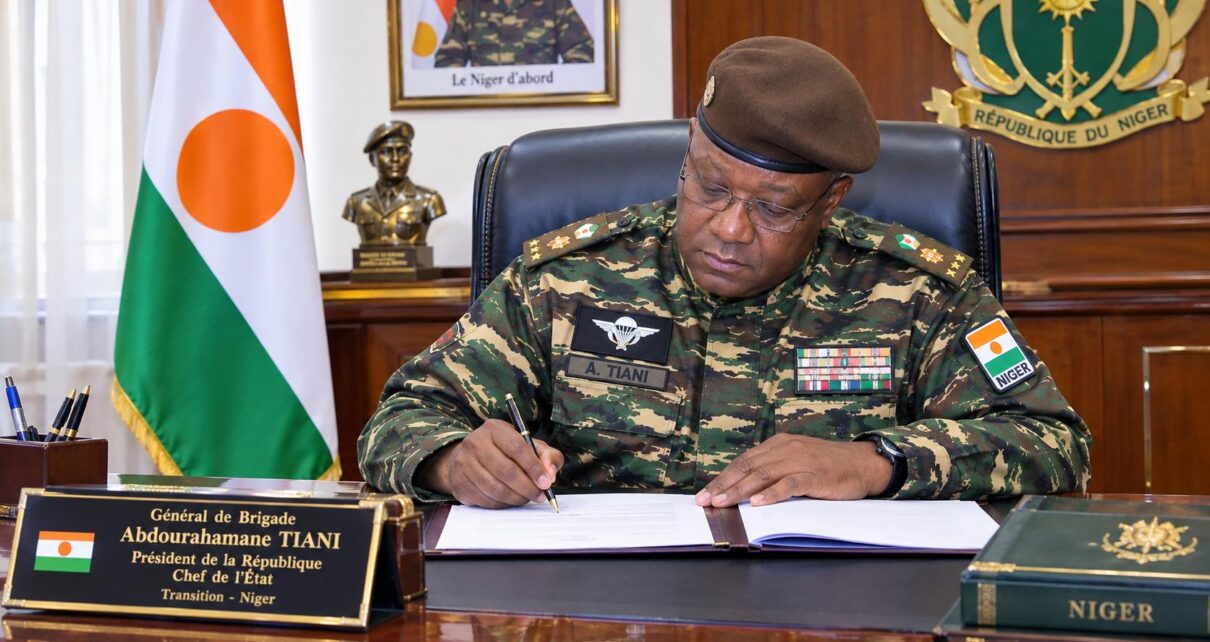
In Niger, a dissenting opinion can now cost far more than your freedom — it can cost you your papers, your savings and your place in the country where you were born. Since the National Council for the Safeguard of the Homeland (CNSP) seized power by force in July 2023, the price attached to political disagreement has expanded well beyond prison and exile. General Abdourahamane Tiani no longer settles for silencing opponents: he erases their legal existence, and the fallout lands on bank accounts, small businesses, salaried households and the wider economy.
Under a doctrine in which criticizing the ruling military equals high treason, nationality itself has become conditional. The consequences are neither abstract nor distant. A revoked ID means no passport, no bank account, no formal contract, no access to public services — and for relatives and employers, a sudden loss of income, credit and trust.
The legal machinery built to punish dissent
The repressive apparatus hardened in late August 2024, when General Tiani signed an ordinance creating a national register of persons involved in acts of terrorism or threats to state security. Behind the catch-all wording and the convenient counterterrorism label sits a legal blade aimed at the political class, civil society and the army alike.
The most corrosive clause of the text allows the provisional or permanent withdrawal of Nigerien nationality from anyone suspected of “activities liable to disturb peace and security”, “regionalist or xenophobic remarks”, or “collusion with a foreign power”. Those deliberately vague criteria turn any protest chant — or any critical editorial — into grounds for national repudiation.
- Publication of the register of “security threats” (August 2024)
- Asset freezes and travel bans targeting opponents
- Presidential decrees withdrawing citizenship
- Confiscation of identity documents, producing de facto stateless people
Five names, five decrees: the growing blacklist
The regime’s scorecard grows with every presidential decree. Wave after wave of removals methodically targets the circle of deposed president Mohamed Bazoum, former ministers and leading figures of the opposition.
| Targeted figure | Role / position | Ground cited by the junta |
|---|---|---|
| Ouhoumoudou Mahamadou | Former prime minister | Alleged intelligence work for a foreign power |
| Hassoumi Massoudou | Former foreign minister | Threat to national security and conspiracy |
| Rhissa Ag Boula | Former minister of state, head of the Resistance Council (FRR) | Rebuilding an armed group, incitement to insurrection |
| Alkache Alhada | Former interior and commerce minister | Circulating data that disturbs public order |
| Amadou Barou Chekaraou | Former official in the state apparatus | Endangering state security and glorifying violence |
Beyond the headline names: activists, media voices and officers
Alongside these prominent political figures, civil society actors, media activists such as Mariama Djibrine (known as Mayra) and former senior army officers have seen their identity confiscated by a simple executive decree. With one stroke of a pen, men and women born on Nigerien soil, who served the country for decades, are administratively banished — virtual stateless people, stripped of passports, bank accounts and every civic right.
The practical effect ripples outward fast. Households lose a breadwinner who can no longer work legally, travel or receive a transfer. Relatives discover that a family name now carries a risk. Local businesses that depended on these figures for contracts, capital or simply for a signature lose a partner overnight.
An economy that bleeds skills, savings and confidence
The economic damage compounds quietly rather than spectacularly. Businesspeople stripped of nationality also lose the legal capacity to sign contracts, hold accounts or travel for procurement. Companies lose managers, partners and correspondents. Families lose the second income that keeps a household running. Every decree removes capital, expertise and connections from a country already under heavy financial strain — and it teaches every remaining entrepreneur a blunt lesson: political caution is cheaper than civic courage.
Freezing assets does more than punish an individual. It chills credit between partners, discourages investment and pushes transactions into informal channels where nothing is declared and nothing is protected. Ordinary consumers ultimately absorb the difference, in prices as much as in uncertainty.
Sovereignty slogans versus shrinking livelihoods
The CNSP’s rhetoric rests on a permanent sleight of hand: the deliberate confusion of the nation with the military power currently in place. For General Tiani, contesting the junta amounts to betraying Niger. That populist posture flatters sovereignist sentiment while masking the absence of any political horizon and the steady deterioration of security in the three-border zone.
Yet a purge conducted through citizenship betrays deep anxiety. A government confident in its popular legitimacy and in its control of territory has no need to hand out patriotism certificates or manufacture stateless people in order to rule. And no decree will bring down the price of staple goods in Niamey or restore security in the Liptako-Gourma.
Where Niger’s decrees collide with international law
On the legal front, the decisions taken by Tiani’s government run straight against the Universal Declaration of Human Rights, whose Article 15 states that everyone has the right to a nationality and that no one may be arbitrarily deprived of it. By applying these sanctions retroactively, outside any judicial process and without the guarantee of a fair hearing before an independent court, Niamey breaches the regional and international conventions Niger has signed.
Jurists and human rights organisations are raising the alarm over the precedent: when nationality becomes a reward for loyalty to an authoritarian regime, the very notion of citizenship erodes. If being Nigerien depends on the goodwill of the junta’s leader, the entire republican edifice is at stake.
The long-term bill: a weaker, angrier republic
By turning nationality into a political adjustment variable, Abdourahamane Tiani’s regime reveals its true face: an autocracy running forward with no exit plan, incapable of tolerating the slightest contradiction. Sealing off every channel of republican dialogue and confiscating the citizenship of opponents only hardens resentment and drives dissent underground — or toward armed action.
History is unkind to governments that confiscate their citizens’ papers out of fear of debate; they end up losing their own legitimacy. A people’s identity is rooted far deeper than a military decree, however peremptory that decree may be.