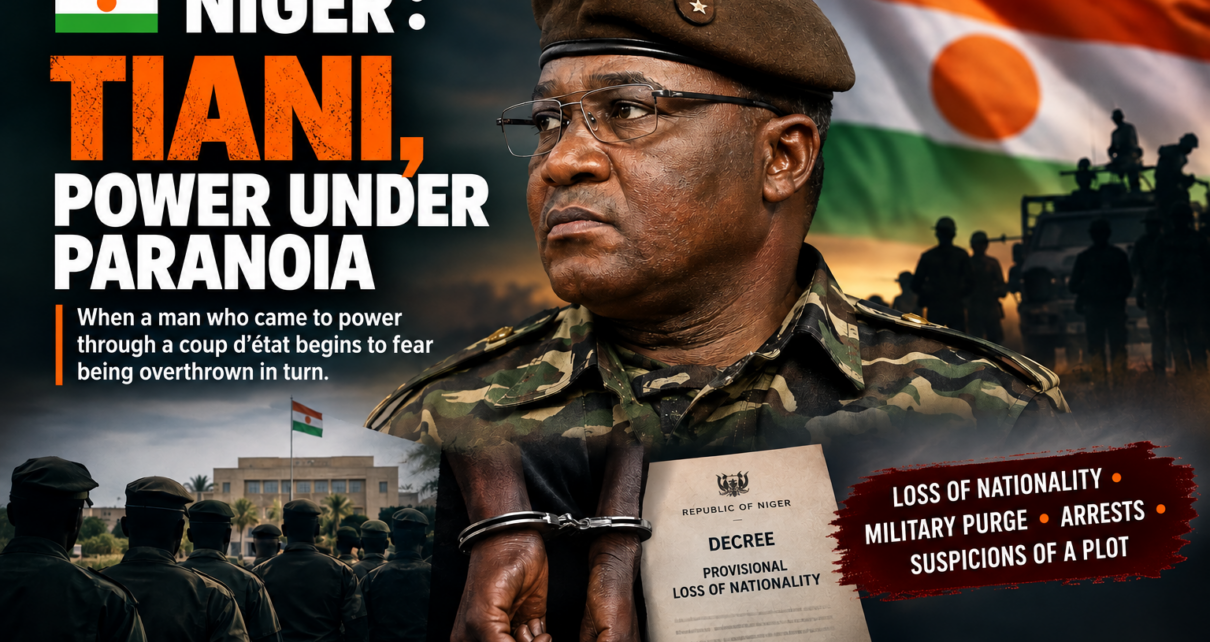
The decree signed on 17 September reads like a dry legal document. Its effects are anything but abstract. Five Nigerien citizens – among them a former prime minister – now find themselves provisionally stripped of their nationality, at a moment when the country is still absorbing the shock of an attempted coup that unfolded in the heart of its capital.
The decision, taken by General Abdourahamane Tiani, targets names that carry weight far beyond any courtroom. For ordinary Nigeriens, for soldiers, traders and state employees, it adds another layer of uncertainty to a political landscape that has been shifting since the night of 29 August.
Five names, and a signal sent to an entire country
Among those affected is Ouhoumoudou Mahamadou, who served as prime minister under Mohamed Bazoum, the president overthrown in July 2023. The text cites intelligence with foreign powers, the dissemination of information liable to disturb public order, alleged involvement in an effort to demoralise the army and the nation, and threats to state security.
It should be said plainly: these are accusations recorded in a decree, not a final judicial conviction. Politically, however, the message travels fast – and it is not lost on the households and businesses whose daily calculations depend on the stability of the state.
With these five additions, the number of people provisionally deprived of their nationality under the mechanism introduced in 2024 now stands at twenty-five.
The shock of 29 august is still being absorbed
Three years after Tiani seized power by force on 26 July 2023, the same method was turned against him. On 29 August, the presidential palace came under attack, air base 101 was targeted, and the public broadcaster was treated as an objective. For hours, the balance of forces inside the military apparatus remained unclear, with some officers hesitant to take sides while the mutineers tried to bring others into the fold.
The attempt failed, but only after several hundred Russian Africa Corps personnel were called in to help retake the air base. Since then, at least 200 soldiers – most of them drawn from the special forces – have been arrested, and the chain of command has been reshuffled from the very top.
On 11 September, the chief of the armed forces staff, General Moussa Salaou Barmou, was dismissed. Days later, four ministers lost their posts. Officially, the changes are about reorganisation, correcting dysfunctions and securing the command structure. In practice, the timing tells its own story: a power that has been directly threatened rearranges itself around the people it considers safest.
What the fallout means for citizens, markets and institutions
The consequences rarely stay confined to barracks or ministry corridors.
- For citizens, nationality has become a reversible condition. The precedent is now set that a decree, rather than a court ruling, can place a person outside the national community – at least temporarily.
- For businesses, the rapid turnover of ministers and senior officers injects friction into every file that needs a signature, a permit or an official counterpart who may not still be in place next month.
- For the armed forces, the arrest of hundreds of soldiers, concentrated in the special forces, raises hard questions about operational capacity at a time when armed groups remain an active threat.
- For the credibility of the state, the accumulation of measures taken in the name of protecting the nation makes it increasingly difficult to separate security policy from political consolidation.
Taken one by one, each of these measures carries an official justification. Placed side by side, they sketch the portrait of a government that, having come under direct threat, is trying to regain control of every circle that might represent a vulnerability.
A regime that keeps finding enemies closer to home
Since 29 August, the danger facing the Nigerien authorities no longer comes only from armed groups or external adversaries. On the evidence of those events, it can now emerge from within the military apparatus itself. And once the loyalty of soldiers becomes the central question, the temptation grows to hunt for those responsible – relays, accomplices, sponsors.
That is precisely where a legitimate security operation risks hardening into a permanent method of governing: a soldier replaced, a minister set aside, troops arrested, veterans of the previous administration singled out, and now citizens stripped of their nationality by decree.
The uncomfortable arithmetic of a power born from a coup
How does a government built on a coup d’etat function once it discovers that the same manoeuvre can be used against it? Tiani knows the mechanics from the inside. He knows a military regime can look unshakeable right up to the moment a handful of officers decide to cross a line.
What was supposed to be impossible became possible around the presidential palace. And when a leader learns he can be toppled by the very methods that lifted him to the top, the fear of the next plot can harden into political obsession.
When loyalty becomes the only currency
Critics of the regime read recent months as a drift with measurable costs. Deciding who is loyal, who is suspect, who is arrested, who is sidelined and who may keep their nationality, Tiani increasingly gives the impression of a leader behaving as though he alone holds the keys to the republic – as though Niger had to be split between those who back the government and those who must be excluded, and as though having served under Bazoum amounted to a permanent political offence.
The general is not Niger. But the concentration of decisions around his person raises the stakes for everyone else, because the boundaries of what is permitted now shift with the perception of threat.
The thin line between protecting the state and protecting the regime
A bitter irony runs through this sequence: a leader who reached the summit through a coup now governs a country that has just survived an attempted coup. Between those two moments, Niger appears to have entered a cycle in which every crisis produces fresh purges, every suspicion triggers a fresh sanction, and every challenge reinforces the concentration of power.
The decree of 17 September is therefore not simply a question of nationality. It is another chapter in a wider battle – one waged by a government determined to eliminate the zones of uncertainty around it.
One question matters more than the rest: by fighting real and supposed plots, is Tiani constructing a system in which any form of contestation is automatically treated as a conspiracy? If so, the issue is no longer only who wants to overthrow him. It is also why a power that presents itself as firmly installed appears so afraid of those closest to it.
And for a population already navigating security threats, economic pressure and a shrinking space for dissent, the answer will shape far more than the fate of five names written into a decree.