The Nigerian military’s relentless crackdown on jihadist factions in the Lake Chad region has delivered a staggering blow to Boko Haram and the Islamic State’s West Africa Province (ISWAP), but the consequences for local economies and displaced communities reveal a fragile recovery. In a sweeping offensive since April 2025, troops have systematically dismantled insurgent networks, seized critical weapons caches, and liberated hundreds of civilians—yet the road to lasting stability remains fraught with uncertainty.
Surge in fatality rates cripples jihadist ranks
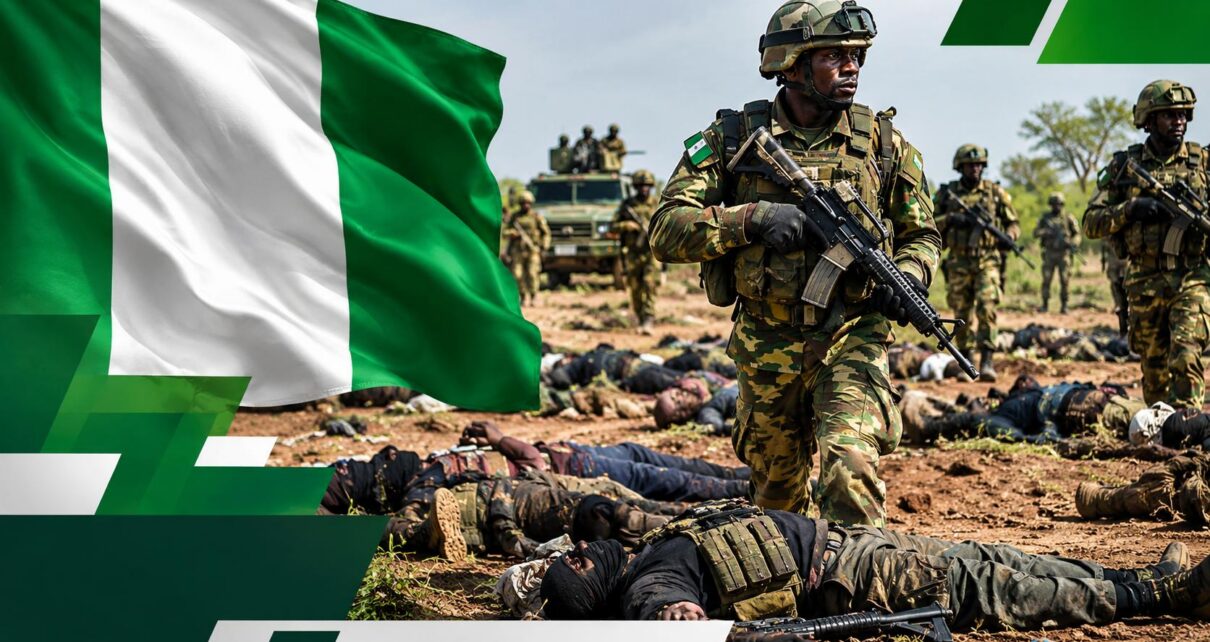
During a transitional briefing in Maiduguri, outgoing Joint Task Force (JTF) HADIN KAI commander Major General Abdulsalam Abubakar disclosed that military operations have neutralized over 1,100 jihadists—including fighters from Boko Haram and ISWAP. The offensive targeted strongholds in the Sambisa Forest, Mandara Mountains, and Lake Chad peripheries, disrupting long-standing insurgent sanctuaries.
The crackdown has also left jihadist forces starved of resources. Troops recovered 475 firearms of varying calibers—ranging from assault rifles to heavy weaponry—alongside substantial ammunition reserves. Additionally, 295 improvised explosive devices (IEDs) were disabled, preventing further civilian and military casualties. These seizures have severely hampered the groups’ operational capacity, forcing fighters into defensive postures.
>Collapse of jihadist supply chains fuels surrenders
The military’s systematic disruption of insurgent logistics networks has triggered a cascade of consequences for the groups’ remaining holdouts. Intelligence-driven operations led to the arrest of 758 alleged collaborators and logisticians, crippling the flow of food, fuel, and communication equipment to remote jihadist camps. This pressure has contributed to a surge in defections, with nearly 970 individuals—including active fighters and their families—laying down arms or fleeing controlled territories under JTF HADIN KAI’s purview.
>Humanitarian relief follows military gains
Amid the tactical victories, Nigeria’s armed forces have prioritized the recovery of civilians held captive by insurgents. Through precision raids and clearing operations, troops freed 638 hostages, many of whom were women and children abducted during jihadist raids on remote villages. The rescued individuals undergo medical and psychological evaluations before being integrated into rehabilitation programs led by civil authorities and humanitarian partners.
>Economic fallout threatens recovery in the Lake Chad basin
While the military’s advances have weakened jihadist influence, the fallout for local economies is severe. Decades of insurgency have displaced over two million people and crippled agricultural and trade activities in Borno, Yobe, and Adamawa states. With infrastructure damaged and markets disrupted, returning displaced populations face daunting challenges as they attempt to rebuild livelihoods.
The ISWAP faction, though degraded, retains the ability to carry out ambushes and deploy IEDs, exploiting the region’s porous terrain to target both civilians and security forces. The handover of command within JTF HADIN KAI arrives at a pivotal moment, with the incoming leadership tasked not only with sustaining military pressure but also with securing liberated zones to prevent insurgent resurgence.
>Sustaining stability requires more than military victories
Military gains alone cannot guarantee lasting peace. The Nigerian government must complement its counter-insurgency efforts with robust economic reintegration programs, infrastructure restoration, and community-based reconciliation initiatives. Without these measures, the risk of re-radicalization and renewed violence remains high.
As the military consolidates its foothold in the region, the focus must shift toward holistic stabilization—balancing security imperatives with social and economic recovery to ensure that the sacrifices of the past decade yield enduring stability for the people of the Lake Chad basin.