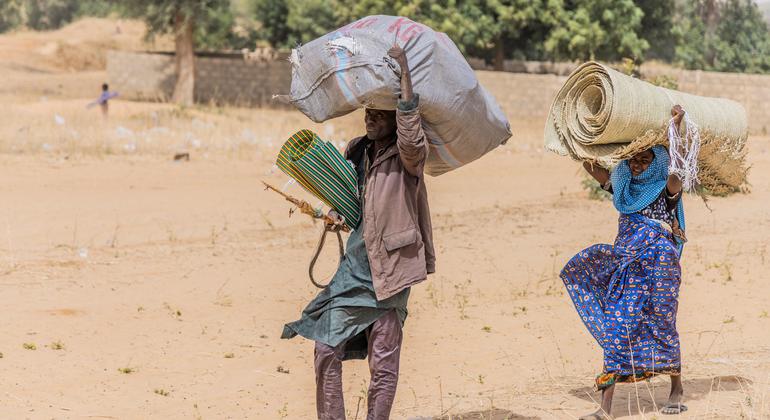
Nigeria’s widening security crisis and forgotten humanitarian emergency
Recent months have seen Nigeria thrust back into international headlines as escalating violence—spanning school kidnappings, entire village attacks, and worshippers snatched from churches and mosques alike—has intensified. The crisis reached a new geopolitical dimension when the United States launched Christmas Day airstrikes against jihadist positions in northern Nigeria, framed as protection for threatened Christian communities.
From localized insurgency to nationwide insecurity
The conflict originated in the northeast in 2009 with Boko Haram’s armed uprising, later joined by its offshoots including the Islamic State’s West Africa Province. Nearly two decades later, this prolonged conflict has fractured Nigeria’s social fabric. According to UN estimates, over 40,000 lives have been lost, while more than 2 million people remain displaced—not temporarily, but having spent entire childhoods in camps, with no alternative reality to remember.
Destruction has been widespread: thousands of schools and healthcare facilities lie in ruins, agricultural lands have become inaccessible, and entire communities have been severed from economic activity. Mohamed Malik Fall, UN Coordinator for Nigeria, emphasizes that “the insecurity isn’t confined to one region—it’s nearly everywhere.”
Rising banditry and communal violence
This long-standing insurgency has been compounded by increasingly diffuse violence. In the northwest, states like Zamfara, Katsina, and Sokoto face what authorities classify as “banditry”: armed criminal gangs engaging in looting, kidnappings, and extortion. Fall notes that “entire villages have been abandoned, with nearly one million displaced in the northwest alone.”
The country’s central belt has become a flashpoint for farmer-herder clashes over land, intensified by land pressure and climate shocks, triggering additional displacement waves. Meanwhile, southern regions grapple with separatist movements and oil industry-related sabotage. The result? With approximately 3.5 million internally displaced persons, Nigeria accounts for nearly 10% of Africa’s total displaced population.
Targeted religious violence or widespread insecurity?
Recent high-profile attacks on Christian churches and schools have reignited global debates. In January, over 160 worshippers were kidnapped during Sunday services in Kaduna State, while northwest villages faced deadly assaults just days earlier. Schools around the Catholic mission at Papiri were also targeted, echoing the 2014 Chibok abduction of 276 schoolgirls—mostly Christian—by Boko Haram.
These incidents have prompted US officials to describe the situation as a “Christian genocide,” though UN experts refrain from such characterizations, citing insufficient evidence of deliberate targeting based on religious affiliation. Fall clarifies, “The vast majority of the 40,000+ conflict-related deaths have been Muslim victims, killed in mosques.” He points to a Christmas Eve attack in Maiduguri—Boko Haram’s historical stronghold—which struck an area “between a mosque and a market,” killing Muslim worshippers emerging from prayers. “Insecurity affects everyone equally, regardless of religion or ethnicity,” he stresses, warning against narratives that could deepen societal divisions.
Deepening humanitarian catastrophe
Beneath the security crisis lies a severe humanitarian emergency. In the northeast alone, 7.2 million people require assistance, with nearly 6 million in severe or critical conditions. Food insecurity looms large: projections indicate up to 36 million Nigerians could face various levels of food insecurity in coming months. Among children under five, over 3.5 million risk acute malnutrition—consequences that extend far beyond immediate suffering. Fall notes, “Malnutrition hampers cognitive development, education, and casts long shadows into adulthood.”
Compounding these challenges are recurring climate shocks—droughts and floods—alongside epidemics like cholera and meningitis, all against a backdrop of a weakened healthcare system. Compounding the tragedy, funding has plummeted: humanitarian response plans dropped from nearly $1 billion annually a few years ago to just $262 million last year, with projections for 2024 falling below $200 million.
Africa’s largest economy facing its darkest hour
Nigeria’s paradox lies in being both Africa’s largest economy and host to one of the continent’s most severe yet overlooked humanitarian crises. Fall stresses, “Nigeria isn’t Sudan, Somalia, or South Sudan—it possesses resources and capacity. The primary responsibility for humanitarian response rests with the government.” The UN is now advocating for a gradual transfer of leadership in aid delivery to federal and state authorities, while urging international donors not to turn away. Fall concludes, “No population desires permanent reliance on assistance. People want opportunities to build economic resilience—not just fish, but the means to fish. The goal isn’t just survival; it’s sustainable recovery.”