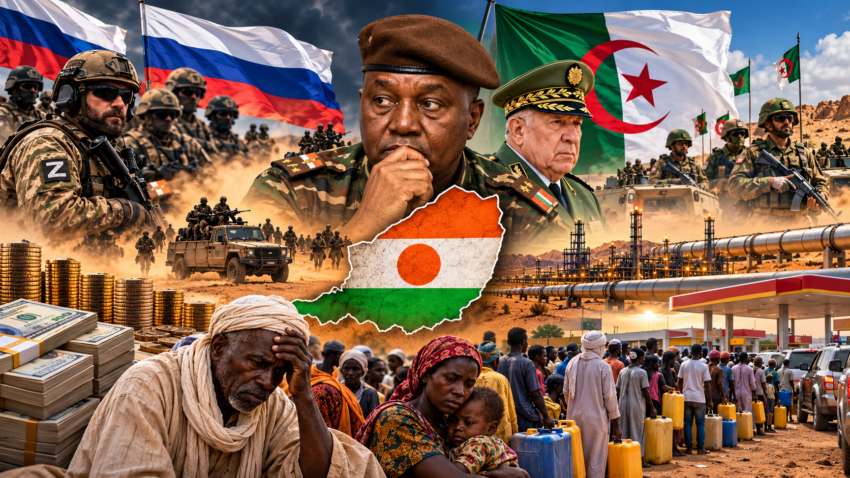
Algeria’s Military Deployment Raises Critical Questions for Niger’s Future
In a significant strategic shift, the Nigerien government has turned to Algeria for military support after relying heavily on Russian mercenary forces. The move comes after the Algerian Parliament approved a deployment of units from the Algerian National People’s Army (ANP) to Niger. While framed as a move to bolster security, the decision raises pressing concerns about financial burden, transparency, and the potential trade-offs for Niger’s struggling economy and population.
The Limits of Foreign Military Partnerships
Niger’s government, led by General Abdourahamane Tiani, initially sought security assistance from Russia through Africa Corps and other mercenary groups. Despite these costly alliances, measurable improvements in security such as reduced armed attacks, safer transportation routes, or strengthened state authority remain elusive. Reports suggest that each Russian mercenary has cost up to $10,000 monthly, though official contract details are not publicly available. With limited accountability, Nigeriens are left questioning whether these expenditures align with real security gains.
Algeria’s Role: Security Partner or Economic Guard?
The recent approval from Algeria marks a pivotal moment, as it signifies a shift in regional military alliances and introduces new questions about the true motivations behind the cooperation. While Algeria emphasizes mutual security concerns such as cross-border threats and regional instability its economic interests also come into play. Key projects like oil infrastructure and the proposed trans-Saharan gas pipeline represent critical stakes for both nations. The question remains: is Algeria’s intervention primarily driven by Niger’s security needs, or by the protection of its own strategic assets?
A joint approach could benefit both countries, but only if the objectives are clearly defined, transparent, and genuinely focused on improving the lives of Nigerien communities.
Unanswered Questions About Financial Responsibility
One of the most pressing concerns for Nigerien citizens is financial accountability. While Algeria’s deployment could ease pressure on Niger’s security apparatus, the costs associated with logistics, transportation, and operational support remain ambiguous. Who will bear these expenses? Will Algeria fund its own mission, or will Niamey cover these costs at the expense of domestic priorities like healthcare, education, and infrastructure? The lack of clarity in the agreement only heightens concerns about the long-term impact on public finances and social services.
The Economic Trade-Offs of Military Alliances
Niger is already grappling with severe economic challenges, including food insecurity, high unemployment, and underdeveloped infrastructure. Every large-scale military investment must be scrutinized to ensure it does not divert critical resources away from urgent civilian needs. If Algeria’s presence leads to increased public debt, reduced social spending, or greater dependency on foreign powers, the consequences could outweigh the benefits. Transparency in budget allocations and the terms of defense agreements is essential to prevent Niger’s citizens from bearing the brunt of opaque military decisions.
Transparency as the Cornerstone of Sovereignty
For a regime that has prioritized sovereignty and rejected past foreign alliances, the reliance on multiple military partners presents a contradiction. Sovereignty is not merely about rejecting old agreements; it is also about demonstrating that new partnerships serve the nation’s best interests. The government must justify why it continues to seek external military help and explain how these partnerships improve security without compromising the country’s financial stability or autonomy.
Without clear benchmarks, measurable outcomes, and public accountability, each new military cooperation risks becoming another unfulfilled promise for Niger’s people.
What Real Security Gains Can Niger Expect?
The true test of this military cooperation will not be in the number of foreign troops stationed in Niger or the volume of agreements signed. It will be measured in tangible improvements: fewer attacks on civilians and infrastructure, safer roads, enhanced state presence in vulnerable regions, and a budget that prioritizes development. The government must answer hard questions: Are the threats being addressed effectively? Are the financial costs justified by measurable security gains? And most importantly, who ultimately benefits from these partnerships the people of Niger, or outside interests?
As Algeria prepares to deploy forces, Niger’s leaders face a defining moment. They must ensure that this new alliance is not just another temporary fix, but a step toward lasting stability, financial responsibility, and democratic accountability. Otherwise, the people of Niger will be left paying the price once again.
By Martin Ngu — Journalist