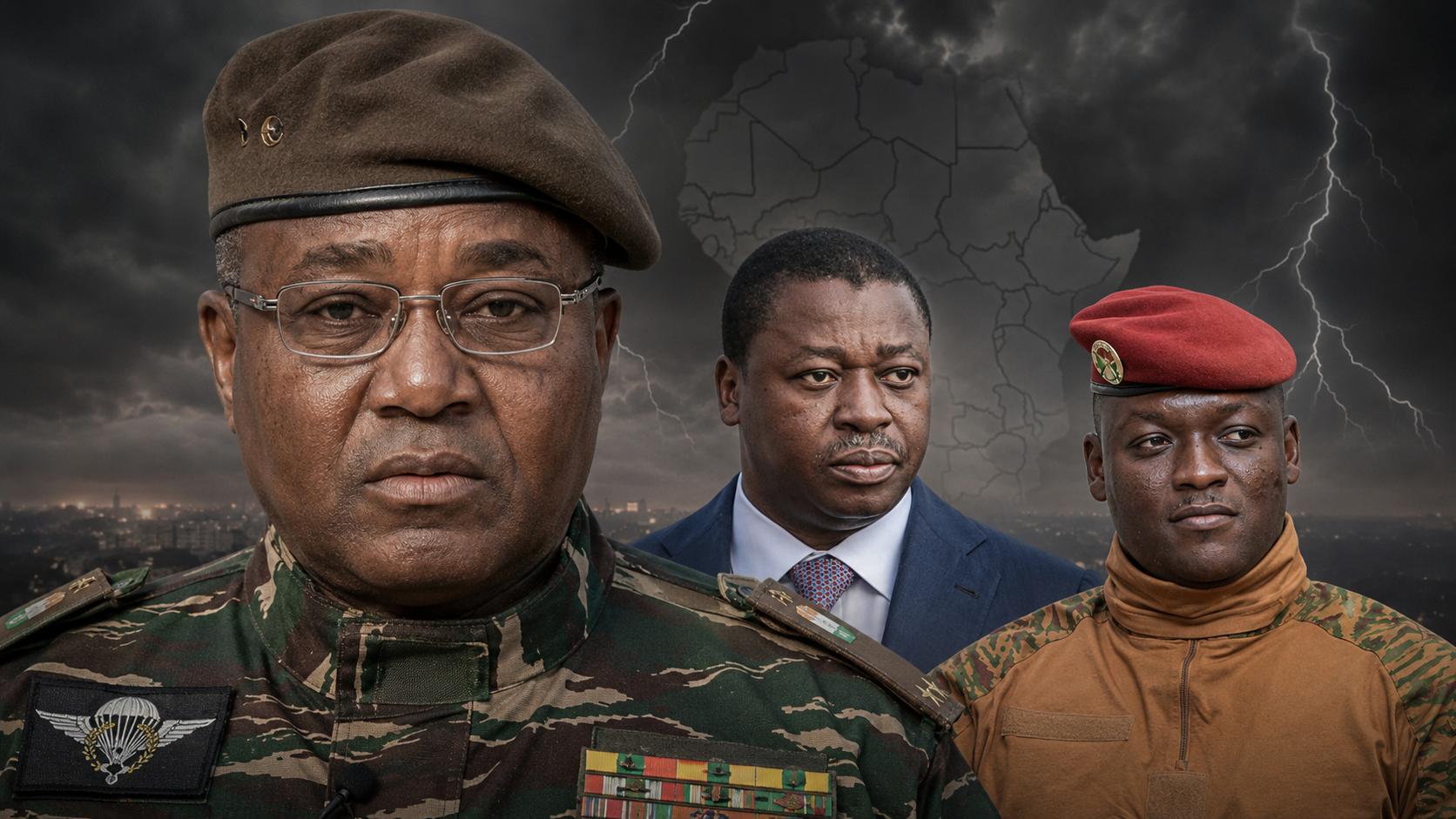
Recent upheavals in Niger’s capital have sent shockwaves through the region, exposing vulnerabilities that extend far beyond Niamey’s borders. Heavy gunfire and political unrest rocking General Abdourahamane Tiani’s regime serve as a stark reminder of the fragility gripping West Africa. Yet the tremors are not confined to Niger alone—they now cast a looming shadow over two neighboring allies: Burkina Faso’s Captain Ibrahim Traoré and Togo’s President Faure Gnassingbé. The fallout from Niger’s crisis has raised alarming questions about whether their regimes could be the next dominoes to fall.
Burkina Faso: A Powder Keg of Military Resentment
For Ibrahim Traoré, the threat is not hypothetical—it’s an ever-present reality. Burkina Faso’s military-led government operates under a cloud of perpetual distrust. Failed coup attempts last seen in early 2026 and again in late 2023 underscore how fragile Ouagadougou’s grip on power truly is.
As Ibrahim Traoré watches Niamey descend into chaos, he recognizes the same volatile mix brewing within his own military:
- Soldier Fatigue: Despite nationalist rhetoric, the military’s frontline pressures remain crushing. Rank-and-file soldiers, bearing the brunt of unfulfilled promises, form the tinderbox for mutinies. The cost of bloodshed breeds discontent that no propaganda can silence.
- Rival Factions: Repeated purges and the rise of the Volontaires pour la Défense de la Patrie (VDP) have eroded cohesion among career officers. Like in Niamey, the specter of dissident factions taking up arms grows stronger by the day.
Togo’s Silent Crisis: When Reorganization Becomes Survival
Though Togo’s political landscape appears calmer on the surface, the unease at the presidential palace is undeniable. August 2026’s emergency reshuffle—installing loyalists at the helm of the military and intelligence services (ANR)—was no routine administrative move. It was a preemptive strike against an invisible enemy.
The urgency behind Faure Gnassingbé’s reshuffle reveals deeper anxieties:
- Barracks’ Distrust: Togo’s perceived involvement in regional geopolitical schemes and worsening security in the North (where the Koundjoaré operation unfolds) have frayed command loyalties. Uncertainty fuels paranoia among top brass.
- Palace Paranoia: When a leader reshuffles military leadership in haste, it’s a tacit admission that institutional loyalty is crumbling. Gnassingbé understands that no West African army is immune to coup contagion—and Togo’s historically military-dominated regime remains a wildcard.
A Domino Effect of Military Overreach
The Niamey-Ouagadougou-Lomé axis has long wielded military force as a tool for political leverage, but recent events in Niger prove the danger of playing with such volatile dynamics. When the chain of command collapses under political pressure, the institution itself becomes uncontrollable.
The lessons of Niamey’s tumultuous night of August 29th are clear: violence begets violence. Ibrahim Traoré and Faure Gnassingbé now face an inescapable truth—power rooted in guns, not governance, is a house of cards. Until their regimes anchor legitimacy in stability rather than armed control, every passing night in Ouagadougou and Lomé will carry the weight of a potential mutiny.