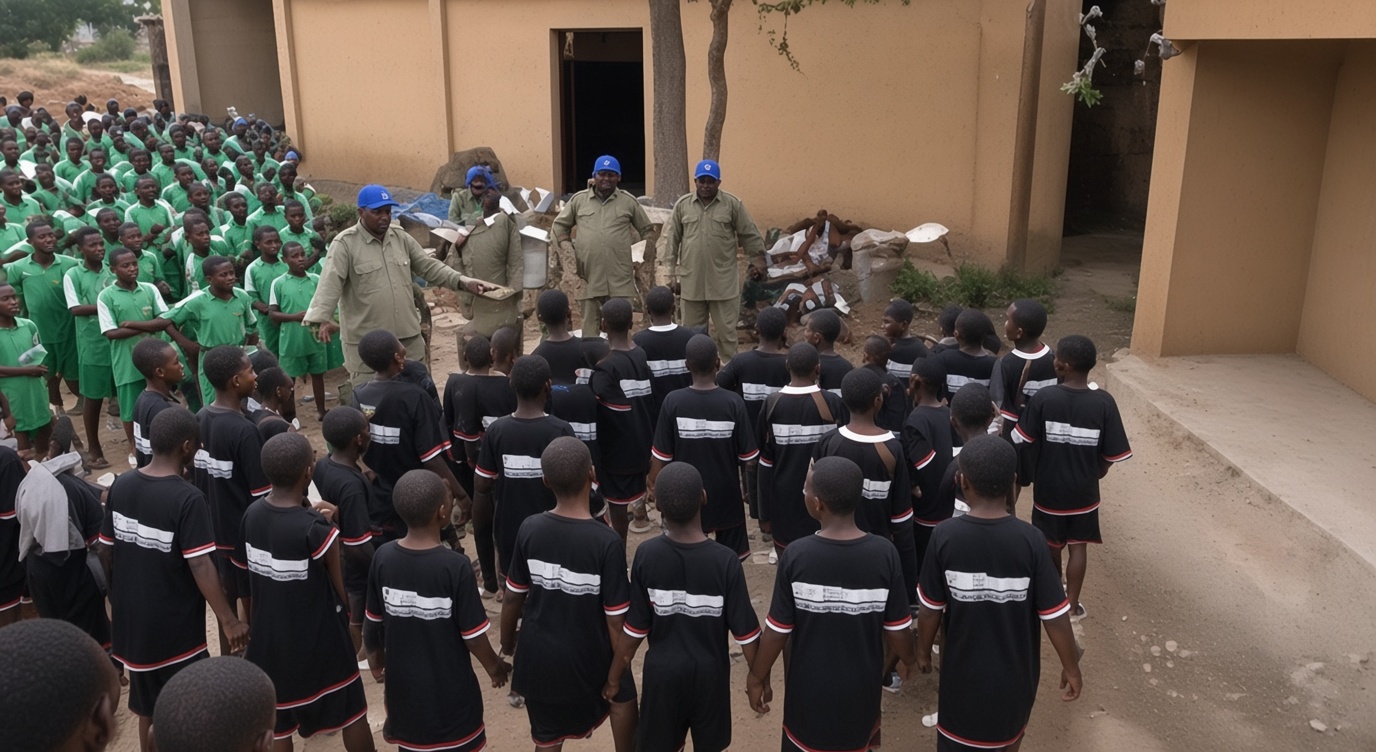
General Abdourahamane Tiani has recently launched a training camp that brings together over 300 young Nigeriens. While framed as a civic commitment, a national rallying cry, and a rebuilding effort, this initiative draws inspiration from the Burkinabè model championed by Captain Ibrahim Traoré. However, beneath the carefully crafted messaging and the glorification of an “engaged youth,” a more troubling reality may be emerging: beneath the veneer of patriotism, the military regime appears to be laying the groundwork for premature militarization.
Education and development should precede military discipline
A child or teenager should never be placed in a militarized or even semi-militarized environment. At this formative stage, priority should be given to schooling, vocational training, sports, cultural engagement, and civic education. Shaping minds that are still developing around military discipline, blind obedience, and constant mobilization risks normalizing the logic of confrontation and weaponry over time.
Militarization of youth as a political strategy
The danger extends beyond the nature of the camp itself. It lies in the political message being sent to an entire generation. When a military-led government portrays youth mobilization as a patriotic duty, it risks conditioning young people to prioritize loyalty to the regime over critical thinking. True civic engagement is not synonymous with unquestioning obedience; it encompasses the ability to question, debate, and advocate for the common good.
The line between civic education and indoctrination becomes increasingly thin when young individuals are continuously exposed to a rhetoric of battle, sacrifice, and national defense. While a mobilized youth can serve the nation, they must never become a mere human resource exploited to sustain a military regime.
Questioning the priorities behind youth mobilization
Why invest so heavily in ideological mobilization when thousands of young Nigeriens urgently need functional schools, vocational training programs, employment opportunities, infrastructure development, and viable prospects for the future? Patriotism does not fill stomachs, replace diplomas, or automatically generate jobs.
By promoting the image of a disciplined, enthusiastic, and sacrificial youth, the regime may be using the rhetoric of “mandatory civic duty” as a convenient smokescreen. This approach diverts attention from pressing economic challenges, systemic educational failures, youth unemployment, and the social consequences of political instability.
Long-term risks of institutionalized militarism
It is also essential to consider the long-term implications of such a strategy. A generation raised in a culture of perpetual mobilization may come to view societal militarization as an acceptable norm. What is presented today as an exceptional initiative could evolve into an institutionalized model for political and paramilitary indoctrination tomorrow.
Avoiding a cycle of militarization in the Sahel
The comparison with Burkina Faso deserves careful examination. The proliferation of initiatives aimed at rallying youth around patriotism and national defense must not push Sahelian states into an arms race of youth militarization. While the security context is undeniably challenging, the solution to insecurity cannot lie in transforming an entire generation into potential combatants.
The youth of Niger deserve more than to be reduced to mere instruments in a regime’s communication strategy. They deserve quality education, employable skills, meaningful employment, intellectual freedom, and the opportunity to participate in public life without being coerced into adopting a political or military doctrine.
The essence of true patriotism
The enthusiasm of young people should never serve as a moral shield to obscure governance failures. A strong State is not one that teaches its children to obey and fight at the earliest age, but one that equips them with knowledge, freedoms, and opportunities to actively shape the nation’s future.
Authentic patriotism entails preparing citizens who are capable of building, innovating, reflecting, and defending their country when required by law—not conditioning them prematurely to embrace a military mindset. Niger must ensure that the fight against insecurity does not become a pretext for the sustained militarization of childhood and youth.