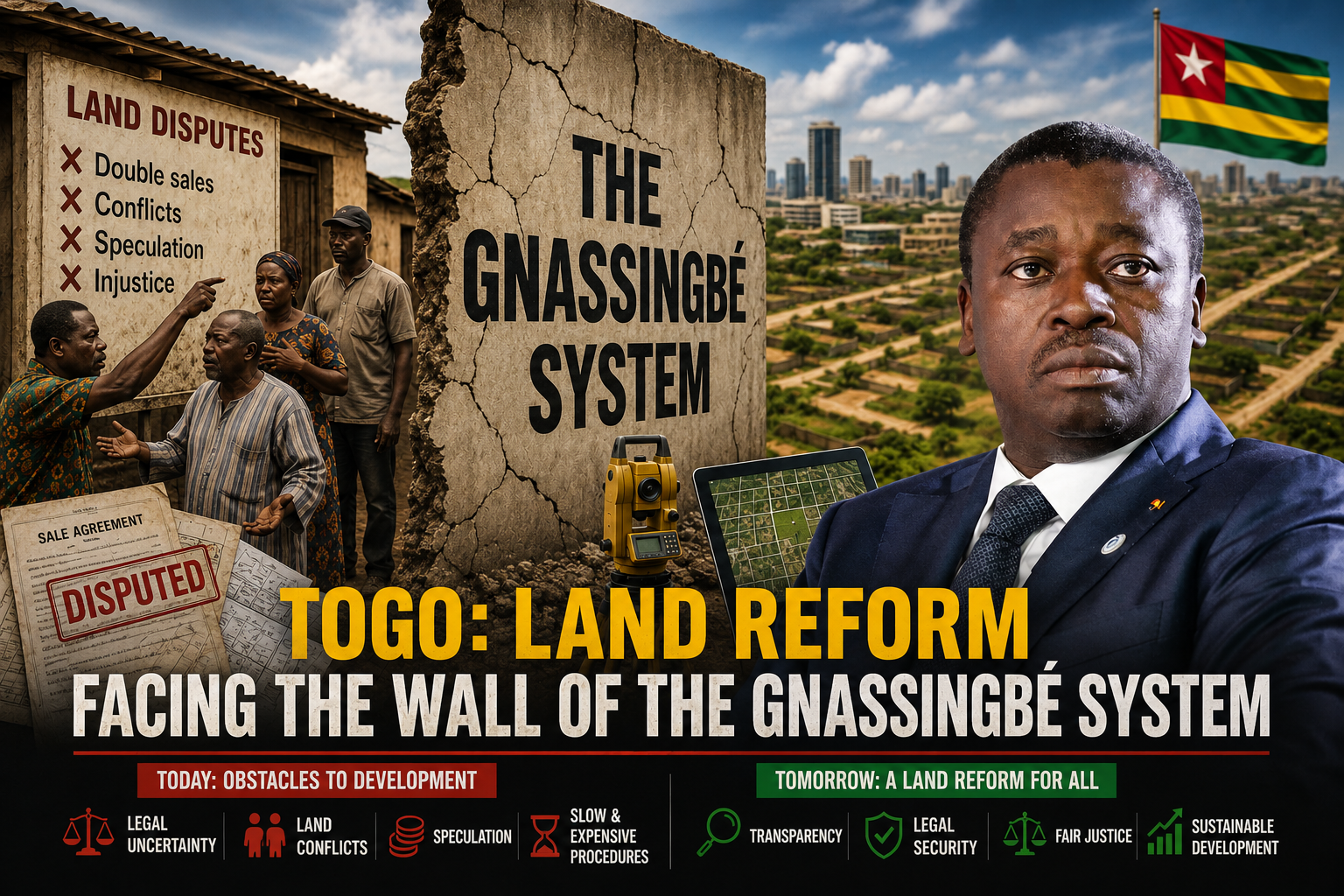
After sixty years of what has often been described as erratic land management, the Togolese government is now pursuing a bold new agenda: to position the land sector as a key driver of economic growth. While this vision is compelling on paper, it immediately confronts a far grimmer reality on the ground. Without addressing entrenched structural flaws, many observers caution, the initiative risks becoming yet another announced reform that ultimately fails to materialise.
The anatomy of a broken system
At the heart of the challenge lies a problem long familiar to Togolese citizens: the proliferation of land disputes. These are fuelled by practices such as double sales, contested ownership claims, poor record-keeping, and the opacity of certain transactions. How can a sustainable development strategy take root when private property remains a persistent source of legal uncertainty? A title deed or sales agreement does not always shield the buyer from claims on the same parcel by another party. This uncertainty deters investment, undermines household savings, and at times traps individuals in financial deadlock.
Administrative bottlenecks and unequal access
Lengthy, costly, and opaque administrative procedures further aggravate the situation. When access to land information is restricted and processes lack transparency, those with financial means, political connections, or inside knowledge gain an automatic advantage. Reform efforts must therefore move beyond simply issuing more land titles; they must ensure every citizen can easily verify a parcel’s full history before any purchase.
The role of justice in securing land rights
Prolonged land disputes do more than create bureaucratic headaches; they can devastate families, stall inheritance processes, freeze land use, and block economic initiatives. Court decisions must be enforced swiftly and fairly, insulated from social, political, or financial influence. Without an accessible, independent, and adequately resourced land judiciary, no administrative reform can deliver lasting results.
Political economy of land governance
The land system in Togo involves a web of actors: customary owners, families, intermediaries, surveyors, government agencies, local authorities, and political elites. Where some of these actors maintain close ties with dominant political or economic networks, conflicts of interest and favouritism risk being perpetuated rather than dismantled. A credible reform agenda must systematically dismantle these grey areas rather than allow them to resurface under new guises.
Urban pressure and speculative risks
In fast-growing urban and peri-urban zones, rapidly rising land values intensify speculation. This environment fosters practices such as multiple sales, manipulative transactions, and the exclusion of low-income populations from a market they cannot navigate. Land ceases to function as a stable asset passed down through generations, instead becoming a speculative commodity accessible only to those with substantial capital.
Overlooked social dimensions
Land conflicts also divide members of the same family, neighbouring communities, or successive generations over inheritance disputes. Without adequate alignment between customary rights and modern legal frameworks, these tensions persist. An effective reform should therefore prioritise mediation, conflict prevention, and public education on legal procedures.
The promise and limits of digitisation
Digital solutions could play a role, but they should not be reduced to a mere administrative buzzword. A reliable, accessible, and regularly updated land database would significantly reduce the risk of double sales and streamline due diligence. Yet digitisation alone will not dismantle fraudulent practices if the underlying data remain incomplete, manipulable, or unevenly accessible.
Transparency across the governance chain
Public scrutiny must extend to every actor in the land management chain: parcel allocation criteria, transaction oversight, sanctions for irregularities, and safeguards for citizens challenging administrative decisions. Until these mechanisms are transparently documented, scepticism will persist, and each new reform will be greeted with doubt.
Macroeconomic stakes
A secure land regime empowers individuals to invest, enables businesses to expand, allows banks to assess collateral accurately, and supports state-led spatial planning. Conversely, insecure land rights immobilise capital, stall projects, and sustain an economy rooted in distrust. The issue transcends individual landowners; it directly affects the country’s ability to attract and retain investment.
The path forward
The central question is not whether Togo can enact another land reform law, but whether it is prepared to accept the political, administrative, and judicial consequences of a genuinely binding transformation. Such change would require decisive transparency, enforceable penalties for fraud, faster courts, stricter administrative oversight, and stronger protections for vulnerable citizens. Without genuine political will to dismantle entrenched networks, strengthen the rule of law, and cleanse the land justice system, any new legislation or commission risks amounting to little more than a cosmetic facelift. Until the protection of private or partisan interests yields to transparency and equal justice under the law, land will continue to fuel conflict rather than serve as the engine of prosperity it was meant to be.