Peru’s president-elect Fujimori backs Morocco’s Sahara autonomy plan
- Keiko Fujimori, Peru’s president-elect, reaffirms support to Morocco’s territorial integrity and UN Resolution 2797
- This stance marks a clear departure from decades of Peruvian ambiguity toward the Polisario Front
- Morocco’s Sahara autonomy plan gains Peruvian backing
- Shift in Peruvian diplomacy ends decades of ambiguity
- Historical context of Peru-Morocco relations
- Morocco’s diplomatic offensive reshapes regional alliances
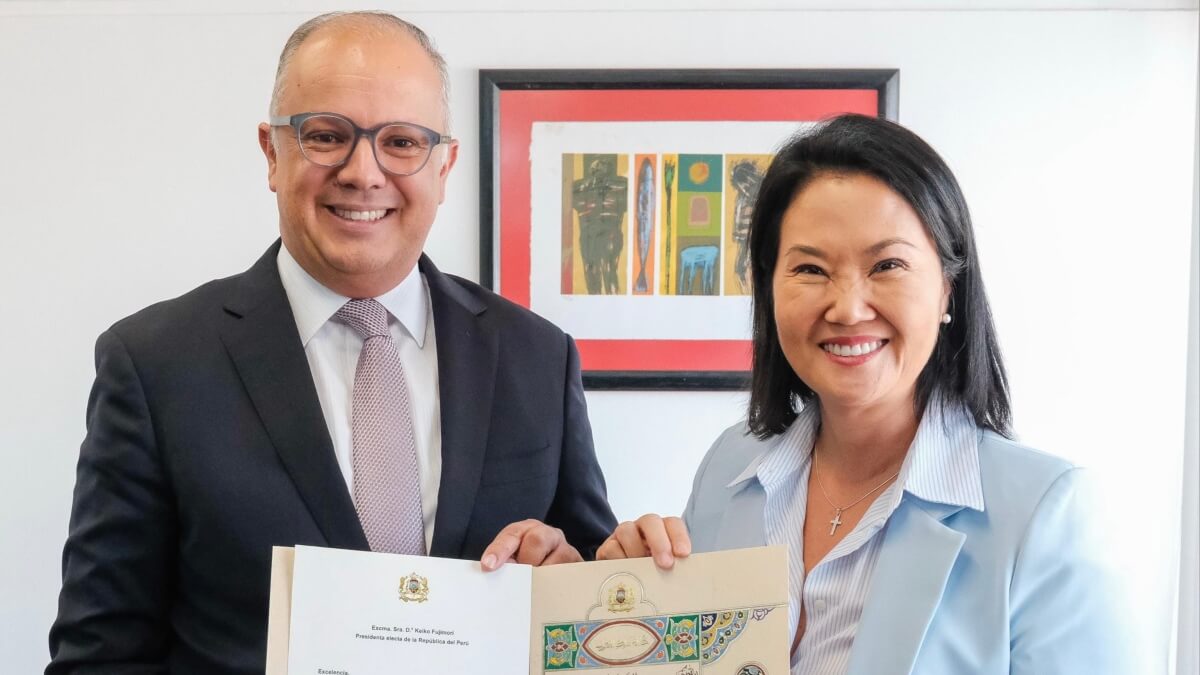
Peru’s newly elected president, Keiko Fujimori, is setting clear foreign policy priorities in the early weeks following her hotly contested victory. One of the most significant shifts involves Peru’s stance on Morocco’s territorial integrity—a position underscored during a recent meeting with Morocco’s ambassador to Peru, Amine Chaoudri, who delivered a congratulatory letter from King Mohammed VI.
Morocco’s Sahara autonomy plan gains Peruvian backing
During the meeting in Lima, President-elect Fujimori informed Ambassador Chaoudri that her administration will formally support Morocco’s territorial integrity and its autonomy plan for Western Sahara. This decision aligns with UN Security Council Resolution 2797, which endorses Morocco’s autonomy initiative as a viable path toward resolving the long-standing regional dispute.
Ambassador Chaoudri also presented President-elect Fujimori with a letter from King Mohammed VI, in which the Moroccan monarch congratulated her on her election and expressed his commitment to strengthening bilateral ties. The letter highlighted the strong historical friendship between Morocco and Peru, rooted in shared values and mutual respect, and called for elevating relations to a strategic partnership that benefits both nations.
Shift in Peruvian diplomacy ends decades of ambiguity
Fujimori’s unequivocal stance on the Sahara issue represents a decisive break from previous Peruvian governments, which had maintained an ambiguous or even supportive position toward the Polisario Front. This shift has drawn significant attention from political analysts, who view it as a deliberate move to realign Peru’s foreign policy.
Peru’s historical relationship with the Sahara conflict dates back to the 1980s. In 1984, during the second term of President Fernando Beláunde Terry, Peru recognized the self-proclaimed Sahrawi Arab Democratic Republic (SADR). This recognition persisted through the presidency of Alan García, who established diplomatic relations with the SADR in 1987. The situation remained unchanged until 1996, when then-President Alberto Fujimori—Keiko Fujimori’s father—suspended these relations, marking a turning point in Peru’s approach to the issue.
Historical context of Peru-Morocco relations
For the next 25 years, successive Peruvian governments—including those of Valentín Paniagua, Alejandro Toledo, Alan García’s second term, Ollanta Humala, Pedro Pablo Kuczynski, Martín Vizcarra, Manuel Merino, and Francisco Sagasti—maintained the status quo established by Alberto Fujimori. However, in July 2021, President Pedro Castillo reversed this policy by restoring diplomatic ties with the Polisario Front in September of that year.
This controversial decision was short-lived. In August 2022, Foreign Minister Miguel Ángel Rodríguez Mackat announced the withdrawal of Peru’s recognition of the SADR and the suspension of diplomatic relations with the separatist group. Yet, President Castillo later reinstated these ties, only to be removed from office in December 2022 following an attempted power grab. His successor, Dina Boluarte, maintained the existing policy until September 2023, when she suspended relations with the Polisario Front without formally withdrawing Peru’s 1984 recognition of the SADR or endorsing Morocco’s autonomy plan. This left Peru’s position on the issue in a state of prolonged ambiguity.
Subsequent leaders, José Jeri and José María Balcázar, held office for such brief periods that they did not address the Sahara question. Fujimori’s presidency is now expected to restore the position adopted by her father in 1996—going even further by fully supporting Morocco’s territorial integrity, sovereignty over Western Sahara, its autonomy initiative, and UN Resolution 2797.
Morocco’s diplomatic offensive reshapes regional alliances
Peru’s policy shift aligns with Morocco’s intensified diplomatic efforts across Latin America, where the Polisario Front had previously enjoyed considerable support. Through strengthened economic, cultural, and academic cooperation, Morocco has forged closer ties with multiple countries in the region, positioning itself as a key gateway to Africa, Europe, and the Arab world.
As a result, several nations that had previously recognized the SADR have since suspended their recognition or severed diplomatic ties with the separatist group. Countries such as Colombia, Guatemala, Paraguay, the Dominican Republic, Haiti, Jamaica, El Salvador, Guyana, Ecuador, and Panama have all adjusted their positions in response to Morocco’s diplomatic outreach.