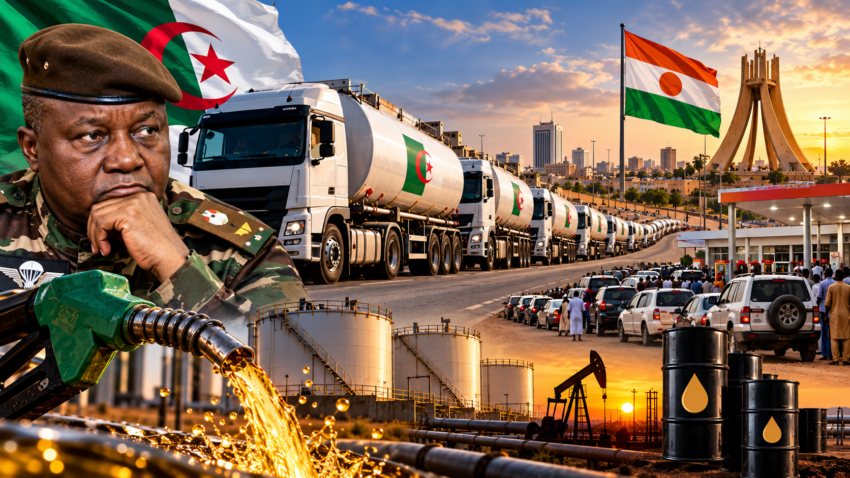
The capital city of Niamey faces mounting economic strain as 150 tanker trucks, each carrying 25,000 liters of Algerian fuel, arrive in the city. Originally intended for Agadez under bilateral agreements, the redirected shipment highlights critical questions about Niger’s fuel procurement strategies and the financial implications of emergency imports.
The strategic diversion that raises questions
The shift in cargo destination underscores an urgent, if controversial, recalibration of fuel supply priorities. While government officials have not yet clarified why Agadez’s needs were deprioritized, the arrival of 3.75 million liters in Niamey signals a possible response to acute shortages threatening public services, transportation, and economic stability in the capital.
The absence of transparent communication from authorities has fueled speculation. Did logistical constraints force a change in route? Was Niamey’s vulnerability to disruption deemed more critical? Without official explanations, citizens and business leaders alike are left to wonder what real-world impact this decision will have on their daily operations and livelihoods.
A steep price to pay: Algeria’s fuel costs compared
The Algerian fuel, delivered at 800 FCFA per liter, comes with a barter arrangement: payment will be made in crude oil rather than cash. While no immediate cash outlay is required, the economic value still must be accounted for especially when compared to historically cheaper Nigerian imports, which cost Niamey 702 FCFA per liter including transport.
At face value, the price difference amounts to 98 FCFA per liter. When applied across the entire 3.75-million-liter shipment, this translates to a potential financial loss of 367.5 million FCFA assuming all fuel were priced at the lower Nigerian rate. Such figures have ignited debate over whether the urgency justifies the added expense, particularly for a country already grappling with economic tightening.
However, price alone cannot determine the merit of an emergency fuel supply. Reliability of supply routes, delivery speed, and risk of disruption must also factor into the equation. A slightly more expensive option may be justified if it ensures uninterrupted access to fuel during a crisis critical for hospitals, markets, and public transit.
The hidden costs of crisis-driven fuel management
Beyond the immediate bill is a deeper concern: Niger’s chronic vulnerability to fuel shortages. Emergency imports, though necessary at times, are not a sustainable solution. They strain national budgets, expose dependence on foreign suppliers, and fail to address underlying structural weaknesses in storage, distribution, and contingency planning.
A crisis-driven approach leaves no room for building strategic reserves. In a city of over one million people, daily fuel demand spans public transportation, energy generation, agriculture, and small businesses. A single disruption can send ripples through the economy higher prices, delayed goods, and lost productivity.
The 3.75 million liters now reaching Niamey could serve two purposes: immediate consumption or long-term stockpiling. But without clear official data on storage capacity, consumption rates, or allocation plans, it’s impossible to know how many days of emergency supply this represents or whether it will be safeguarded or quickly exhausted.
What Niger risks by normalizing emergency fuel
Economic leakage: Repeated barter deals or expensive spot purchases siphon off budgetary resources that could fund infrastructure, social programs, or renewable energy initiatives.
Supply chain fragility: Over-reliance on one regional partner increases exposure to geopolitical shifts, sanctions, or logistical interruptions.
Loss of national control: Payment in crude oil ties future exports to current fuel needs, potentially locking Niger into unfavorable energy-for-fuel agreements.
From emergency to strategy: what Niamey needs now
Crisis response is temporary. True energy security requires foresight. Niger must transition from ad-hoc imports to a structured, multi-source fuel strategy. That means:
Investing in domestic refining capacity to reduce import dependency.
Establishing and replenishing national fuel reserves with transparent criteria and regular audits.
Diversifying supply corridors including renewable energy mix to buffer against shocks.
Releasing clear public updates on current stock levels, usage rates, and contingency plans.
Until such measures are in place, Niamey will remain hostage to the next supply hiccup no matter which neighbor ships the fuel tonight.
Whose fuel strategy is running the capital?
The arrival of Algerian fuel in Niamey is not just an economic transaction; it’s an unspoken policy shift. Citizens and entrepreneurs are being asked to accept higher costs and unanswered questions in exchange for continuity. Yet a city without reserves is not a resilient one.
Until Niger develops a coherent plan one that values foresight over panic the real cost won’t be measured in FCFA per litre, but in locked engines, empty shelves, and stalled futures.
By Martin Ngu — Journalist