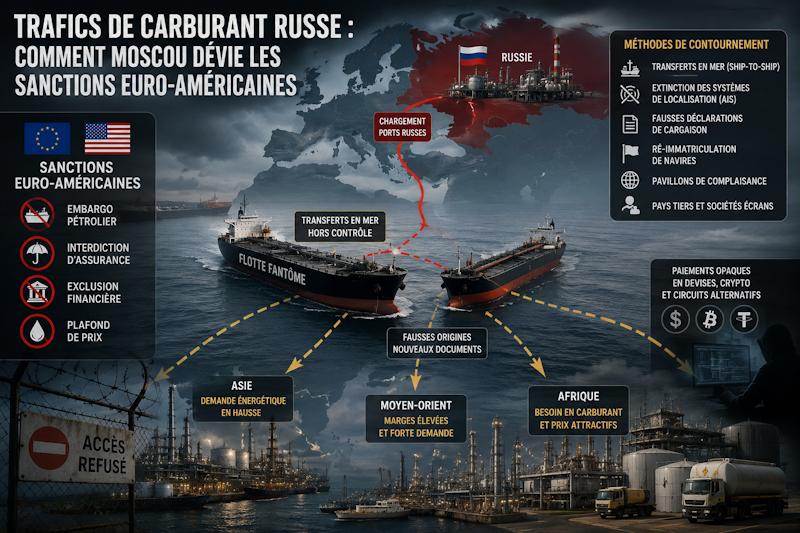
Investigative reports reveal a sophisticated network funneling Russian oil through Morocco, circumventing Western sanctions imposed after the Ukraine invasion. The North African kingdom has quietly become a critical transit hub for fuel destined for markets officially closed to Russian products.
Geneva-based trader central to fuel smuggling operation
The transformation began in 2025 when Morocco emerged as North Africa’s top importer of Russian petroleum products. Behind this shift stands a low-profile Geneva-based trader, Alvari SA, which orchestrated multimillion-dollar shipments of Russian oil to Moroccan ports like Jorf Lasfar and Mohammedia. Three tankers—Tranquil Sea, Duke II, and Eldia—were allegedly used to transport fuel from Baltic terminals to Morocco, despite their inclusion on international sanction lists.
The case of the Tranquil Sea exemplifies the tactics employed to obscure the true origins of these cargoes. British sanctions lists flagged the vessel in October 2025 as it approached Moroccan waters, followed by similar measures from the EU and Switzerland. Ukrainian defense authorities further alleged the ship had been repurposed as a surveillance platform targeting NATO military and air activities, with Finnish authorities boarding it under suspicion of damaging an undersea cable. When confronted by investigators, Alvari SA’s legal representatives denied any involvement in chartering or operating these vessels.
Paper trails mask Russian origin with Turkmen labels
To disguise the fuel’s true source, investigators uncovered a scheme involving the Chamber of Commerce and Industry of Cyprus, which issued certificates falsely attributing Russian diesel to Turkmenistan. The cargoes were reportedly transshipped offshore Gibraltar under the guise of routine Off Port Limits operations—typically reserved for minor logistical tasks but exploited here to mask high-risk fuel transfers.
Financial records show payments routed through Moroccan banks: Attijariwafa Bank, controlled by the royal holding Al Mada, served as the buyer’s financial intermediary, while the supplier used the Tangier-based offshore branch of Banque Centrale Populaire. Moroccan distributors reportedly secured discounts of up to seven dollars per metric ton compared to European benchmarks, avoiding the 15-dollar premium currently applied to non-Russian fuel—a total savings of 22 dollars per ton that never reached pump prices.
The timing of these shipments coincided with high-level diplomacy. As the Tranquil Sea approached Morocco’s shores, Foreign Minister Nasser Bourita traveled to Moscow for talks with Sergey Lavrov. Days later, Russia abstained during a critical UN Security Council vote on Western Sahara—a decision favorable to Rabat’s interests.
Spain raises alarms over Moroccan fuel re-exports
Spanish media has documented a parallel concern: a surge in diesel imports from Morocco into Spain. Industry insiders suspect a triangular scheme allowing Russian oil to penetrate the EU market via Moroccan transit, exploiting the kingdom’s lack of domestic refining capacity. According to shipping data provider Kpler, Morocco imported 645,000 tons of Russian diesel in 2025, rising to 489,000 tons in early 2026—comprising 45% of Morocco’s total fuel imports. Notably, Morocco exported no diesel to Spain before the 2022 Ukraine war and subsequent EU sanctions.
Spanish customs data reveals that after the March-April 2026 escalation in the Middle East and the closure of the Strait of Hormuz, Moroccan diesel shipments to Spain rebounded dramatically. Between April and June 2026, 76,000 tons arrived at ports including Tarragona, Barcelona, and Bilbao—virtually absent from trade flows for nearly a year. Spanish refiners, represented by the Spanish Fuel Industry Association (AICE), warn such practices distort competition and undermine the integrity of EU energy markets.
Converging investigations, unresolved questions
While two separate investigations—one from North Africa-focused outlets and another from Spanish press—paint a troubling picture of sanctioned Russian oil transiting Morocco en route to Europe, neither provides definitive proof of every cargo’s exact journey. Both rely on maritime tracking data, customs documents, and sector testimonies to build their case. Yet they acknowledge the inherent difficulty in tracing refined products once they enter complex global supply chains, leaving key questions about origin and final destination unanswered.