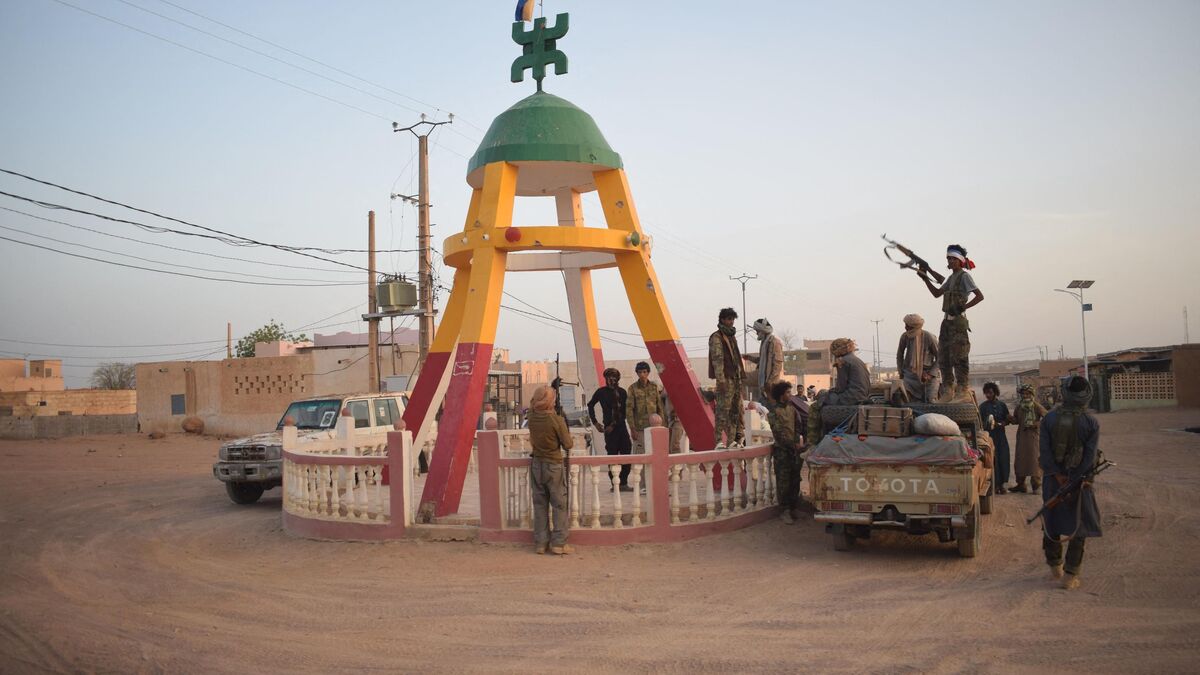
The Africa Corps, Moscow’s latest paramilitary force deployed across Africa, has faced a setback in Mali. Rebels, including Islamist factions and Tuareg separatists, reclaimed Kidal—one of the junta’s most critical strongholds—over the weekend. The region had been under the firm control of Africa Corps for years, marking a significant shift in the balance of power.
This development follows a dramatic escalation in violence across Mali. On April 25, coordinated attacks targeted government forces in Bamako and other major cities, resulting in the death of Defense Minister Sadio Camara. The assaults underscored the growing instability gripping the country as regional factions challenge the ruling junta’s authority.
Africa Corps emerged in 2023 as a successor to the infamous Wagner Group, which had operated independently under oligarch Evgueni Prigojine. After Prigojine’s death in a suspicious plane crash in August 2023—alongside former officer Dmitri Outkine—Africa Corps was formally established under the Kremlin’s direct supervision. Igor Korotchenko, a former colonel and pro-Kremlin military analyst, revealed its creation in November 2023, citing Iounous-bek Evkourov, Russia’s Deputy Defense Minister, as its overseer.
The new paramilitary unit has swiftly repositioned itself as a more disciplined and centralized force compared to its predecessor. While Wagner was notorious for its brutal tactics and human rights violations, Africa Corps is focusing on strategic partnerships with allied African governments. By providing military training, equipment, and personnel, Moscow aims to deepen its influence across the Sahel and North Africa, extending its reach into Burkina Faso, Libya, Sudan, the Central African Republic, and Niger.
Strategic objectives driving Moscow’s new military arm
Africa Corps was designed with clear geopolitical ambitions. According to Korotchenko, its mission includes conducting large-scale military operations to help African nations break free from neocolonial dependence, expel Western influence, and assert full sovereignty. The group’s name itself is a deliberate homage to the Afrikakorps, the Nazi-era German military unit that operated in North Africa during World War II—a historical reference Moscow has leveraged to signal its long-term commitment to the continent.
Unlike Wagner, Africa Corps has sought to present a more restrained image, avoiding the widespread criticism tied to its predecessor’s actions. Its approach prioritizes collaboration with regional governments, offering security support in exchange for political and economic concessions. This strategy has enabled the group to gain a foothold in Mali, where it has deployed hundreds—or potentially thousands—of fighters since 2024. Many former Wagner commanders and their units have reportedly defected to Africa Corps, further consolidating its presence.
Mali’s fragile stability and Russia’s regional ambitions
Africa Corps plays a pivotal role in propping up Mali’s military junta, which seized power in 2020. The group’s fighters have been instrumental in countering Tuareg rebellions and Islamist insurgencies, particularly in northern regions like Kidal. However, the recent loss of this strategic city underscores the challenges facing the junta and its Russian backers. The rebels’ success highlights the limitations of Africa Corps’ military strategy and raises questions about Moscow’s ability to sustain its influence in the face of growing resistance.
Russia’s involvement in Mali is part of a broader effort to fill the vacuum left by Western powers, particularly France, which withdrew its troops in 2022 following the collapse of Operation Barkhane. Moscow has positioned itself as an alternative security partner, offering not only military support but also access to lucrative mining contracts and migration control. These objectives align with Africa Corps’ stated mission to challenge Western dominance and secure critical resources.
Despite its quieter operational style, Africa Corps has not escaped international scrutiny. In 2024, the United Kingdom imposed sanctions on the group, accusing it of widespread human rights abuses and the exploitation of natural resources for profit. These allegations further complicate Moscow’s efforts to legitimize Africa Corps as a legitimate security partner rather than a proxy force advancing Russian interests.