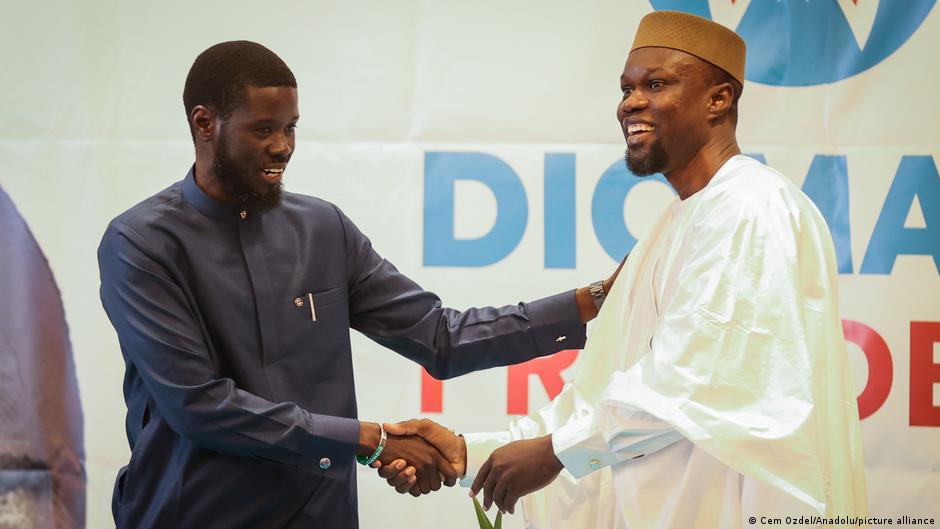
In Dakar, the political landscape of Senegal is witnessing a sharp turn as President Bassirou Diomaye Faye and former Prime Minister Ousmane Sonko sever their alliance, leaving many young supporters in a state of shock.
The announcement came swiftly this week when the newly appointed prime minister unveiled the government’s lineup. Almost simultaneously, Ousmane Sonko, leader of the ruling party Pastef-Les Patriotes, declared that none of its members would be part of the new administration.
This move seals the final break between the two leaders, once seen as an unstoppable force driving the nation’s political transformation.
Young voters face shattered expectations
At the heart of the disappointment are students at the Cheikh Anta Diop University, where debates rage over the sudden end of an alliance that once symbolized hope. Amath Segnane, a student revising under the shade of a tree, reflects the mood of many. He had believed the promise of unity and collective action between Faye and Sonko.
“They told us that Diomaye and Sonko were inseparable. That they trusted each other completely and would work side by side to rebuild this country. Now that they’ve split, it feels like a huge betrayal,” he shares, his voice tinged with frustration.
For Amath and others, the collapse of this partnership raises urgent questions about the credibility of the political message that once inspired Senegal’s youth.
Was the rupture unavoidable?
Not everyone is caught off guard. Mamadou Bah, a student at the Faculty of Economics and Management, believes tensions between the two leaders had been simmering for months.
“It was clear that the former prime minister was no longer respecting the president’s authority. He acted as if he were above the head of state. So, his removal—and the eventual split—wasn’t surprising. I stand with the president’s decision,” he remarks.
Though disappointed, Mamadou supports Faye’s move to reclaim control of the executive branch, seeing it as a necessary correction.
Doubt lingers over a final split
Omar Sarr, an Arabic student, refuses to accept the idea of a permanent break. He points to the long years of collaboration that led to their electoral victory.
“Without Sonko, Diomaye wouldn’t have reached the presidency. They worked together for years. Now, everyone is divided—some support Diomaye, others Sonko. I refuse to believe this split is permanent,” he insists.
Today, President Faye governs without the backing of Pastef-Les Patriotes, while Ousmane Sonko, now Speaker of the National Assembly, has taken on the role of opposition leader. This new political reality continues to spark intense discussions across Senegal, leaving citizens grappling with uncertainty about what comes next.