- Top Stories
- Politics
Sudan war spills over into Chad amid rising tensions
Three years into Sudan’s brutal civil war, violence has now spilled across its western border, engulfing Chad in a widening security crisis.
The conflict pits Sudan’s regular army, led by General Abdel Fattah al-Burhan, against the Rapid Support Forces (RSF) commanded by Mohamed Hamdan Dagolo, widely known as Hemedti. Despite N’Djamena’s official stance of neutrality, evidence suggests Chad has quietly backed the RSF—arming them and allowing weapons shipments from the United Arab Emirates to pass through strategic border towns like Amdjarass and Adré. This policy has drawn sharp criticism, particularly as it risks destabilizing Chad itself.
The RSF’s war against Darfur’s non-Arab populations—including the Zaghawa ethnic group—mirrors internal fractures within Chad’s leadership, where Zaghawa figures occupy key government and military positions. This contradiction places President Mahamat Déby’s administration in an increasingly untenable position.
Tiné at the heart of the cross-border crisis
Two towns share the name Tiné—one in Sudan, the other in Chad—each serving as a critical transit point for civilians fleeing Darfur’s war zones. The RSF seized the Sudanese side on February 21, 2026, sparking immediate clashes with Toroboro fighters—Chadian and Sudanese militias allied with General al-Burhan—as well as rogue elements of Chad’s own military. Within days, Chadian forces reclaimed the town, but the violence underscored the porous nature of the border.
The crisis escalated on March 21 when a drone strike killed at least twenty civilians in Tiné, Chad. While N’Djamena denies involvement, accusations have mounted. Opposition figure Ousmane Dillo, now exiled in Sudan, released an audio message accusing Mahamat Déby of endangering the Zaghawa community and calling for his removal. Meanwhile, Sudan’s Darfur governor, Minni Arkou Minawi, declared that « the war with Chad has already begun », signaling a dangerous regional escalation.
N’Djamena ramps up security measures
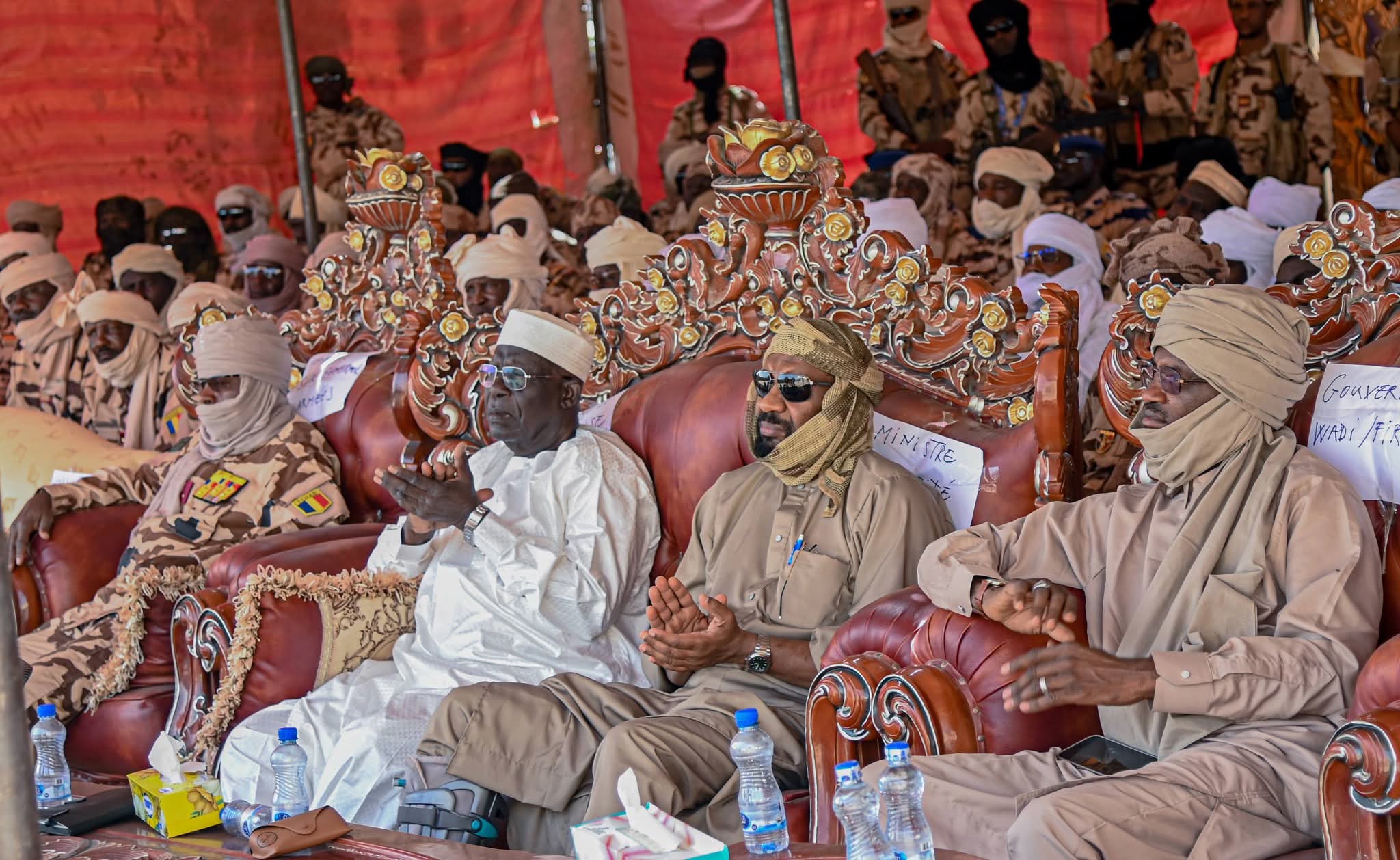
Chad’s government has responded with a mix of defiance and escalation. Government spokesperson Gassim Chérif Mahamat reaffirmed Chad’s neutrality while vowing a « proportionate response » to any incursions. President Mahamat Déby ordered the military onto high alert, and on March 22, a high-level security summit convened in Tiné to fortify the border and prevent further spillover. « This is Tiné, Chad—not Tiné, Sudan. Let the Sudanese army, the Toroboros, and the RSF fight it out over there. They must not bring their war here to kill our people, » declared General Ali Ahmat Akhabach, Minister of Security.
In a move criticized by aid groups, Chad has since sealed its border with Sudan, blocking civilians—particularly women and children—from escaping the conflict. The government claims the restriction aims to curb potential Zaghawa rebellions, but analysts warn it risks deepening the crisis. « Chad’s military buildup at the Sudanese border is likely to provoke direct involvement in the war rather than prevent it, » cautioned Cameron Hudson, a Sudan conflict analyst. « Déby’s posturing could prove a costly strategic misstep. »
Communal tensions fueled by the regional war
The conflict’s reach extends beyond the Zaghawa. Security sources report that the RSF has begun recruiting young men from the Tama ethnic group, a transborder community spread across eastern Chad and western Sudan. Historically, the Tama were mobilized as janjaweed militias during the 2003 Darfur war, fighting against groups like the Zaghawa. Now, their renewed recruitment threatens to reignite old communal divides within Chad, sparking fears of further instability.
What was once a calculated gamble by N’Djamena has spiraled into a dangerous overreach. The border, once a buffer, has become a flashpoint where Sudan’s war is no longer confined to its own soil. Chad’s leadership now faces the prospect of a conflict it can neither contain nor control.