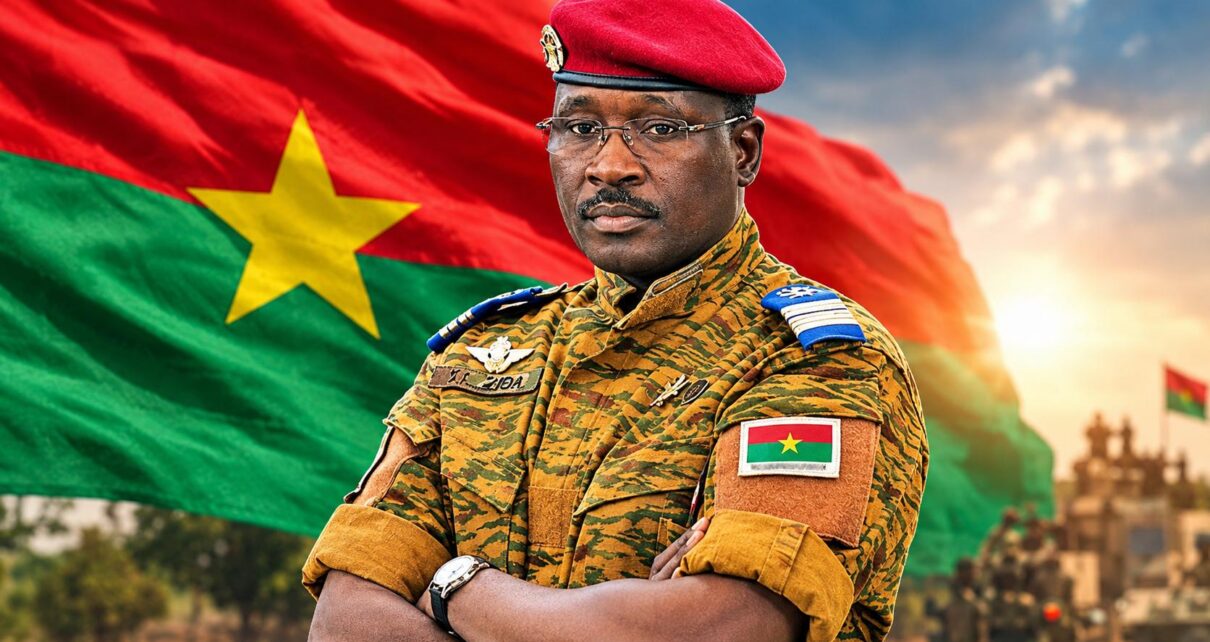
In a blunt and unsparing assessment, General Yacouba Isaac Zida has exposed what he describes as the political fraud being perpetuated by Captain Ibrahim Traoré within the Alliance of Sahel States (AES). Zida’s verdict is unambiguous: “True sovereignty does not consist of choosing whom to depend on, but of giving oneself the means to depend on no one.” The statement cuts to the heart of a contradiction that the Ouagadougou regime would rather leave unexamined.
Zida himself is no stranger to the paradoxes he now denounces. A former head of Burkina Faso’s transitional executive, he was struck from the army rolls for desertion and now lives in exile. His own trajectory mirrors the broader drift of a Burkinabè military class that remains trapped in a cycle of instability and unfulfilled promises.
The frantic rush toward Moscow
The eagerness with which the transitional government in Ouagadougou has thrown itself into Moscow’s orbit — all under the banner of an “anti-imperialist break” — amounts to little more than a crude renegotiation of the terms of submission. Behind the populist slogans, the government struggles to conceal a chronic inability to build genuine autonomy. Instead, the country remains locked into a fourfold external dependency.
Military and doctrinal subordination
The ambition to create a national defense tool collapses under the weight of systematic reliance on foreign instructors and paramilitaries. The supply of aerial vectors, ammunition and light armored vehicles — often falsely presented as “locally manufactured” when they are merely assembled on site — confirms a total subordination to external logistics chains.
The humiliation of food dependency
The rhetoric of self-reliance runs headlong into the facts. The media spectacle surrounding the reception of Russian wheat donations, or the repeated appeals for international humanitarian aid to feed displaced populations, demonstrate that the regime cannot even guarantee the basic subsistence of its citizens.
Financial and budgetary vulnerability
Unable to finance its own crisis budget through sound internal resources, the military authorities resort to financial expedients and emergency loans contracted from new geopolitical sponsors, mortgaging the economic future of generations to come.
Technological and strategic deadlock
Whether it is agricultural inputs or energy equipment, the absence of an autonomous industrial base condemns the country to beg beyond its borders for what it cannot produce itself.
The AES: a supranational slogan to mask internal failure
The haste to create a confederal army and supranational structures within the AES amounts to a propagandistic flight forward.
Surrender in the face of domestic emergencies
Claiming to merge regional sovereignties while national territory remains largely outside state control is strategic blindness. The absolute priority should be securing populations and consolidating basic institutions — not stacking up empty shells.
The staging of legitimacy
The multiplication of summits and fiery declarations serves primarily as a political shield to perpetuate unelected regimes of exception, at the expense of rigorous and realistic planning.
Authentic sovereignty is not displayed in military parades or in dependence on foreign grain handouts. By substituting Moscow’s patronage for Paris’s, Captain Traoré has not freed Burkina Faso: he has simply changed its guardian.